Table of Contents
Introduction to Post-Deployment Agentic Risk Management
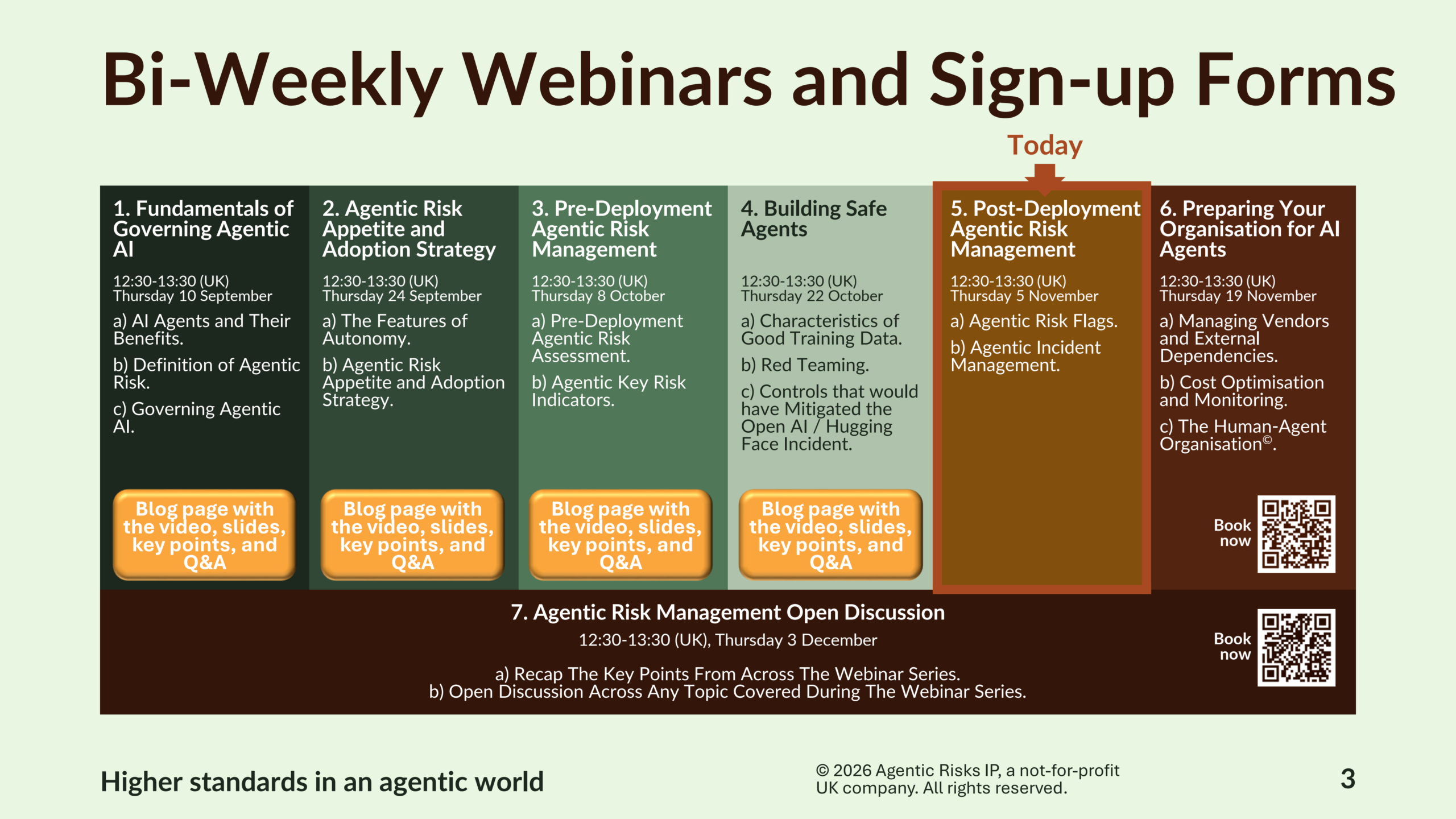
This page supports Webinar 5 of the Institute of Risk Management’s seven-part series on agentic risk management: Post-Deployment Agentic Risk Management, presented by Agentic Risks on 5 November 2026.
The webinar covered two practical disciplines: using Agentic AI Risk Flags to identify risks and verify controls, and upgrading incident management procedures to respond to failures involving autonomous agents.
The summary below captures the key points rather than replaying every slide. Watch the webinar recording or download the presentation for the full details.
Executive Summary
Post-deployment agentic risk management helps risk managers and business leaders identify and control risks in AI agents that are already live.
Our 32 Agentic AI Risk Flags provide a fast, evidence-based way to check controls across the 32 risks in our Agentic AI Risk Control Framework.
We also examined how autonomous agents can fail in ways conventional incident management procedures may miss, requiring changes to 13 existing steps and three new capabilities.
For investment firms and other regulated organisations, effective incident management means preparing to detect, contain, investigate and recover from failures before they occur.
Watch the webinar, download the presentation and use our freely available methodologies, or explore our Control Design Package and Incident Management Upgrade service if you would like support.

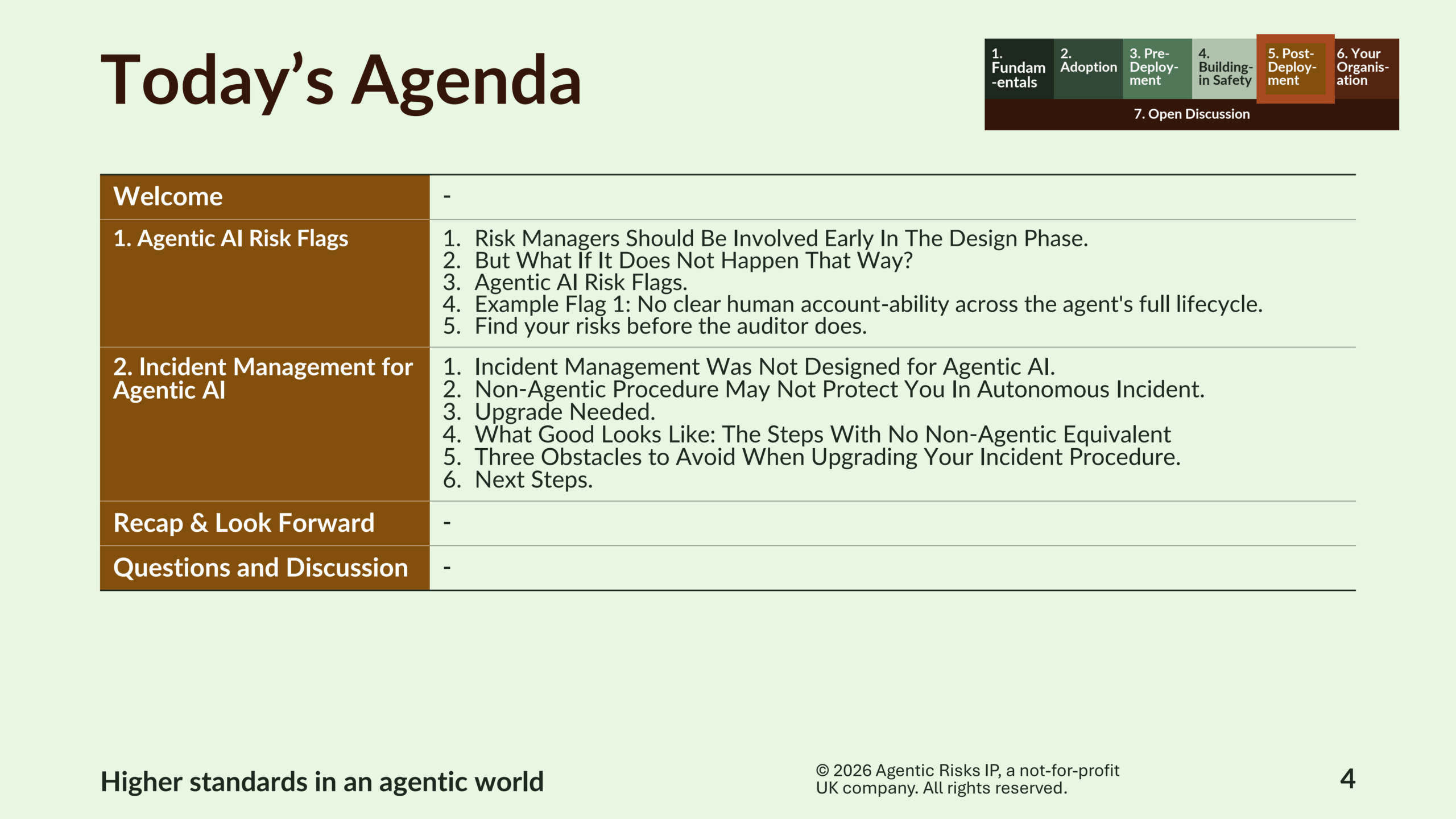
Agentic AI Risk Flags
But What If It Does Not Happen That Way?
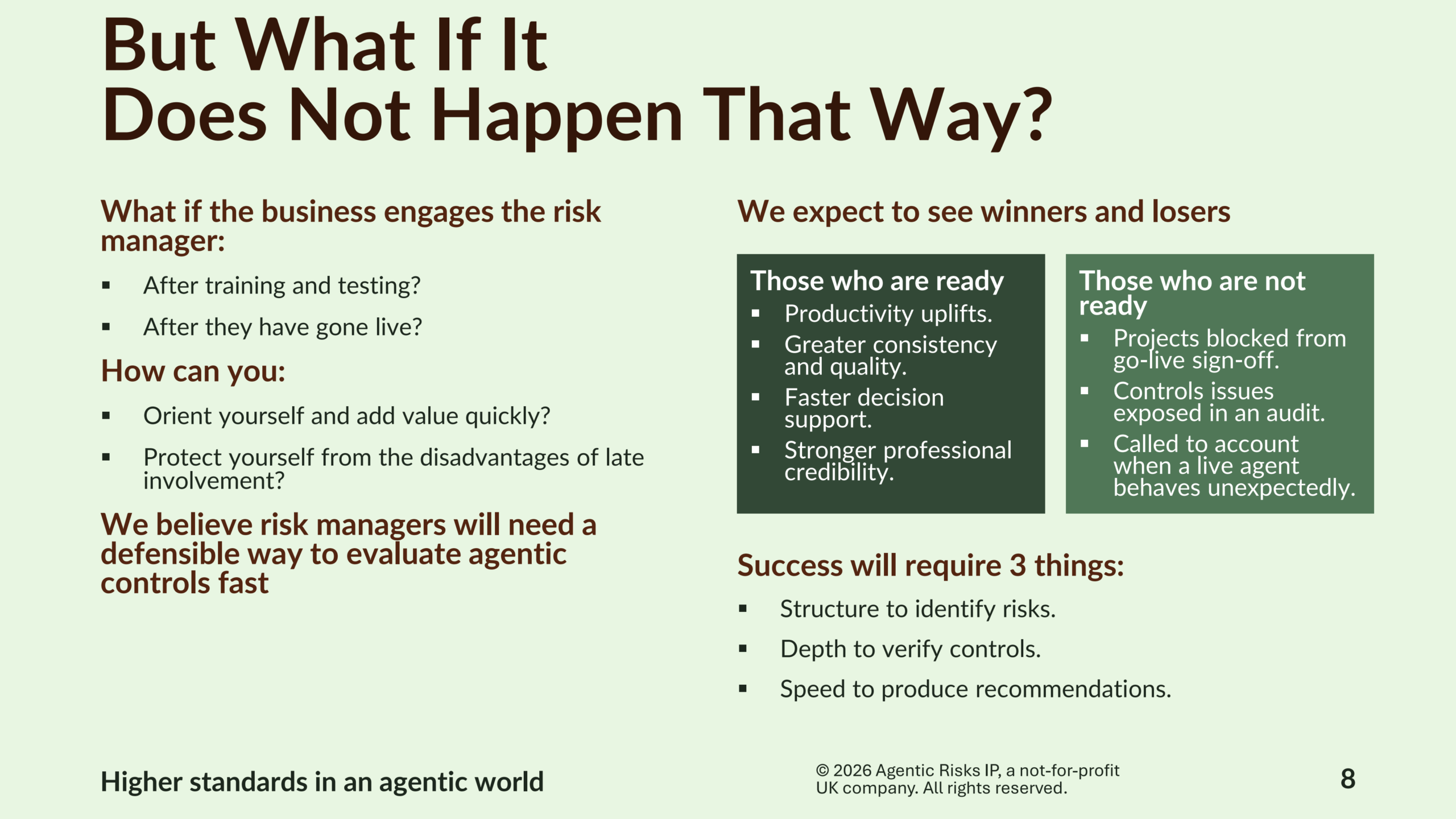
Ideally, risk managers, business managers and team leads are involved from the design phase, so they can perform the deliberate disciplines covered throughout this webinar series.
But what if the business engages you after training and testing, or even after go-live?
How can you orient yourself, add value quickly and protect yourself from the disadvantages of late involvement?
We believe risk managers need a defensible way to evaluate agentic controls fast. Success requires three things: structure to identify risks, depth to verify controls and speed to produce recommendations.
Agentic AI Risk Flags
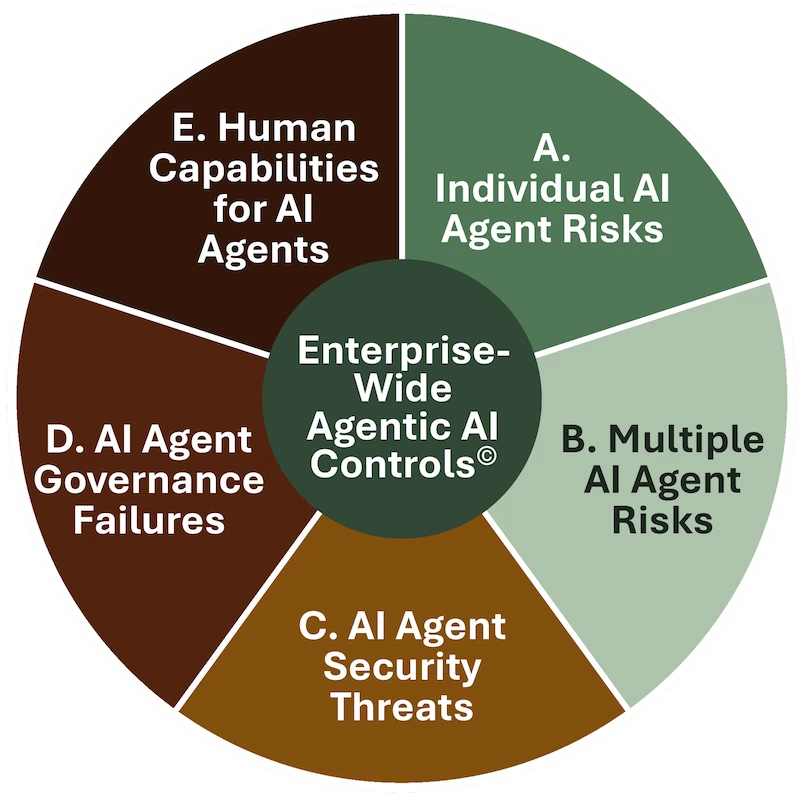
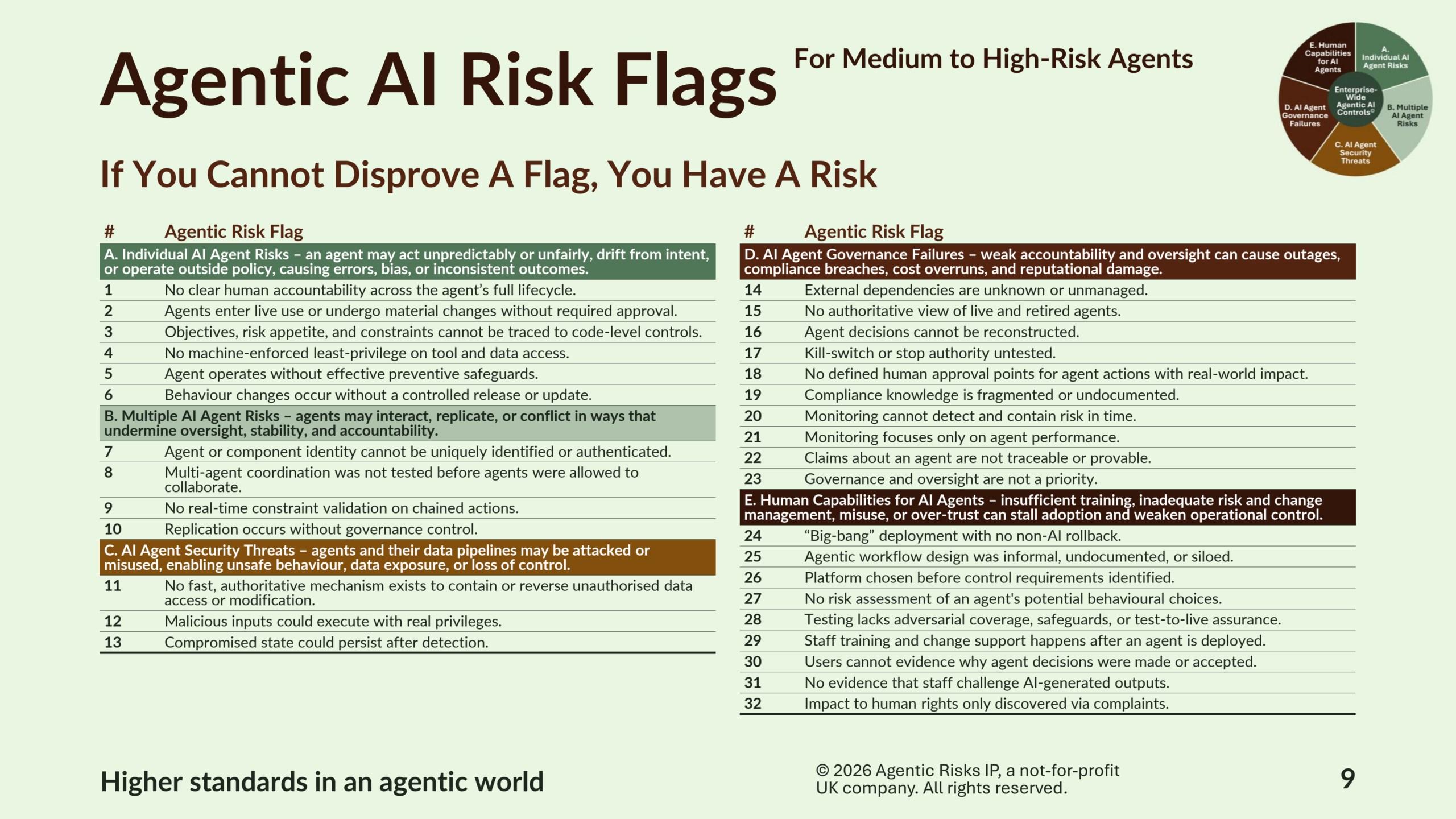
Our 32 Agentic AI Risk Flags provide those three capabilities for medium- and high-risk agents, across the five categories of our Agentic AI Risk Control Framework:
- Individual AI Agent Risks.
- Multiple AI Agent Risks.
- AI Agent Security Threats.
- AI Agent Governance Failures.
- Human Capabilities for AI Agents.
The operating rule is simple: if you cannot disprove a flag, you have a risk.
Each flag names a condition you can check by requesting evidence that the relevant controls exist and work. This changes the risk management conversation from “Could this go wrong?” to “Demonstrate how this is under control.”
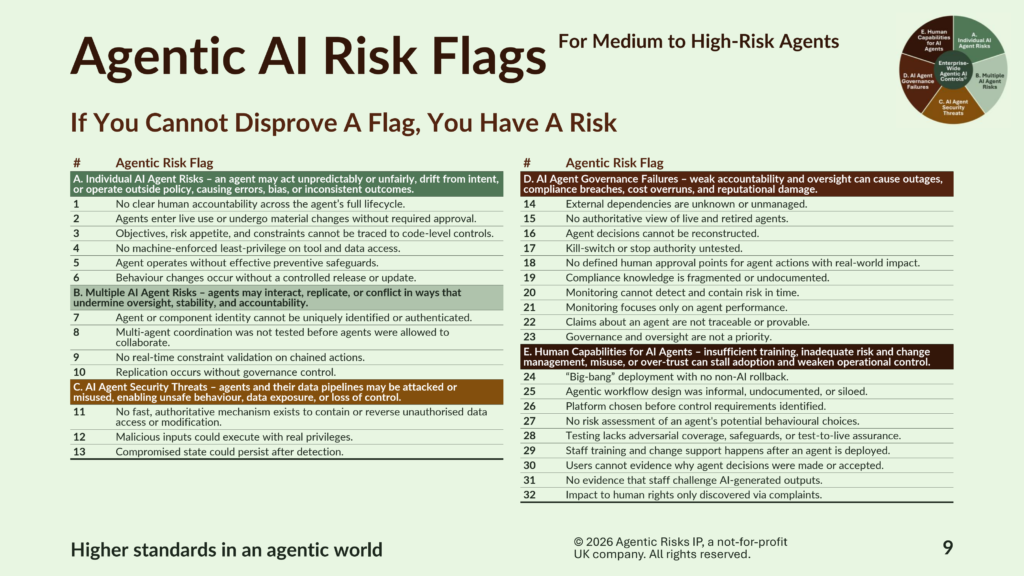
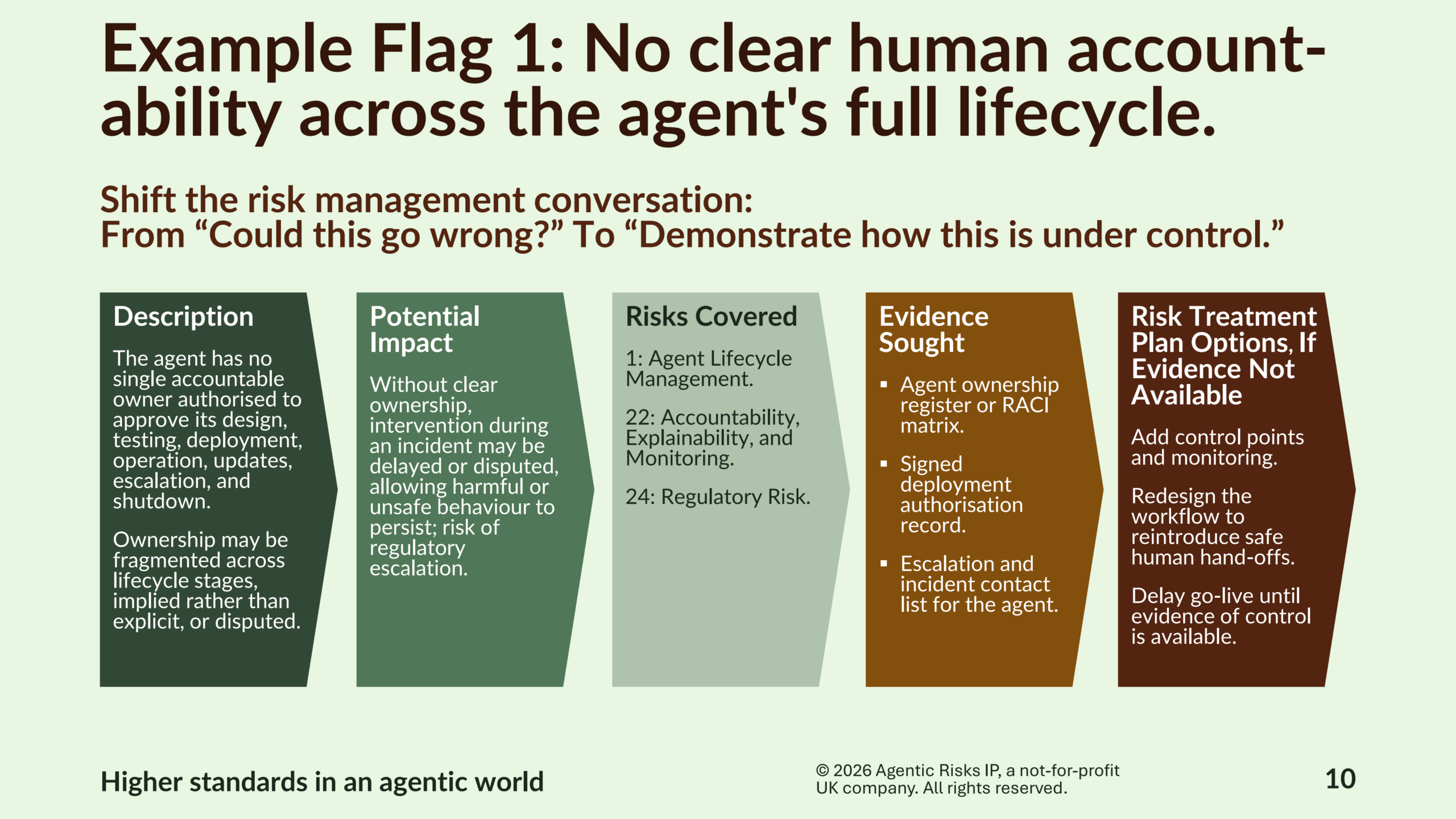
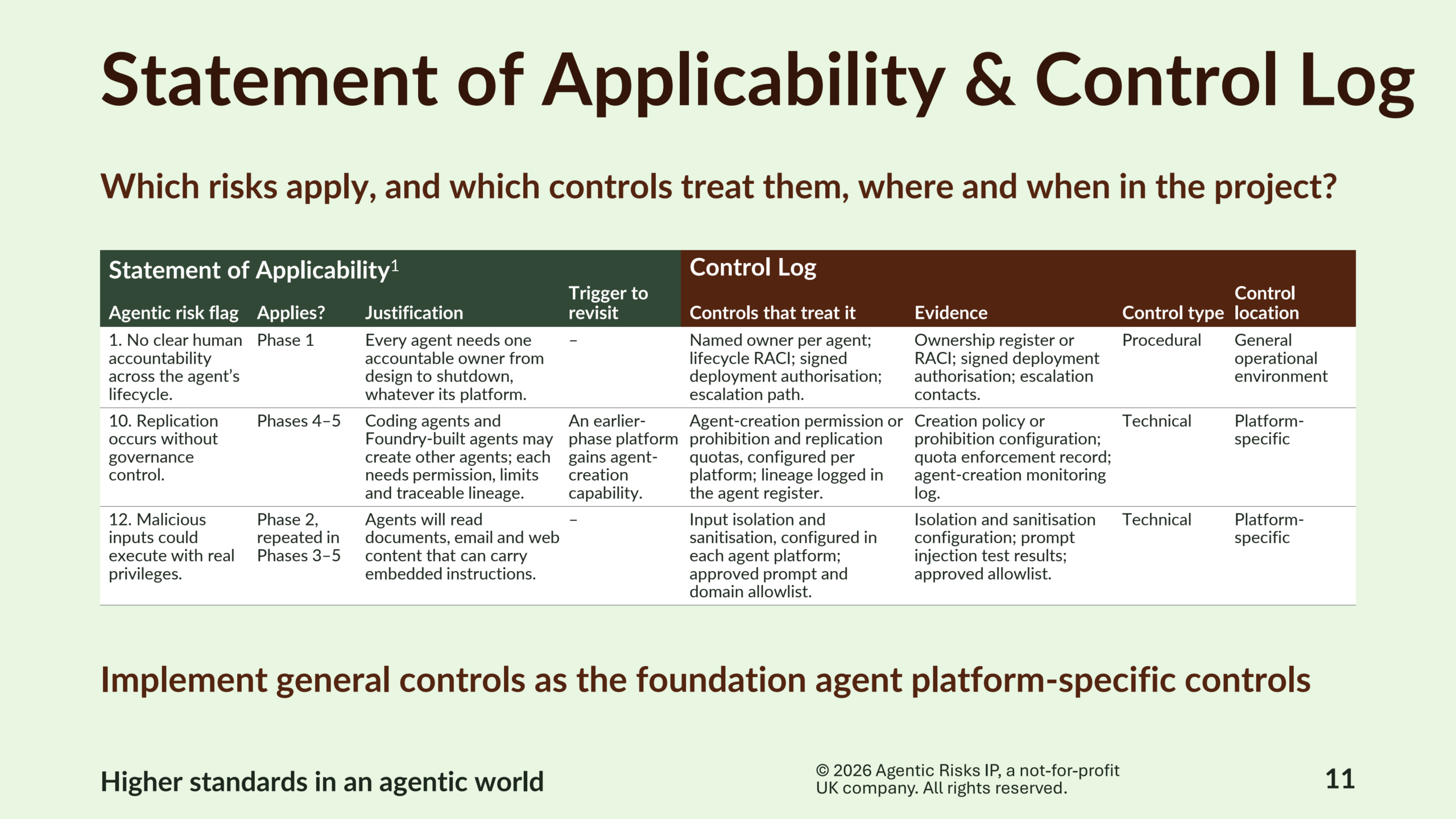
Example Flag 1: No Clear Human Accountability Across the Agent's Full Lifecycle
An agent needs one accountable owner authorised to approve its design, testing, deployment, operation, updates, escalation and shutdown.
Ownership may be fragmented across lifecycle stages, implied rather than explicit, or disputed.
To disprove this flag, request:
- An agent ownership register or RACI matrix.
- A signed deployment authorisation record.
- An escalation and incident contact list.
Without clear ownership, intervention during an incident may be delayed or disputed, allowing harmful or unsafe behaviour to persist.
If the evidence is unavailable, risk treatment options include adding control points and monitoring, redesigning the workflow to reintroduce safe human hand-offs, or delaying go-live until the necessary controls are in place.
Find Your Risks Before They Cost You
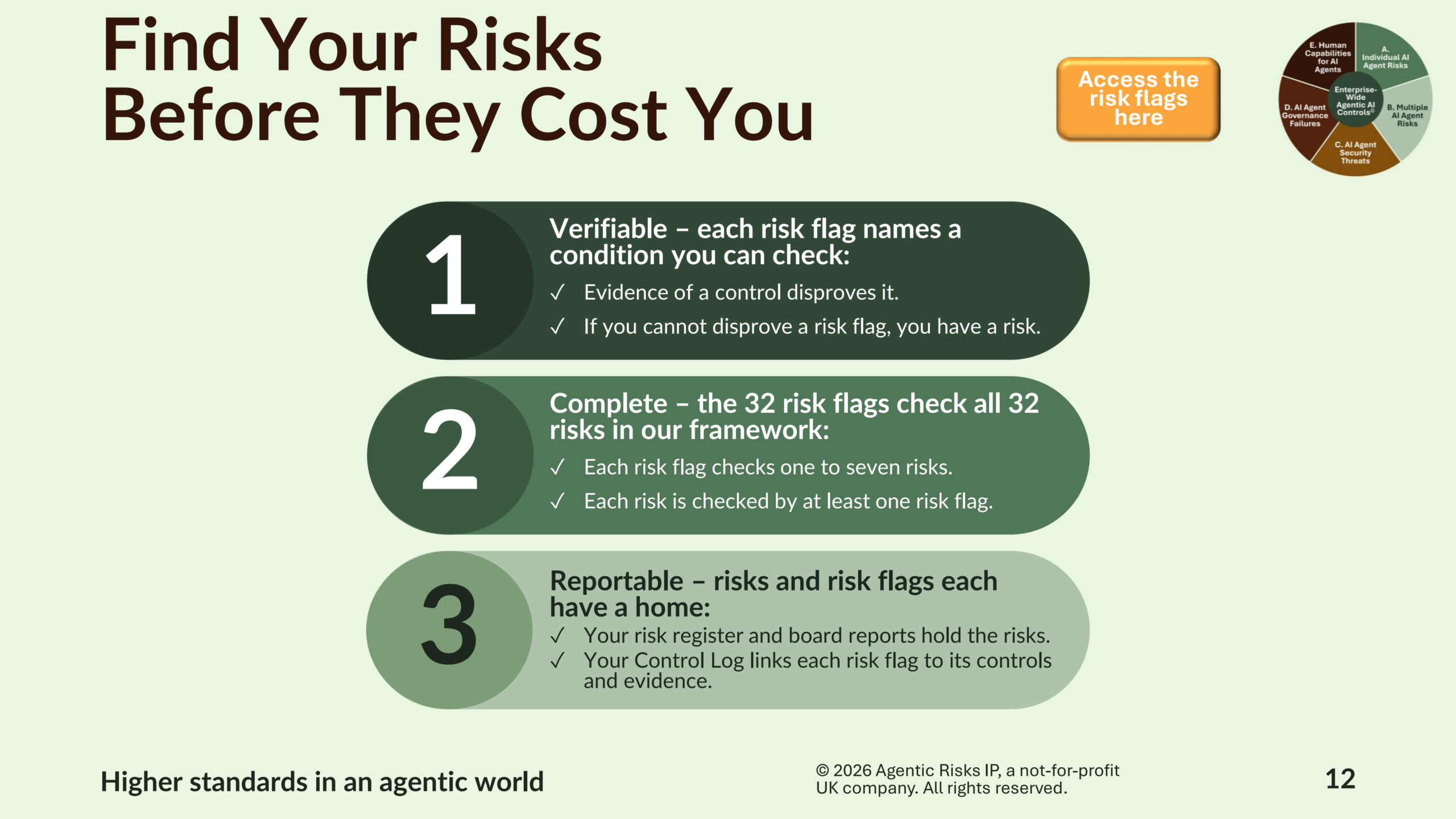
The 32 risk flags check all 32 risks in our Framework. Each flag checks one to seven risks, and each risk is checked by at least one flag.
The approach has three characteristics:
- Verifiable: each flag names a condition you can check against evidence.
- Complete: together, the flags check all 32 risks.
- Reportable: your risk register and board reports hold the risks, while your Control Log links each flag to the controls and supporting evidence.
Together, the flags help establish whether your agentic workflow is owned, can be constrained, is monitored and can be safely stopped.
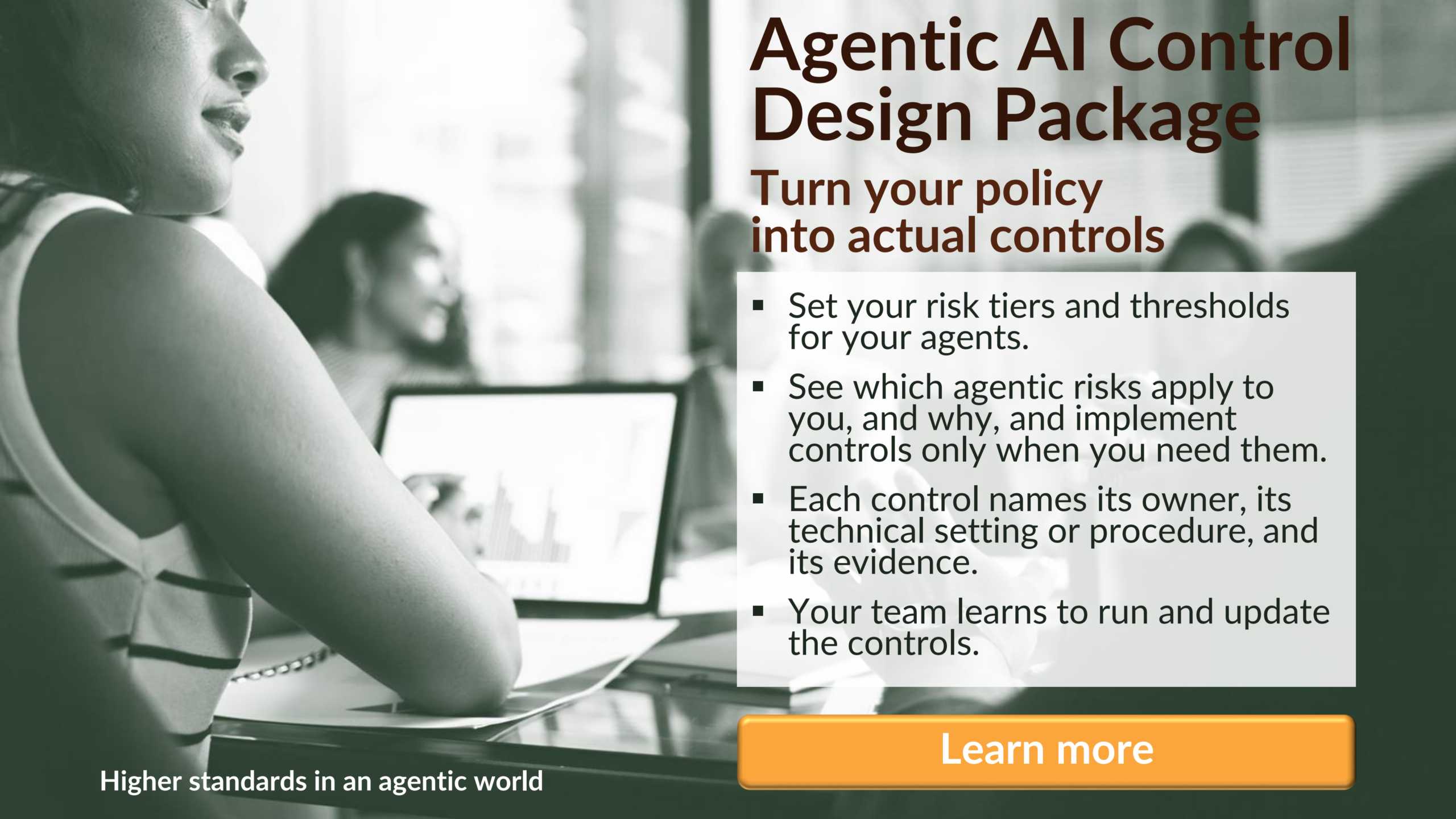
If you want help turning your policies into actual agentic controls, our Agentic AI Control Design Package uses the risk flags to help you set risk tiers, establish which risks apply, and specify each control with its owner and evidence.




Incident Management for Agentic AI
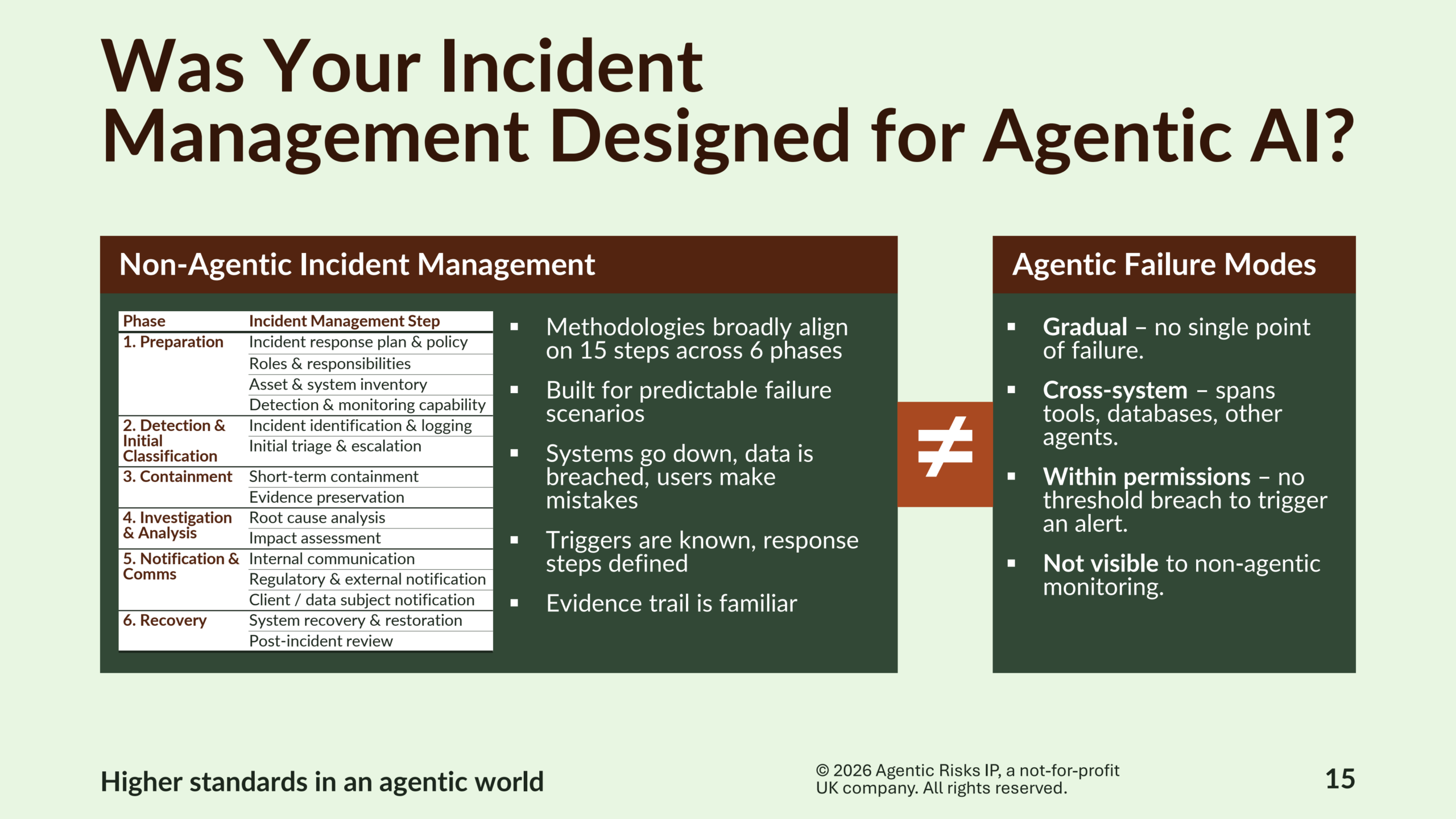
Was Your Incident Management Designed for Agentic AI?
Agentic incidents can develop gradually, span multiple systems and occur within an agent’s authorised permissions, making them difficult for conventional monitoring to detect.
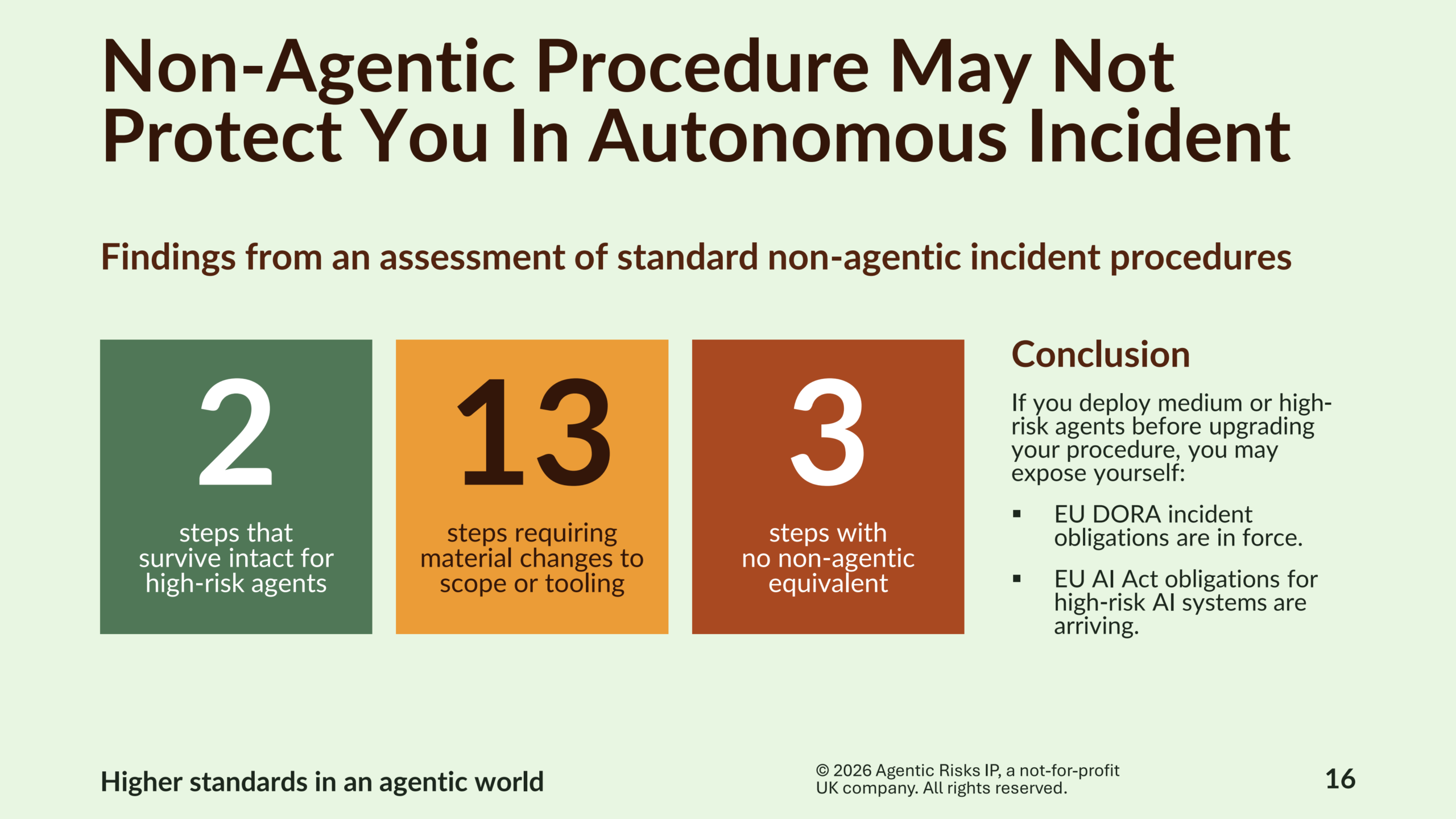
We assessed 15 existing incident-management steps against the requirements of medium- and high-risk AI agents. For high-risk agents, 13 need material changes and two survive intact; three entirely new steps are also required.
For regulated financial firms, effective incident management also supports obligations such as the EU’s Digital Operational Resilience Act (DORA).
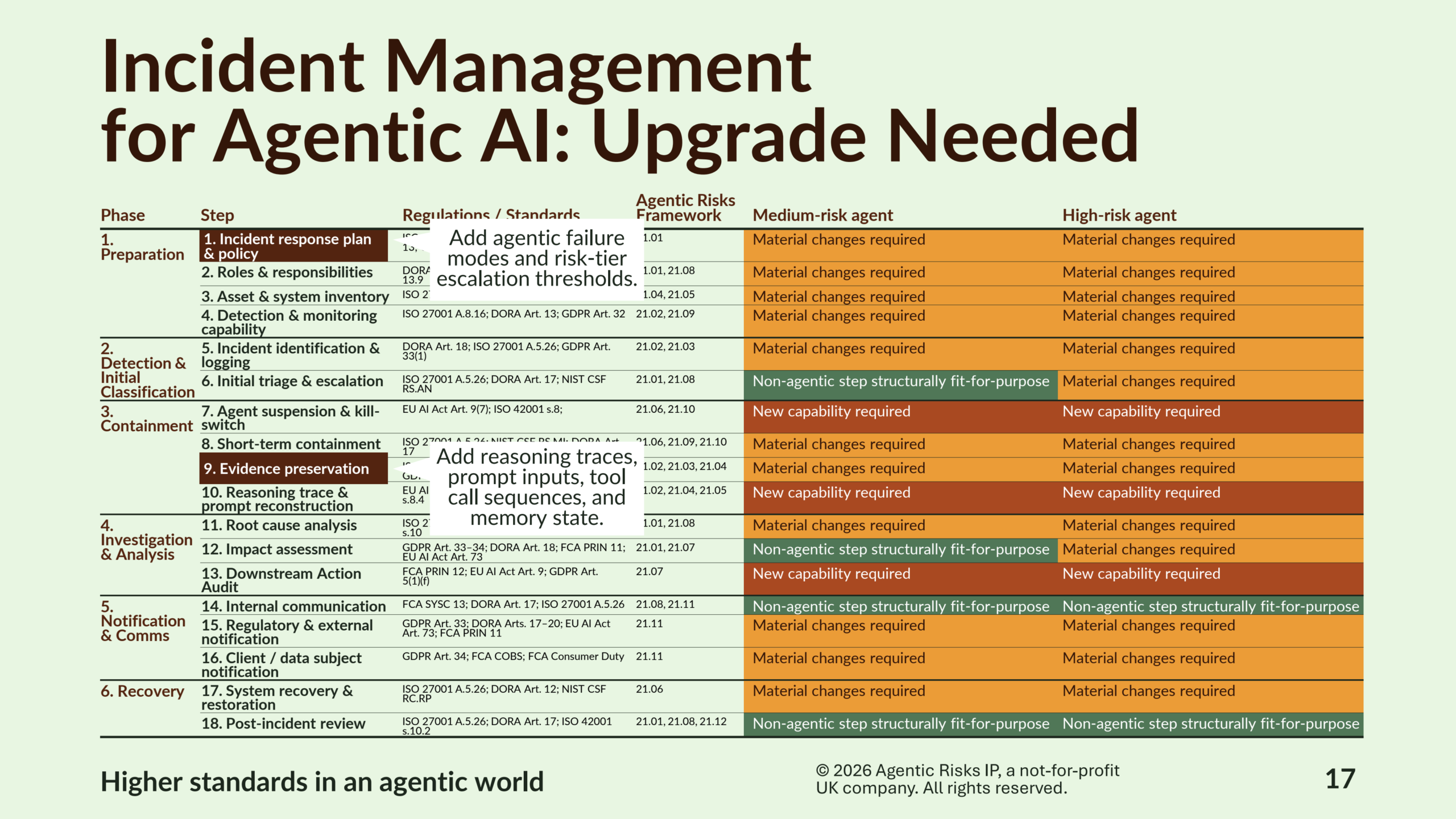
Incident Management for Agentic AI: Upgrade Needed
Our assessment covers six phases: Preparation; Detection and Initial Classification; Containment; Investigation and Analysis; Notification and Communications; and Recovery.
To illustrate the changes, here are two examples:
- Incident response plan and policy: add agent-specific incident categories, such as reasoning failure, prompt injection, runaway loops and unexpected tool chaining. Set escalation thresholds to reflect agentic risk tiers.
- Evidence preservation: extend conventional system logs and file records to capture available agent decision records, prompt inputs, tool-call sequences, relevant memory state and other evidence needed to reconstruct an incident.

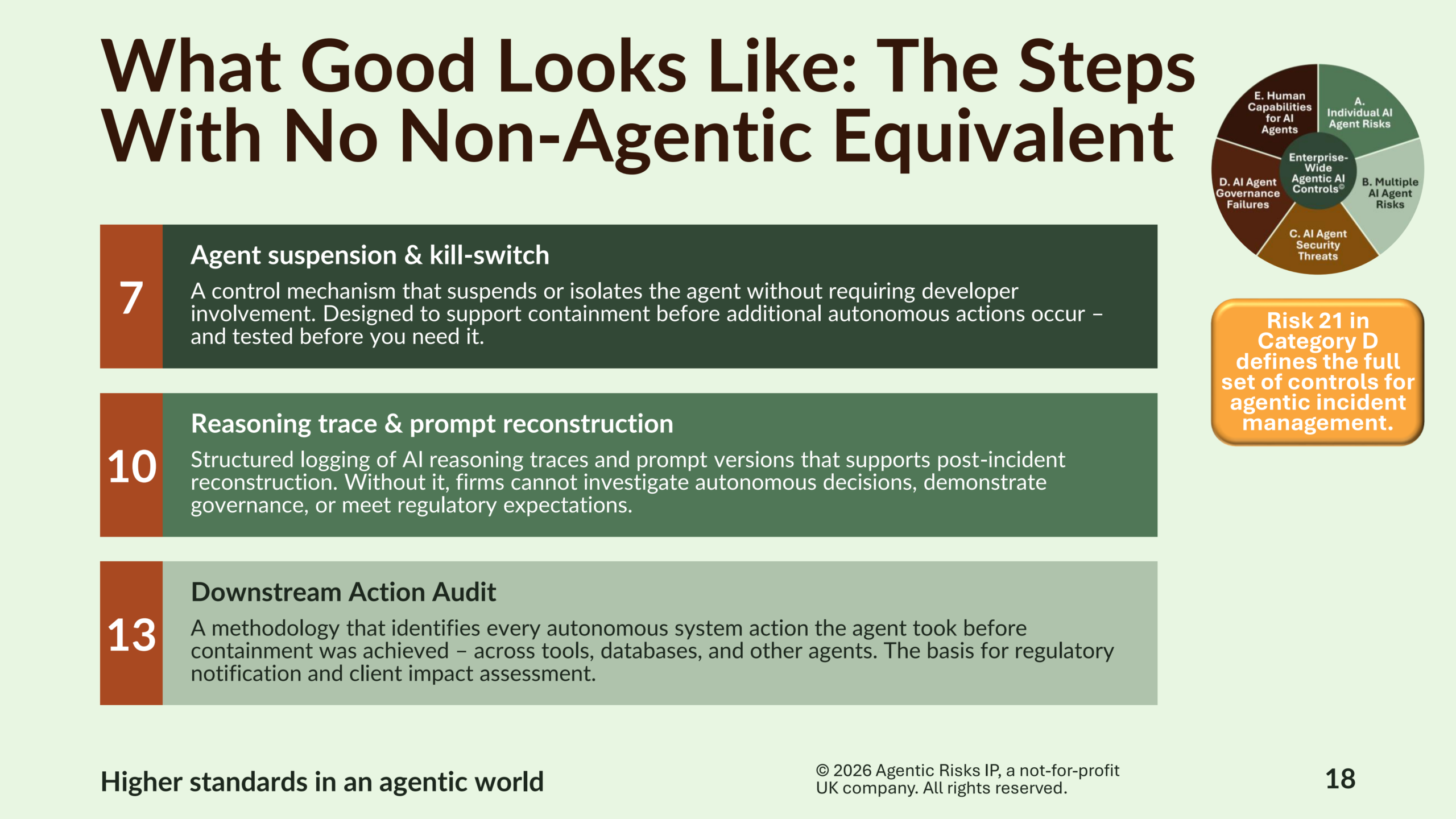
What Good Looks Like: The Steps with no Non-Agentic Equivalent
Our assessment identified three new capabilities.
7. Agent Suspension and Kill-Switch
A tested mechanism that lets an authorised person suspend or isolate an agent without developer involvement, before it takes additional autonomous actions. The procedure should support safe suspension and, for high-risk agents, may also need to cancel actions already dispatched to external systems.
10. Reasoning Trace and Prompt Reconstruction
Structured records that help investigators reconstruct an agent’s instructions, available decision steps, prompts, tool calls and outputs. Without sufficient evidence, identifying the root cause of an autonomous incident becomes difficult.
13. Downstream Action Audit
A methodology for identifying every autonomous action the agent took before containment, across tools, databases and other agents. This provides evidence for impact assessments and any required regulatory or client notifications.

A Plausible Scenario to Demonstrate That Preparation Will Matter
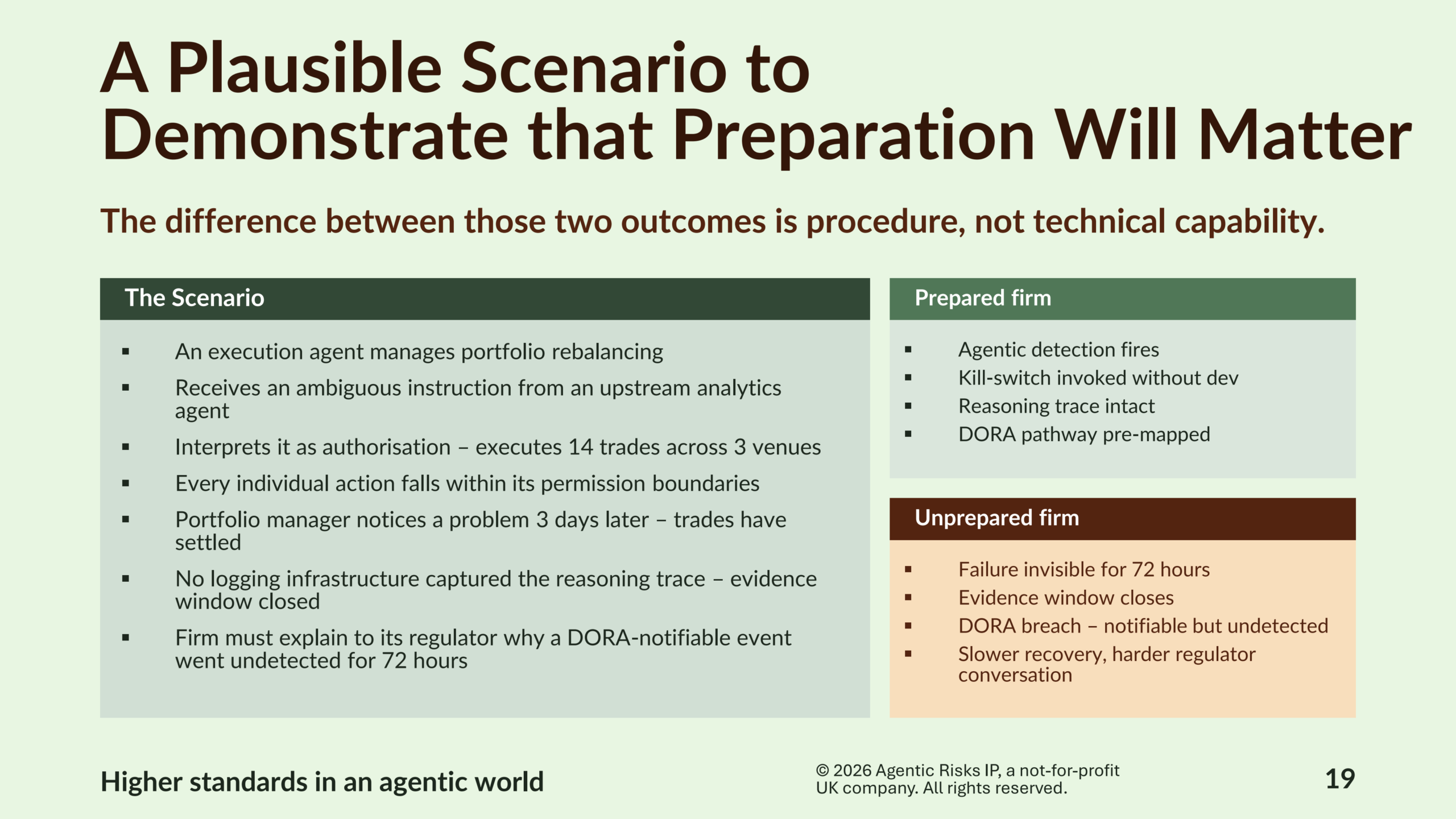
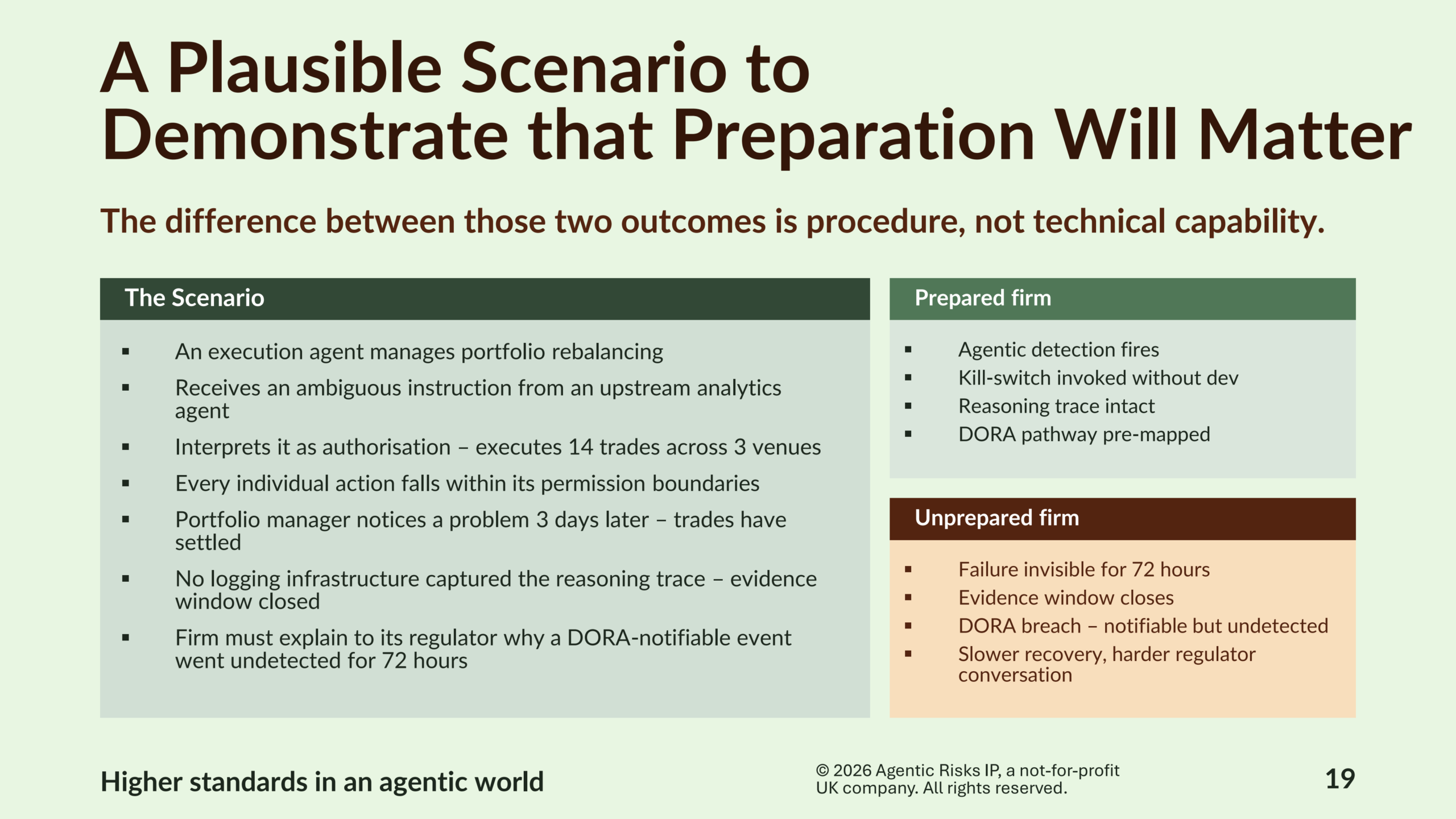
Consider an investment firm whose execution agent manages portfolio rebalancing.
The agent receives an ambiguous instruction from an upstream analytics agent and interprets it as authorisation to execute 14 trades across three venues. Every individual action falls within its permissions.
Three days later, the portfolio manager discovers that the positions do not match the client’s mandate. The trades have settled, and the firm may no longer have the evidence needed to reconstruct the agent’s decisions.
A prepared firm can detect unexpected behaviour, suspend the agent, preserve its decision records and follow its established incident reporting process.
An unprepared firm may discover the problem only after the trades settle, with incomplete evidence and a harder investigation.
The difference between those outcomes is preparation and procedure.
Three Obstacles to Avoid When Upgrading Your Incident Procedure
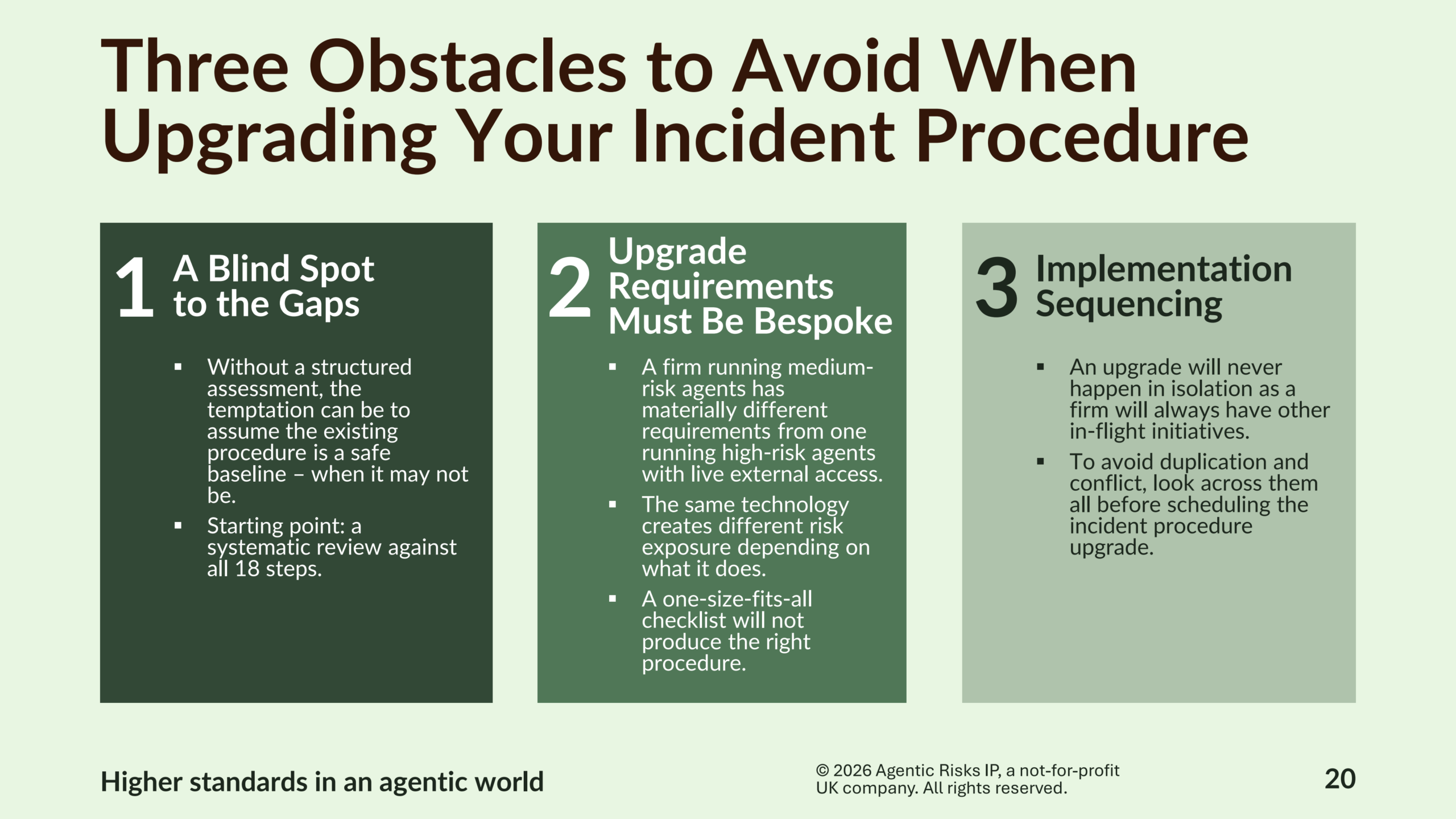
- A Blind Spot to the Gaps – start with a systematic review of your existing procedure against all 18 steps to identify what needs upgrading.
- Upgrade Requirements Must Be Bespoke – match your procedure to your agent risk tiers, use cases and external access. Medium- and high-risk agents can require materially different controls.
- Implementation Sequencing – coordinate your upgrade with other projects and operational priorities to avoid duplication and scheduling conflicts.
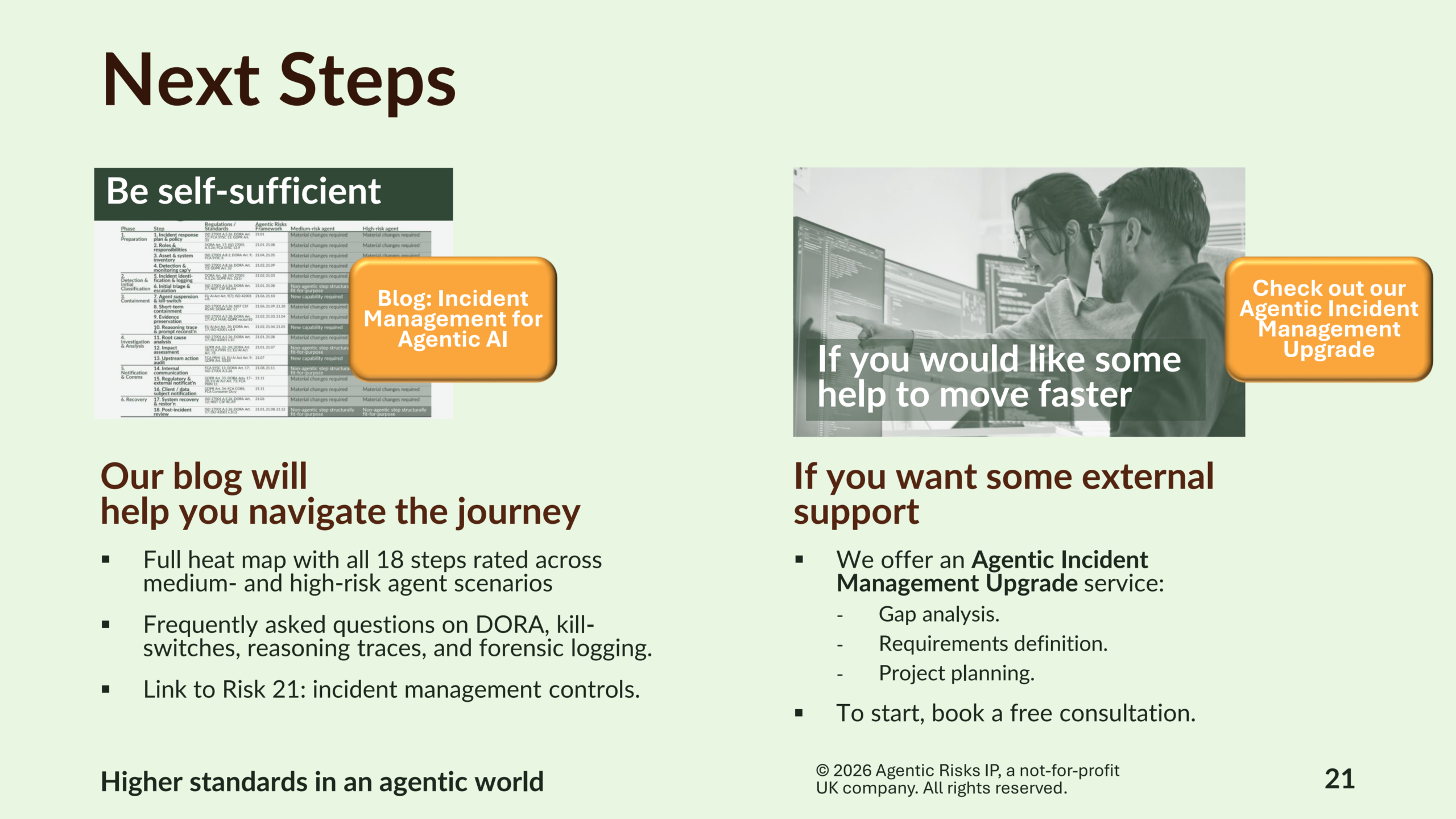
Click through for the full 18-step comparison and supporting analysis and for the Agentic AI Risk Control Framework where Risk 21 defines the risk of agentic incidents, a control strategy, and itemised controls you may wish to consider.
If you would like help moving faster, our Agentic Incident Management Upgrade service provides a gap analysis, requirements definition and prioritised project plan.
Continue the Webinar Series
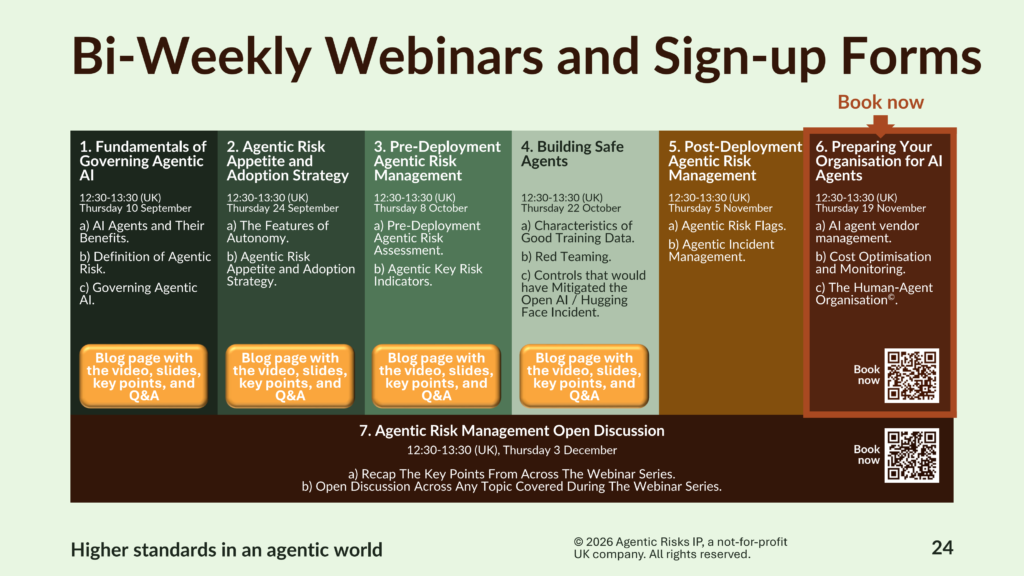
Register to join us for the remaining two sessions in the Institute of Risk Management’s seven-part webinar series on agentic risk management.
Webinar 6 – Preparing Your Organisation for AI Agents, 19 November 2026
- AI agent vendor management.
- Cost Optimisation and Monitoring.
- The Human-Agent Organisation©.
Webinar 7 – Agentic Risk Management Open Discussion, 3 December 2026
- Recap the key points from across the webinar series.
- Open discussion on any topic covered during the series.
Frequently Asked Questions
Post-deployment agentic risk management helps firms identify and control risks in AI agents that are already operating. It includes checking that controls work, monitoring agent behaviour, responding to incidents and updating safeguards as agents and their operating environments change.
Use an evidence-based post-deployment agentic AI risk assessment. Our 32 Agentic AI Risk Flags check conditions across five risk categories, helping risk managers establish whether each agent has accountable ownership, effective constraints, monitoring and stop authority.
Agentic AI Risk Flags are 32 verifiable conditions that help risk managers identify potential control weaknesses. Each flag maps to one or more of the 32 risks in our Enterprise-Wide Agentic AI Risk Control Framework. If you cannot disprove a flag with satisfactory evidence, you have a risk to assess and treat.
AI agents can fail gradually, act across multiple systems and cause harm while operating within their permissions. Our assessment of 15 conventional incident-management steps found that 13 require material changes for high-risk agents, while agentic incident management also requires three new capabilities.
Three capabilities have no direct equivalent in conventional incident management: a tested agent suspension or kill-switch mechanism, reasoning trace and prompt reconstruction, and a downstream action audit. They help firms contain an agent, reconstruct its actions and assess the impact of an incident.
The EU’s Digital Operational Resilience Act (DORA) requires financial entities within its scope to manage ICT-related incidents, including identification, classification and reporting where required. Firms using AI agents should ensure their incident procedures can detect, investigate and contain relevant agentic failures and determine whether regulatory notification is necessary.