Table of Contents
Executive Summary to the Agentic AI Organisational Structure
For the first time, a worker that cannot bear liability can feature on an org chart, which will challenge theories about the division of labour that assume positions are occupied by humans and create an impact of agentic AI on organisational structure.
Agentic AI’s vast processing capacity is shifting where power sits inside organisations, yet accountability must stay with humans because laws and regulations require it.
Specific structures will vary, but many firms will need a new management layer of agent supervisors that will require leadership skills from people early in their careers and still developing these qualities.
Leaders should redesign roles, assign accountability, define ‘Spans of Agency’ and measure oversight capacity before scaling.
In this article, we assess the impact of agentic AI on organisational structure, itemise key next steps, and further explore people management for agentic AI.
If the four dimensions describe work that still lies ahead for you, we can help you with agentic workflow accountability mapping, agent oversight capacity measurement, and delivering a development programme for your agent supervisors. Skip straight to this section of the article.

Context

Introduction to Organisational Structure for Agentic Era
Mintzberg (1979) defines structure as the ways an organisation divides labour into distinct tasks and coordinates them. Following Galbraith’s Star Model analogy – structure is an organisation’s anatomy and processes are its physiology – we assess the division of labour and location of decision-making authority under Structure, and how organisations coordinate work under Processes.
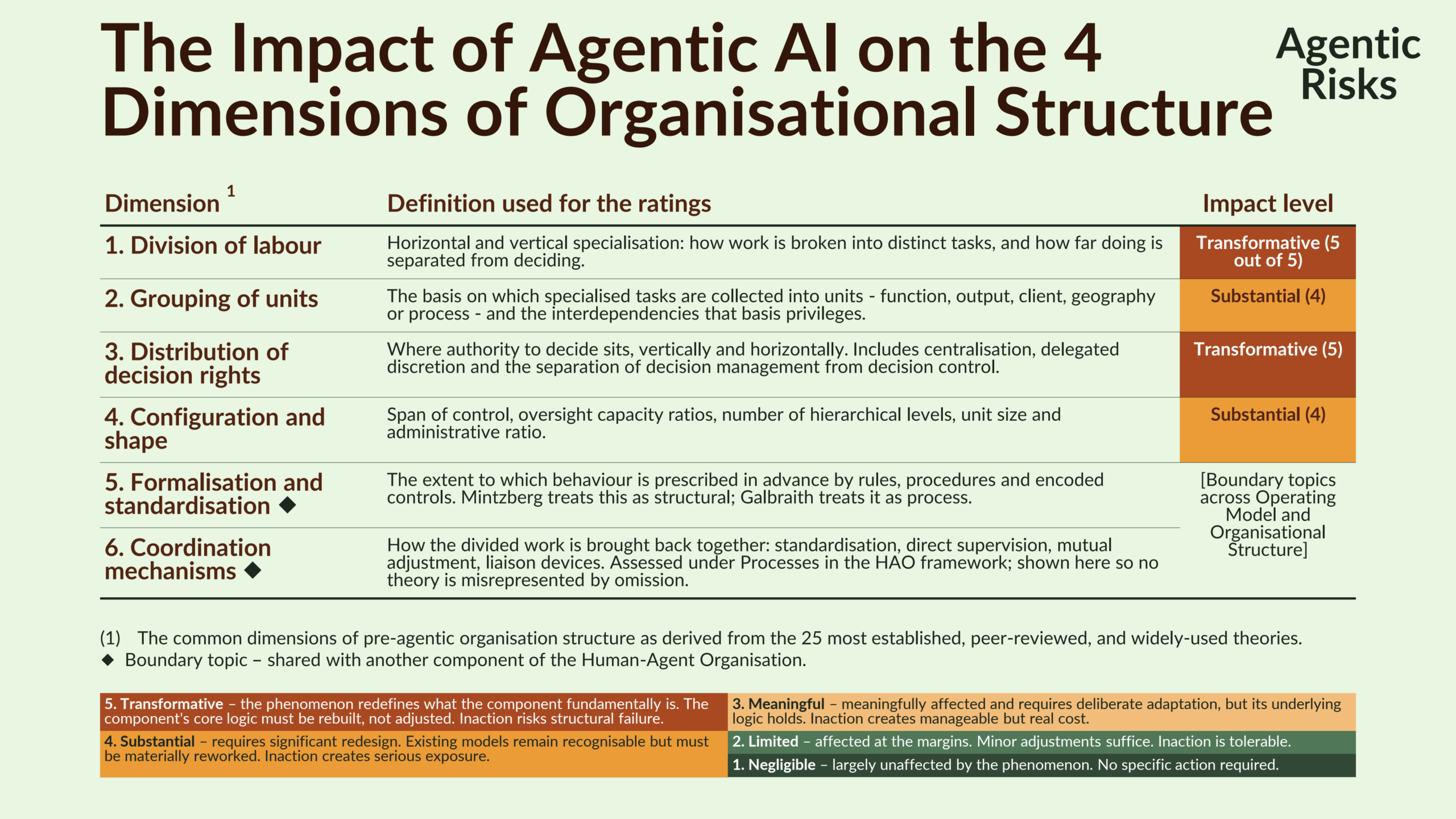
That gives four structural dimensions: division of labour, grouping of units, distribution of decision-making authority, and configuration and shape. Two further topics straddle both Structure and Processes, so we treat them as ‘areas of overlap’: formalisation (how far rules and procedures prescribe behaviour), and coordination (how we keep different parts of an organisation aligned).
We also explore a premise we introduced in our first article: accountability will remain with the human. It remains there because laws, regulations, and firms place it there, linking each assignment of accountability to a position in the organisation. If you change the structure you must also reassign accountability. AI agent accountability in organisations therefore requires deliberate structural design.
This matters because, building on Child’s 1972 work, authority sits where a firm chooses to put it: people with power choose structures and determine where authority sits. Firms must therefore deliberately preserve accountability as structures change.
Ultimately, we use these dimensions to explain agentic AI organisational structure, assess how much agentic AI changes each one, outline key leadership decisions and actions, and note considerations for regulated firms.
The Four Dimensions of Agentic AI Organisational Structure
1. Division of Labour
Description of the Dimension
Division of labour covers how organisations break down work into tasks and allocate it:
- Horizontal specialisation – how narrow each job is.
- Vertical specialisation – how far organisations separate doing from deciding.
It is the field’s most measured dimension, appearing as specialisation in the Aston studies (Pugh et al., 1968) and job specialisation in Mintzberg’s categories for organisational design. Puranam, Alexy and Reitzig (2014) also reduced ‘organising’ to four universal problems and ‘task division’ and ‘allocation’ were the first two.
In our opinion, Weber (1922) made the key move here: authority attaches to the office (the organisational position). That separation allows a non-human worker to occupy the position and hold its authority.
As a result, division of labour deserves to be a distinct dimension of the agentic AI organisational structure because AI agents change its unit of division – ‘who’ and now also ‘what’ work is divided among. Firms that do not address this may see agent deployment as a question of staff numbers, while staff numbers may be the last place the change appears.
Impact of Agentic AI – ‘Transformative’ (Level 5 of 5) – the requirement to divide labour survives but, for the first time, a worker that cannot itself bear legal liability can feature on an org chart. This is why the Human-Agent Organisation uses Worker for anyone or anything performing labour and reserves People for humans. Every established theory of organisational structure assumes a person occupies each position. The change therefore concerns what the division divides among, requiring firms to rebuild the component’s fundamental logic.
Investment management example – an asset manager divides investment research by sector, with juniors gathering data and building models and seniors forming recommendations:
- Research agents now perform the gathering and modelling, so the firm reduces the number of junior staff.
- Eighteen months later, nobody owns tasks such as judging when an agent’s output is wrong, when the assumptions behind a model are no longer valid, or when two agents have reached conflicting conclusions about the same company or security issuer.
- The role descriptions omitted these tasks because the redesign treated the change as staff reduction; in practice, the organisation was adding a second class of worker.
Leadership Decisions and Actions
- Audit at the task level. A role that loses XX% of its tasks to agents may become a different role requiring deliberate redesign and new capabilities and skills.
- Establish both the tasks an agentic deployment creates and those it removes, and give each an owner before you determine the post-deployment structure.
- Differentiate between Workers and People as formal organisational vocabulary so job and role structures can distinguish them.
- Link every non-human worker to a named human worker who is accountable for it.
Regulatory Considerations – Training and Competence rules assume firms can describe a person’s work, and regulators are likely to expect firms to identify who remains accountable when software performs a task. Firms strengthen their ability to demonstrate competence by keeping role descriptions aligned with the work. Under the Senior Managers and Certification Regime (SMCR), statements of responsibility describe what a senior manager is answerable for; if agents absorb part of that work, the statement should identify who is answerable for them.

2. Grouping of Units
Description of the Dimension
This dimension covers how organisations group teams or units: by function, output, client, geography or process.
In our view, Thompson (1967) offers the strongest rule: first, group tasks that depend on each other in both directions; then those that depend on one another in sequence; then those that mainly share common resources, because each choice determines which dependencies are easier or harder to manage.
And Chandler (1962) showed that when strategy changes, the grouping basis often follows.
Therefore, how we group organisational departments and units requires a distinct lens because it determines where the effort and cost of coordinating work falls before coordination begins.
It is also one of the two dimensions with the least pre-agentic academic literature (see ‘An Unexpected Finding’ below), so firms may find less established guidance than they expect.
Impact of Agentic AI – ‘Substantial’ (Level 4 of 5) – Thompson’s rule survives the arrival of AI agents: dependencies between tasks still determine what should sit together. However, two things change materially and, together, they change how firms organise AI agents and shared capabilities when dependencies cut across existing teams:
- First, a new grouping basis appears – Conway (1968) observed that organisational designs mirror communication structures, while later research on modular design, including Sanchez and Mahoney (1996), showed that standard ways for groups to connect can build coordination into the design itself. An Agentic Capability Catalogue (a structured list of reusable agent capabilities) is one such design.
- Second, regrouping non-human workers costs almost nothing – firms can create, regroup and remove agents in seconds, turning grouping from a semi-permanent commitment into something firms can change continuously.
In sum, the way a Human-Agent Organisation groups work will remain recognisable but will require significant change.
Accounting and Audit example – an audit firm groups its people by client and engagement, which is appropriate when most two-way dependencies sit within each audit.
- It then builds shared agent capabilities for sampling, matching evidence, reconciling records and flagging exceptions.
- Within a year, the most important dependencies shift from engagement teams to the people maintaining each capability and every engagement using it.
- A problem in the sampling capability now spreads across every audit at once.
- Engagement grouping remains right for the humans while the work increasingly requires a different grouping basis, forcing a choice between ownership by the teams using the capability or by a central function.
Leadership Decisions and Actions
- Decide whether agent ownership sits with the business function using the agent or with a central specialist team (centre of excellence), and record why. Where several units use a capability, name one accountable owner with authority to block its use. Deferring these ownership decisions leaves them to whoever moves first.
- Treat your catalogue of agentic capabilities as part of agentic AI organisational design and use it to settle how work is divided before deciding who performs it.
- Map task dependencies again after deployment, as well as before. This is because agents change task dependencies, turning pre-deployment maps into estimates to be confirmed once you know for sure.
Regulatory Considerations – operational resilience rules require firms to map which resources their important business services depend on. When a firm reuses one capability across multiple services, it creates one point of failure that a service-by-service map will show multiple times. Firms should expect regulators to ask whether shared agentic capabilities appear in their mapping.

3. Distribution of Decision-Making Authority
Description of the Dimension
Decision-making authority covers where formal power resides, up and down the hierarchy and across teams.
The Aston studies measured concentration and found it largely independent of how firms organise activities: a firm can use highly standardised processes while still spreading decision-making authority.
Jensen and Meckling (1992) explain that because specialist knowledge can be hard or costly to transfer, either the knowledge moves to the person with authority to decide, or the authority moves to where the knowledge sits.
Meanwhile, Fama and Jensen (1983) divide decisions into four steps: initiation (proposing), ratification (approving), implementation (carrying out) and monitoring (checking), calling the first and third ‘decision management’, and the second and fourth ‘decision control’. In human organisations the two usually travel together within a role, and firms separate them deliberately, as segregation-of-duties regimes do.
However, an agent may perform a large share of decision work while formal authority remains with humans, or receive wide freedom to decide within a narrow task. As a result, firms transforming into Human-Agent Organisations should consider agentic AI decision-making authority separately from their division of work.
Impact of Agentic AI – ‘Transformative’ (Level 5 of 5)
- Proposing and carrying out decisions, and approving and monitoring them, can now be separated at scale: an agent can initiate and implement, but it cannot formally approve or monitor in a way that makes it legally accountable because it cannot be questioned, sanctioned, or held answerable.
- Therefore, for the first time in organisational history, a worker that receives decision-making authority cannot itself bear accountability for it.
- In response, firms must rebuild the link between decision-making authority and accountability by deliberately assigning accountability to a human.
- To provide that link, we apply the Span of Agency we introduced in the Human-Agent Operating Model (the defined boundary of what an agent may decide or do).
- It connects decision-making authority to human accountability by stating what freedom the agent has, what remains with humans, who approved the split, who is accountable for designing the boundary, and for outcomes within it.
Legal example – a commercial law firm deploys a contract review agent with authority to categorise clauses, accept standard contract positions and send exceptions to a human.
- A legal technology team sets the Span of Agency when it sets up the system based on what the technology can reliably do.
- Nobody asks which partner is answerable for the boundary.
- Six months later, a fallback contract position the agent accepted eight hundred times proves commercially unfavourable in a particular set of circumstances.
- In this case, the lawyers correctly reviewed the cases the agent escalated, the agent stayed within its boundary; the design failure lay in the boundary itself.
- In sum, the firm allocated ‘decision management’ with care but lost sight of ‘decision control.’
Leadership Decisions and Actions
- Separate accountability for designing the agent’s decision boundary from the outcomes within it, and name a person for each. This is the highest-value organisational design decision in an agentic transformation.
- Require every Span of Agency to state what freedom to decide remains with the human and who approved the split.
- Deployment often relocates specialist knowledge while decision-making authority stays where it was, so locate your agentic decision-making authority where the specialist knowledge sits, then check whether agents have moved that knowledge.
- Make supervisory authority real by giving agent supervisors authority to pause, override and redirect, and require evidence that they have used it.
Regulatory Considerations – under the UK’s SMCR, regulators expect senior managers to take ‘reasonable steps’, but this assumes the manager could have acted. If another function set the boundary in a system the manager cannot inspect, that assumption fails. Firms should expect regulators to ask who set the Span of Agency, on what basis and how the firm informed the accountable individual. UK guidance for managing risks from models, such as Supervisory Statement SS1/23, offers the closest precedent for governing systems whose outputs can vary even when the inputs are similar, and we expect regulators to focus on this early.

4. Configuration and Shape
Description of the Dimension
Configuration refers to organisational shape and comprises span of control (how many people or workers a manager supervises), number of management layers, unit size, and the ratio of administrative to operating staff.
Woodward (1965) found these varied systematically with the technology firms use to produce work, providing a precedent for new technology to reshape them.
Early research established the hard limit:
- Graicunas (1933, reprinted in Gulick and Urwick, 1937) showed that a supervisor must track both direct relationships with subordinates and relationships among those subordinates, which grow much faster than the number of subordinates because each additional subordinate creates multiple new relationships.
- Ashby (1956) generalised the point – effective control requires a supervisor to cope with as many different situations as the system can create.
As you transform your firm into a Human-Agent Organisation, configuration deserves separate treatment because conventional measures can mask the change: staff numbers, costs, and span of control can indicate stability while, underneath, the level of supervisory work may have multiplied.
This creates a new agentic AI span-of-control problem: staff numbers can stay flat while supervisory relationships multipl
Impact of Agentic AI – ‘Substantial’ (Level 4 of 5) – the pre-agentic logic holds: the Human-Agent Organisation will still encounter a limit to how many relationships a supervisor can track, and Ashby’s principle will still apply. The principle holds while its application changes materially:
- Supervisors now oversee far more workers, many of them non-human.
- The number of handoffs between agents can grow much faster than the number of agents while staff numbers stay flat.
- A new management layer will emerge whose members mainly supervise non-human workers.
Existing organisational configuration models remain recognisable but require material rework, supporting a Substantial (Level 4) rating. This is the second area with limited pre-agentic research, so firms must develop new measures.
Investments Operations example – an operations team of six supervises agents that reconcile records across four fund ranges.
- Management reports a span of control of six to one, unchanged. In practice, each supervisor oversees nine agents whose outputs feed one another, creating dozens of possible handoff failure points; by design, agents send humans the exceptions.
- The error rate holds for a year, then degrades sharply during market volatility as the number of exceptions rises and the amount of work needed for supervision passes an unmeasured limit.
- Throughout, the firm’s span-of-control figure remains unchanged.
Leadership Decisions and Actions
- Define and measure oversight capacity through agent-to-agent handoffs, separately from span of control.
- Set hard limits on how much agent output one person can meaningfully review, and use them as firm deployment limits.
- Test oversight capacity under both normal and volatile conditions, using the peak as the binding constraint.
- Design, develop, and lead a new management layer of agent supervisors that will require leadership skills like delegation and judgment from people who may be earlier in their careers.
Regulatory Considerations – operational resilience rules depend on humans detecting and responding to disruption within defined limits on acceptable disruption (‘impact tolerances’). An oversight function beyond sustainable capacity is a resilience weakness that a map of each service’s dependencies will miss because the function appears staffed. Firms should consider whether realistic severe scenarios (‘severe but plausible’ scenarios) include loss of effective human oversight of AI agents while every system remains available.

Two Boundary Topics
Two further dimensions sit on the boundary between Structure and Processes. We address them here, and assign each one explicitly, to represent accurately the sources that treat them as central.
1. Formalisation and Standardisation (Rules and Procedures)
Formalisation is the extent to which rules and procedures prescribe behaviour in advance and the literature is split on where it belongs:
- Mintzberg treats behaviour formalisation as a feature of organisational design because a heavily formalised role differs from a lightly formalised one.
- Galbraith treats rules and programmes as ways to coordinate work because they settle decisions in advance and reduce management escalation, so he treats them as part of the process.
We place formalisation in Structure, with a split:
- Rule content – an AI agent’s authorised scope of action is structural because it defines the position.
- Enforcement – how firms build the rule into software, monitor it and show that it works while the agent operates is process.
Galbraith counts rules as coordination because they settle decisions in advance and so reduce how much information must move up the hierarchy. A software-enforced rule does something different: it removes the decision from the agent altogether, which directly constrains authority. A Span of Agency is formalisation in exactly this sense, defining a role’s freedom to decide in advance, which is why we place it in Structure.
Adler and Borys (1996) caution that rules can either help people master their work or force compliance, depending primarily on design. Firms that treat new software-enforced rules for AI agents purely as restrictions may default to the compliance-focused version.
Because a Span of Agency is a decision right written down in advance, we assess its impact under Distribution of Decision-Making Authority.
Accounting Example – a firm builds a rule into software that automatically approves expenses below a threshold. The rule changes who has authority to make the decision and removes it from every manager who previously held it. It arrived as a software setting yet it changes managers’ roles and decision rights.

2. Coordination
Coordination is central to Mintzberg’s definition of Structure, but we assess it under Processes in the Human-Agent Operating Model. We took this approach for Galbraith’s reason: structure is anatomy; coordination is physiology.
How much physiology will the Human-Agent Organisation need? Lawrence and Lorsch (1967) found that as organisations divide work into more specialised units, they need more structural mechanisms to keep those units aligned.
This implies that as agentic AI divides work more finely in several ways – more specialised units, distinct capabilities and two kinds of worker – the effort needed to keep units aligned rises with it, faster than the number of units.
Therefore, finer agentic specialisation requires proportionate coordination to keep units aligned.
Legal Example – a firm builds separate agentic capabilities for contract review, regulatory research, and client correspondence, each excellent and owned by a different practice group. The firm therefore needs a coordination mechanism to detect incompatible positions across capabilities, and its absence would be a failure of coordination, not technology.

Agentic AI Organisational Structure – Services
If the four dimensions above describe work that still lies ahead for you, these three services are where firms usually begin.
The smallest step establishes who is answerable for what. Our Agentic Workflow Accountability Mapping audits one or two workflows at the task level: the tasks a deployment creates as well as removes, the human accountable for each non-human worker, and a Span of Agency for each agent. It identifies the role descriptions and statements of responsibility that need updating to match the work.
If your agents are live, the next question is whether the human supervisors can cope. Our Agent Oversight Capacity Measurement measures agent-to-agent handoffs per supervisor, review quality, and the shift in work mix once agents absorb the routine tasks that once provided recovery in the day. You finish with defensible and stress-tested review limits.
Further out, and requiring a larger commitment, agents absorb the routine work that formed the apprenticeships through which junior staff build judgement. Our Agent Supervisor Development Programme counteracts that by adding agent-supervision skills to your skills framework as a distinct skill set, and building the new management layer whose members mainly supervise non-human workers.
Methodology
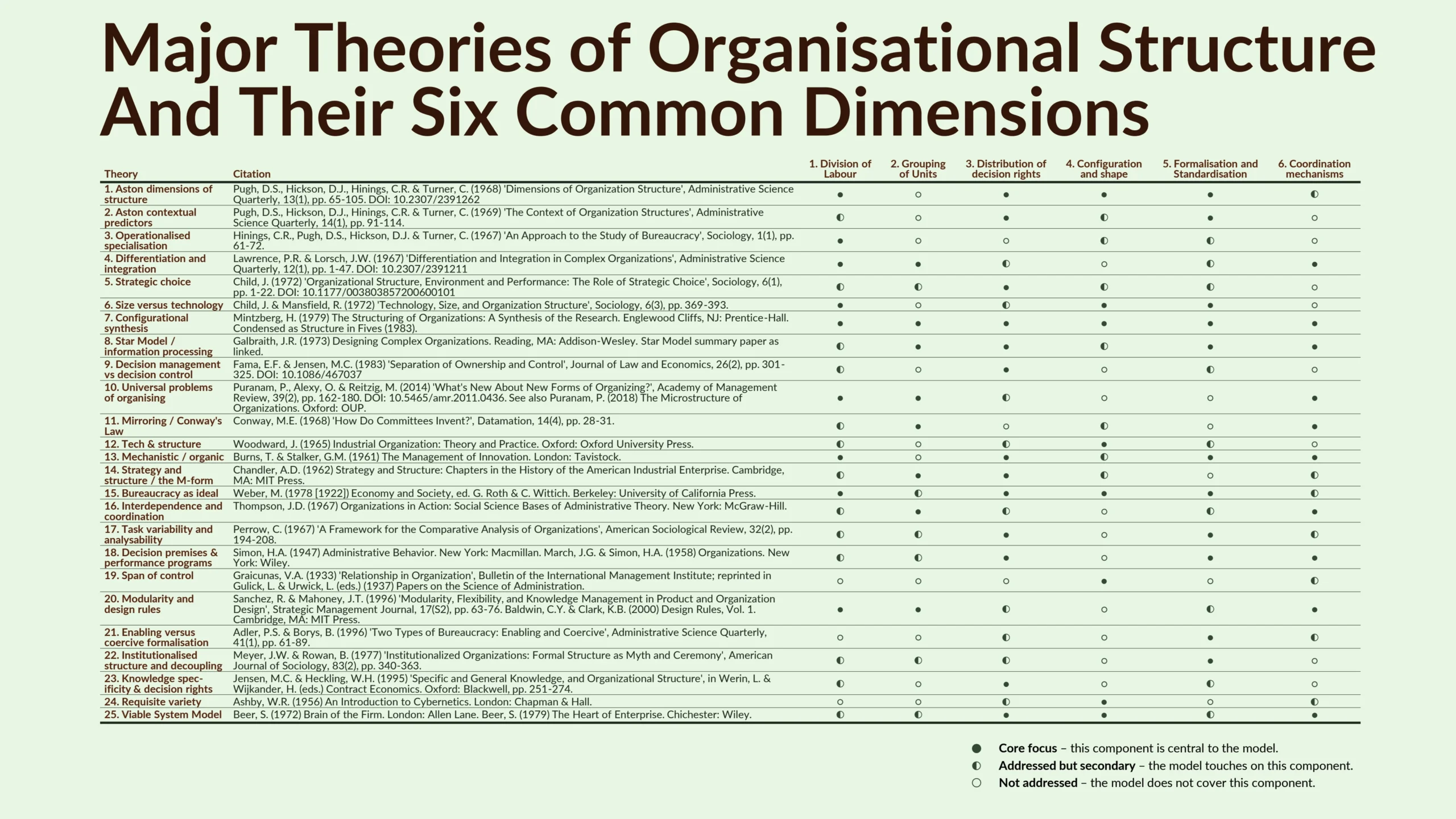
Selecting the theories – we selected theories of organisational structure based on how well established they are in research that other academics have reviewed and that draws on observed data, and how widely practitioners and educators use them. Twenty-five qualified, published between 1922 and 2018, spanning seven major schools of organisational theory. To minimise bias, we allowed conflicting theories into the sample.
Deriving the dimensions – we restated each theory’s main claims in plain, theory-neutral language and compared the underlying ideas, yielding four recurring dimensions: division of labour, grouping of units, distribution of decision-making authority, and configuration and shape; plus two boundary topics: formalisation and standardisation, and coordination. We rated each theory as having a core or secondary focus on each dimension, with blanks marking dimensions outside a theory’s scope. We rated each theory by its original scope, because a theory’s reputation and text can differ.
Testing the common pattern – each of the six dimensions is a core focus of at least eight independently developed research programmes. The common pattern survives removing the weakest evidence: excluding sources we could verify only through summaries of the original work leaves every dimension a core focus of at least six. The pattern therefore reflects the wider field.
Assessing the impact – we assessed each dimension independently against the five-level scale we use throughout this series: 1 Negligible, 2 Limited, 3 Meaningful, 4 Substantial, and 5 Transformative. We built the assessments bottom-up with the four dimensions yielding two Level 5s and two Level 4s, averaging 4.5. Our overall Transformative rating for Structure rests on the 4.5 average and on the first dimension: the unit of division of labour changes and changing a component’s founding assumption requires a rebuild.
Verifying the sources – we retrieved and inspected an accessible source for every theory. Most are original texts or publisher pages containing the abstract (summary); four of the 25 are encyclopaedia entries or other summaries. We also record one citation conflict: two papers claim the same SSRN paper identifier, so we cite Fama and Jensen through their publisher DOI (digital object identifier).
Limitations:
- Because we derived the dimensions from recurring themes, our method partly builds recurrence into the result.
- We drew the set mainly from mainstream theories originating in the UK and US.
- These theories predate workforces combining human and non-human workers, so we offer the dimensions as a testing structure whose validity requires further evidence.
An Unexpected Finding: Two Hypotheses Where Existing Theory Is Limited
Comparing the dimensions with the existing theories identified that the two dimensions with least established support – grouping of units and configuration and shape – are where agentic AI raises the sharpest practical questions. As a result, practitioners will face a thin evidence base. We therefore set out two testable hypotheses.
The Oversight Capacity Hypothesis
We hypothesise that human oversight capacity depends primarily on the number of relationships between agents a supervisor must track. Because those relationships multiply rapidly as firms add agents, oversight can deteriorate while conventional measures remain flat.
Graicunas showed this rapid growth in relationships among human subordinates. Handoffs between agents create similar relationships and grow much faster than the number of agents because agents are cheap to add and their outputs routinely feed one another. If this holds, span of control and staff numbers may remain flat while effective oversight deteriorates, first surfacing as reviewers miss more errors.
Testing requires three things:
- A new measure of agent-to-agent handoffs per supervisor.
- Tracking review quality as the key outcome.
- Comparing teams with different ratios of agents to human workers within the same firm while allowing for other differences an agentic transformation causes.
The Capability Mirroring Hypothesis
We hypothesise that a firm’s organisational structure will come to resemble the way it organises its agent capabilities, so the agent capability catalogue may be a better predictor of the future organisation chart than the current organisation chart.
Conway observed that design mirrors the communication structure of the organisation that produced it. Later research on modular design established the relationship in both directions.
If capabilities become the main unit for organising governance, as we argued in the Human-Agent Operating Model, the strongest dependencies will shift toward capability owners and consumers across existing business units, and structure will follow.
If so, firms are designing their future organisation when they design their capability catalogue, often before they realise it.
Testing requires comparing ways firms organise agent capabilities with later reorganisations in firms that adopted a catalogue approach early, and checking whether capability boundaries better predict emerging reporting lines than older functional departments.
Firms deploying many agents across the organisation over the next two years will effectively run this experiment.
We will develop both hypotheses as our Human-Agent Organisation work progresses and encourage firms to test them against their own use of agentic AI.
Frequently Asked Questions
Traditional span of control measures can understate the real supervisory load. A manager may oversee a stable number of people while also supervising many agents whose outputs feed one another, creating far more handoffs to monitor. Firms should measure oversight capacity separately, set hard review limits and test capacity under peak conditions.