Table of Contents
Executive Summary
In the agentic era, culture will remain a human domain because only people accumulate shared experience, transmit tacit assumptions, and attach emotional stakes to them.
Agentic AI will change culture, however, as norms, practices, and informal information flows shift; deeper assumptions will evolve too, more slowly.
But as AI agents absorb routine work, entry-level staff will lose the ‘apprenticeship’ through which previous generations developed knowledge and judgement. This will create capability and talent pipeline issues.
In Agentic AI and Organisational Culture, we define the informal organisation, assess the impact of AI agents, and propose leadership responses.
If this work still lies ahead for you, we can help with agentic workflow accountability mapping, agent oversight capacity measurement, and an agent supervisor development programme. Skip to this section.

Introduction
In The Advent of the Human-Agent Organisation ©, we assessed the impact of a combined human and agent workforce on the six components of organisation design. For one component – the Informal Organisation – the impact of agentic AI was ‘Meaningful’ (Level 3 out of 5), and this article explores that assessment in depth.
The Informal Organisation is culture and everything alongside, rather than on, the formal organisational chart: shared assumptions, norms in use, relationships and unscheduled learning.
Schein defines culture as a pattern of shared basic assumptions that a group learns as it solves problems of adapting to the outside world and working together internally, then teaches to new members as the correct way to perceive, think and feel. We adopted that definition in the inaugural article and retain it here.
A defining feature of the Human-Agent Organisation is that humans stay in charge, and the key word in Schein’s definition is ‘group’. Accordingly, we treat AI agents as objects the group forms assumptions about, not members of the group:
- A person should set and reset an agent’s behaviour through training and re-training, so the group’s intangible shared experience accumulates among people and not in the agent.
- When one version replaces another, a human can rewrite an agent’s instructions, rules, and tool permissions, so the agent does not pass on the group’s learned assumptions and transmission runs through people.
- While assumptions carry emotional stakes for humans, provoking anxiety when they are revised, agents feel no such anxiety when we edit and retrain them.

Can an Agent Teach Another Agent?
Agents can create agents: in orchestration patterns, one agent can write another’s instructions, set its rules, and allocate its tools. Does cultural transmission occur too?
In our view, no. What matters is what passes, not who passes it, and anything one agent hands another is explicit: a written instruction, a configuration, a permission. This is replication rather than socialisation, whereas Schein’s assumptions are the opposite – tacit, taken for granted, and durable.
Two other differences also prevail: what passes did not arise from a group solving problems together over time; and it carries no emotional stake.
As a result, we believe that in the Human-Agent Organisation, a group’s learned assumptions will still transmit through people, continuing to be a human culture.
Therefore, the question is how agentic AI and organisational culture interact: where does culture bend and how far?
The Six Aspects of the Informal Organisation
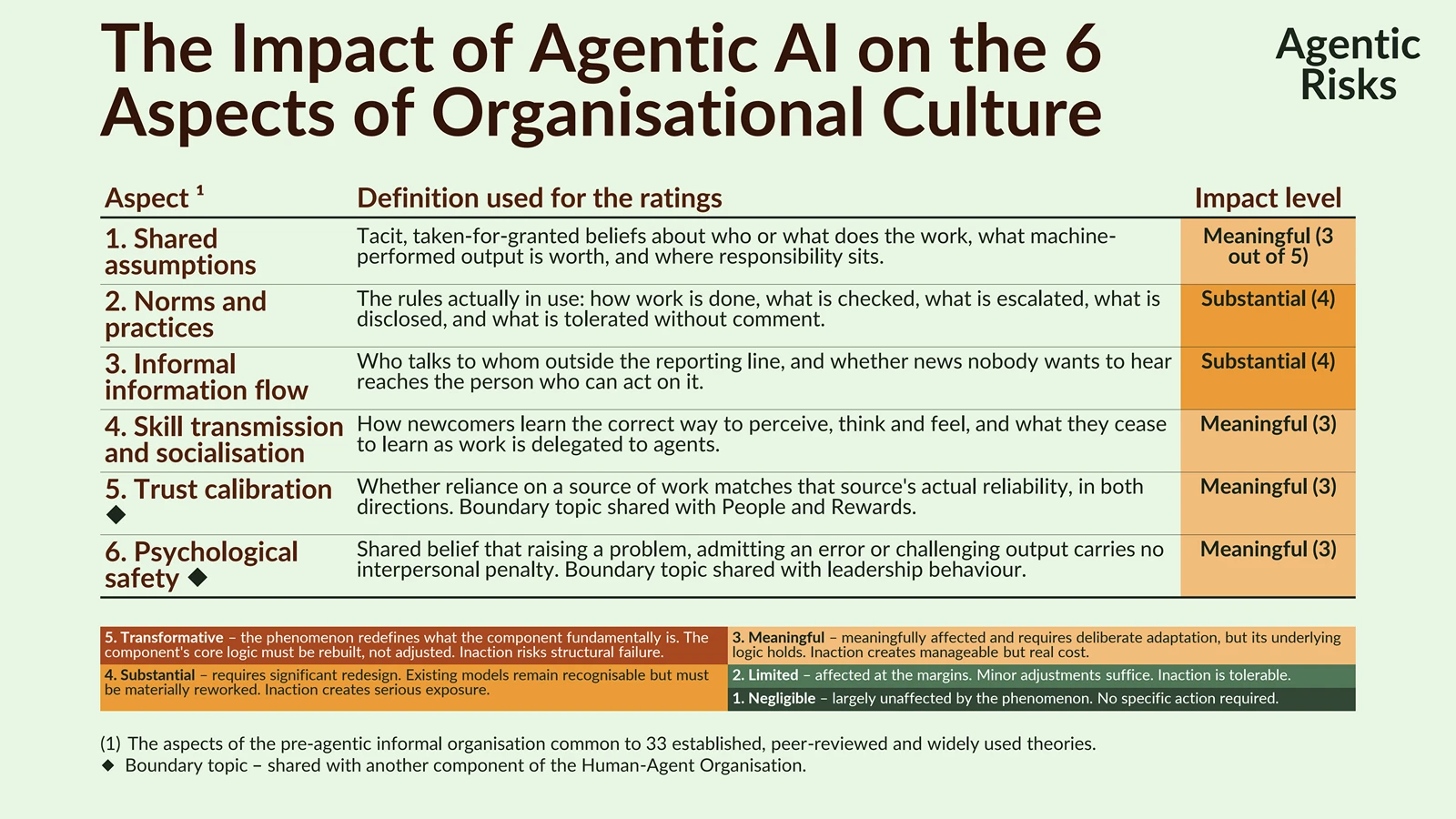
To assess the impact of agentic AI on organisational culture, we identified six aspects common to independent, widely accepted and pre-agentic theories of the informal organisation. We then assessed how agentic AI affects each.
Four sit clearly within the scope of the overall Human-Agent Organisation’s cultural component – Shared Assumptions, Norms and Practices, Informal Information Flow, and skill transmission and socialisation.
The remaining two are boundary topics – Trust Calibration and Psychological Safety – which means they overlap with other components.
Across the five-level scale used in this series, the impact of AI agents on the six topics averages 3.3, rounding to Level 3 for agentic AI and organisational culture. However, the impact on two aspects is greater than average, and both concern behaviour.
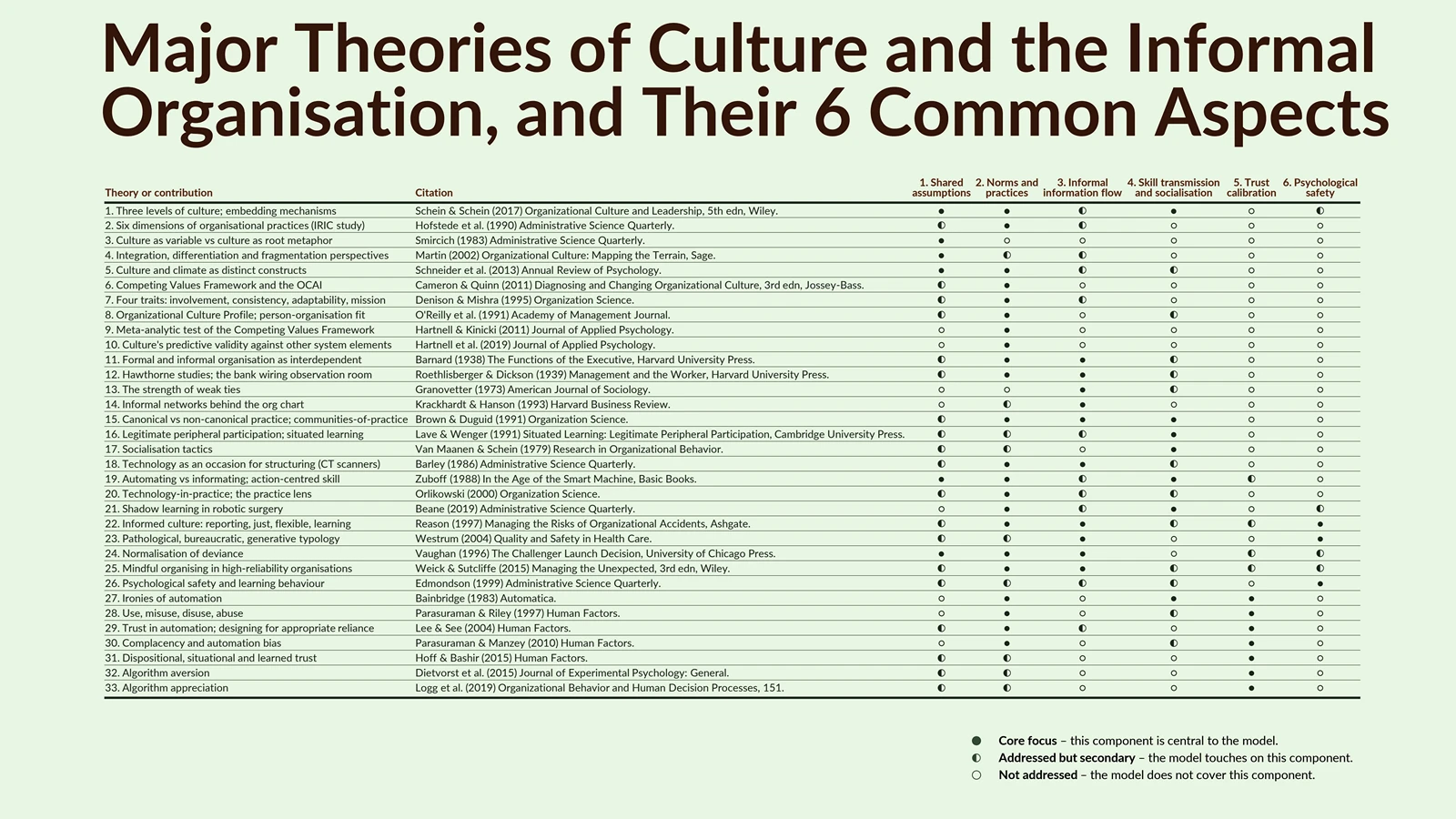
We have explained our methodology near the end, including the mapping of 33 academic works.

1. Shared Assumptions
Description of the Cultural Aspect
Shared assumptions are beliefs a group stops examining: who or what does the work, what machine-performed output is worth, and where responsibility sits when something goes wrong. They are Schein’s third and deepest level, below visible signs of culture and stated values, and they persist because they reduce uncertainty.
Smircich drew the distinction that determines what leaders can do about them: whether culture is something an organisation has and can manage, or something it is. We take the first view, believing deliberate cultural development is possible, while acknowledging that the deep layer moves at its own pace.
For executives and change leaders, separating this topic from norms and practices explains a puzzling pattern: people can follow a well-designed policy to the letter and still misapply it. Schneider and colleagues separate culture from workplace climate for the same reason: measuring perceived rewards alone can misclassify the underlying belief problem as a compliance problem.
Impact of Agentic AI – ‘Meaningful’ (Level 3 of 5) – the human-only organisation is all today’s workforce has known, exactly the condition under which assumptions run deepest. In terms of impact, the content of the culture will change while the mechanisms hold:
- People will form new assumptions about how far to trust machine output, who’s at fault when an agent makes a mistake, and whether reviewing an agent counts as real work.
- These assumptions will form regardless of management and, in turn, will be slow to revise.
- The way assumptions form will remain the same as the pre-agentic era, making the impact ‘meaningful’ rather than substantial.
Investment management example – an investment team covering several asset classes adopts a research agent. Within a year, two assumptions harden without discussion. Portfolio managers treat agent-produced credit summaries as if it was a junior analyst’s work: they limit their review to the conclusion. When an output proves wrong, their instinct is to change the agent’s instructions, while giving little attention to accountability. Both assumptions are informal; both determine what the firm’s formal oversight arrangements deliver.
Leadership Decisions and Actions
- Ask what people assume about agent output before publishing what they should assume; the first gives the second a useful target.
- Make clear who is accountable and repeat it, because the assumption that a machine can absorb blame forms easily and is slow to correct.
- Watch what leaders do under pressure. If they accept unchecked agent output at a deadline, that is the assumption the organisation will learn.
- Use a multi-year horizon to judge cultural work.
Regulatory Considerations – regulators assessing culture look for alignment between stated and actual beliefs, including through staff interviews. If people privately assume the agent decides but a firm’s documentation names a human, closing the gap requires aligning actual beliefs with documented responsibility. Where accountability rests with a named senior manager, that person should be able to show colleagues understand who decides.

2. Norms and Practices
Description of the Cultural Aspect
Norms and practices are the rules in use: how people do the work, what they check, escalate and disclose, and what passes without comment. Practices show most clearly how agentic AI changes organisational culture. Across twenty units in ten organisations, Hofstede and colleagues found that organisations differ mainly in shared practices while nations differ mainly in shared values, identifying six patterns of practice.
Brown and Duguid explored the gap between documented processes and the work that actually gets done. For people and change managers, norms and practices might change early but only appear in surveys later. The field’s measurement tools also assess this aspect, including Cameron and Quinn’s Competing Values Framework, Denison and Mishra’s four traits and the Organizational Culture Profile.
Hartnell et al (2019) placed culture’s ability to predict outcomes alongside strategy, structure, and leadership . However, Hartnell and colleagues’ 2011 study, which combined results from many other studies, yielded mixed evidence on whether a measurement framework worked as intended.
Impact of Agentic AI – ‘Substantial’ (Level 4 of 5) – agents change how people actually work. For example, a system that drafts in seconds forces the redesign of a practice in which one human drafts, a second reviews, and a third approves. Because of this, new practices emerge spontaneously:
- What constitutes a reasonable check?
- When to accept an agent’s answer?
- Whether to disclose agent involvement to a client?
- What to do when an agent and a colleague disagree?
Firms can still use existing methods to set and measure norms, but the content requires material rework wherever firms deploy agents. The impact will be ‘Substantial’ (Level 4), creating the potential for Culture’s overall impact rating of 3 to mask these near-term effects.
Legal example – a commercial firm’s contract review assumed that a junior lawyer read every clause. A review agent now classifies clauses and flags exceptions, while the documented process and quality manual still require a full review. In practice, junior lawyers read what the agent surfaces: an unwritten norm everybody follows. When someone asks whether the firm reviewed a clause, the honest answer is ambiguous. In response, the firm rewrites the standard to require checking a sample of clauses the agent did not flag, making the new practice defensible.
Leadership Decisions and Actions
- Document how functions using agents actually do the work and treat any gap from the documented process as the real standard until the firm deliberately closes it.
- Define a sufficient check for each specific application in terms that someone can perform, and another can audit. Otherwise, whoever is busiest will define it.
- Set a norm for disclosing agent involvement, internally and to clients, before a client asks.
- Give ownership to the function doing the work; ownership by the technology team can create a second documented process with weak adoption.
Regulatory Considerations – where rules require firms to follow documented procedures, divergence between documented and actual practice is itself a finding, regardless of outcomes. Expect regulators to test actual practice. For example, in audits, quality management standards require firms to respond to identified quality risks and narrowed review practices are unidentified risks. Records showing what people checked, who checked it and on what basis carry more weight than a statement that a review occurred.

3. Informal Information Flow
Description of the Cultural Aspect
In 1938, Barnard established that the informal organisation is a precondition for the formal one, while the Hawthorne studies showed that informal group norms govern output regardless of formal incentives. Separately, Granovetter explained why useful information often arrives through looser relationships outside close-knit groups, and Krackhardt and Hanson showed that the people colleagues actually turn to for advice and trust differ from formal management lines.
Westrum made this testable by classifying organisations by how they handle bad news: suppressing it (‘pathological’), processing it procedurally (‘bureaucratic’) or actively surfacing and learning from it (‘generative’). Reason reached the same point from a safety perspective, arguing that an informed culture is one where people report problems, the organisation treats them fairly, adapts when needed, and learns from experience. Both define culture through observable behaviour, letting firms produce behavioural evidence.
For change leaders, this determines whether oversight is real. For example, on paper, almost every firm has a route for raising serious concerns, but whether an inconvenient message actually receives appropriate treatment determines whether human accountability works in practice or remains only an aspiration.
Impact of Agentic AI – ‘Substantial’ (Level 4 of 5) – this is because three things change at once:
- Agent behaviour produces ambiguous signals that fall between established routes for managing incidents and giving feedback to colleagues.
- Unreported errors can spread faster and further.
- Concerns often start with junior staff who see outputs first, while the agent may have senior backing.
Vaughan’s ‘normalisation of deviance’ describes the result: repeated anomalies gradually come to seem acceptable. In the era of agentic AI, information flows may remain the same, but the content, speed, and social resistance will require rebuilding. This makes agentic AI and informal information flow a distinct leadership concern and a substantial impact.
When one agent configures another, a misconfiguration can propagate before anyone approves or rejects it. This is a governance problem rather than a technical one: you can prohibit agent replication, but wherever you allow it, the signal that something is wrong still has to reach a person, and the informal ways of signalling errors were built for human mistakes.
Audit example – a commercial firm’s contract review assumed that a junior lawyer read every clause. A review agent now classifies clauses and flags exceptions, while the documented process and quality manual still require a full review. In practice, junior lawyers read what the agent surfaces: an unwritten norm everybody follows. When someone asks whether the firm reviewed a clause, the honest answer is ambiguous. In response, the firm rewrites the standard to require checking a sample of clauses the agent did not flag, making the new practice defensible.
Leadership Decisions and Actions
- Create a named, easy-to-use route for agent behaviour queries that are concerning but do not yet qualify as incidents, explicitly welcoming partial or uncertain observations.
- Separate the agent’s sponsor from the person receiving concerns, so those best placed to see problems can, if necessary, route concerns independently of the initiative’s champion.
- Test whether queries travel by tracing a real one end to end.
- Review configurations an agent inherited from another agent on the same basis as configurations a person wrote.
- Treat zero agent-related concerns as a warning: at scale, a healthy route for raising concerns should generate observations.
Regulatory Considerations – regulators already treat willingness to raise concerns as evidence that a system of safeguards works. Firms should ensure whistleblowing and other channels for raising concerns visibly cover badly configured agents, so staff know odd machine behaviour falls within them. For human oversight in agentic AI to work, senior managers relying on staff challenge as a safeguard should be able to show that challenge happens in practice. In audit and accounting, where a lead audit partner both sponsors a tool and signs the audit opinion, the independence of the reporting route deserves particular attention.

4. Skill Transmission and Socialisation
Description of the Cultural Aspect
This aspect covers how newcomers learn the group’s ‘correct’ way to perceive, think and feel – it is the second, often implicit, clause of Schein’s definition. Van Maanen and Schein specified ways organisations help newcomers learn how things are done. Meanwhile, Lave and Wenger described legitimate peripheral participation: newcomers move from the edge of real work toward its centre, absorbing judgement and norms.
Technology research has tested what happens when a machine occupies that space. For example, Barley showed that identical CT scanners in two radiology departments triggered similar changes in how staff organised work but produced different roles, providing strong evidence that technology can drive organisational change without determining its outcome.
Orlikowski argued that ways of working emerge through repeated use, while Beane found robotic surgery restricted trainees’ participation so severely that approved learning methods failed.
We separate this from capability and skills, to which we gave a Level 5 impact rating in the People Management component, where we addressed the formal development route: what people must be capable of and how firms build it deliberately.
Here we address the informal: norms, judgement and unwritten standards that subordinates absorb while sitting near their bosses. Agentic AI will affect both, but while HR can redesign the formal development route, informal transmission depends on wider organisational practices.
Impact of Agentic AI – ‘Meaningful’ (Level 3 of 5) – socialisation itself endures: newcomers still learn through proximity, observation and correction, and the tactics still work. What changes is the raw material, because agents absorb the routine work that previously exposed juniors to seniors’ judgement. Firms can compensate deliberately, but this will require adaptation to account for agentic AI and workplace learning, making the impact ‘meaningful’.
Accounting example – a mid-sized firm developed judgement by having juniors prepare account reconciliations (checks that records match) beside a partner, learning which client explanations to accept and which to examine more closely. An agent now prepares them. Formal training and technical exams continue, while agent preparation removes the times a junior heard why a plausible answer felt wrong. The firm deliberately restores proximity by having juniors present agent-prepared work to a partner and defend their acceptances, restoring the conversation around agent-prepared work.
Leadership Decisions and Actions
- Identify what juniors learned incidentally in each function and which exposure they have lost.
- Decide which lost exposure to recreate or accept, and record the decision.
- Use existing workarounds to design the replacement, preserving proximity to experienced judgement where possible.
- Give experienced staff explicit time to transmit judgement, because the mechanism that once did so implicitly is gone.
Regulatory Considerations – training and competence rules assume people build and demonstrate competence through supervised experience. Where agents absorb that experience, firms should expect to explain both how competence now forms and how they assess it. In audit and legal practices, where professional qualification rules specify supervised work, firms should check whether it still contains what those rules assumed.

Two Boundary Topics
5. Trust Calibration
Description of the Cultural Aspect
Trust calibration means relying on a source of work in proportion to how reliable it actually is – neither too much nor too little. We treat it as a boundary topic shared with People and Rewards because reliance norms are cultural, even though the research concept is not.
Here, culture literature gives way to research on how people interact with systems. Lee and See established the principle that people should rely on systems only as much as their reliability warrants. Parasuraman and Riley distinguish correct use from over-reliance, under-use, and inappropriate use of automation. In 1983, Bainbridge highlighted the irony of operators monitoring systems they can no longer take over from. Hoff and Bashir helped explain how trust operates at different levels by distinguishing trust based on personal tendency, the situation, and experience.
Reliance moves both ways. Dietvorst and colleagues found that people abandon an algorithm faster than a human after seeing it err. In contrast, Logg and colleagues found that, in other conditions, people weigh algorithmic advice more heavily than human advice. Hence, the goal is calibration.
Impact of Agentic AI – ‘Meaningful’ (Level 3 of 5) – the calibration problem has four decades of research behind it. Deliberately, at scale, and across functions, firms must now apply practices previously reserved for highly monitored settings such as flight decks and control rooms. The theory remains intact after its contact with agentic AI, but applying it organisation-wide is new, making the impact meaningful.
Investment Management example – a credit team decides how closely to review a research agent when the team first deploys it. Eighteen months and two rounds of retraining later, its error pattern has changed, but the review norm still reflects the original deployment. The team over-checks categories where the agent is now reliable and under-checks those where retraining changed what the agent handles reliably. The mismatch comes from outdated calibration, the norm staying tied to an obsolete version of the agent.
Leadership Decisions and Actions
- In terms reviewers need, publish where each agent is reliable and weak and update this whenever the agent changes.
- Reset reliance norms on a defined cycle tied to changes to the model or its settings.
- Treat too little reliance as an equal-and-opposite problem to too much reliance.
- Measure trust in agents by the accuracy of reliance.
Regulatory Considerations – where human review is a safeguard, its effectiveness depends on evidence that reviewers’ level of trust matches the agent’s reliability. Expect regulators to ask what the firm told reviewers about the agent’s limitations and when and keep sight of the fact that a review beyond the reviewer’s realistic capacity is a weak safeguard, however complete the record.

6. Psychological Safety
Description of the Cultural Aspect
Edmondson defined psychological safety as a shared belief that people can speak up, ask questions, and admit mistakes without fear of negative consequences, and showed that it predicts learning behaviour and, through it, performance. We treat it as a boundary topic shared with people management, where we assessed its individual and managerial sides. Here we treat it as a property of the informal organisation.
Weick and Sutcliffe’s principles for staying alert to risk, particularly deferring to the most knowledgeable people regardless of rank and resisting simplification, describe how authority migrates to whoever knows most about the problem, which is what a junior needs when challenging a sponsored agent. Martin’s view that different groups can experience different cultures adds a useful corrective: safety is rarely uniform across an organisation, so an organisation-wide score may describe nobody.
In a Human-Agent Organisation, this raises issues of agentic AI and psychological safety because the interpersonal risk of challenging an agent lies with its human sponsor, usually a senior. That gives the problem a different shape from the idea’s original setting.
Impact of Agentic AI – ‘Meaningful’ (Level 3 of 5) – relationships will remain human-to-human, and the concept of psychological safety will still apply. What changes? Silence about an agent lets errors spread faster and further than silence about a colleague, while the implicit challenge targets the sponsor. Therefore, firms must measure and act on psychological safety differently. The underlying logic holds, which is what makes the impact ‘meaningful’ rather than substantial.
Legal example – a litigation team uses a document review agent championed by the head of the legal practice. A paralegal thinks its judgements about which documents are relevant are too narrow. However, the paralegal says nothing because challenging the agent means challenging the partner who introduced it in front of a team whose leaders have just said it is working. The firm responds by making challenging an agent’s output a role expectation.
Leadership Decisions and Actions
- Make challenging agent output a stated role expectation, a routine practice, and its absence a deviation.
- Measure psychological safety at the team level, where teams use agents and treat weak results as a risk finding with a named owner.
- Have sponsors publicly invite challenge to their initiative and act visibly on the first challenge.
- Check safety separately if the agent’s sponsor sits in the management chain.
Regulatory Considerations – regulators examining culture treat willingness to challenge as evidence that safeguards work. Silence about agent errors exposes the firm to cultural scrutiny that is harder to address. As a result, firms relying on human challenge as a stated safeguard should show instances of challenge occurring in practice.

Agentic AI and Organisational Culture – Services
In conclusion, culture in the Human-Agent Organisation stays human, and the component needs deliberate work rather than redefinition. What the six aspects add is where to start.
Practices and informal information flow receive the earliest and hardest impacts, while the effect on shared assumptions takes longer to surface. As a result, a firm that treats culture only as a slow problem will meet the fast half of it unprepared.
If the four dimensions above describe work that still lies ahead for you, these three services are where firms usually begin:
- The smallest step establishes who is answerable for what. Our Agentic Workflow Accountability Mapping audits one or two workflows at the task level: the tasks a deployment creates as well as removes, the human accountable for each non-human worker, and a Span of Agency for each agent. It identifies the role descriptions and statements of responsibility that need updating to match the work.
- If your agents are live, the next question is whether the human supervisors can cope. Our Agent Oversight Capacity Measurement measures agent-to-agent handoffs per supervisor, review quality, and the shift in work mix once agents absorb the routine tasks that once provided recovery in the day. You finish with defensible and stress-tested review limits.
- Further out, and requiring a larger commitment, agents absorb the routine work that formed the apprenticeships through which junior staff build judgement. Our Agent Supervisor Development Programme counteracts that by adding agent-supervision skills to your skills framework as a distinct skill set, and building the new management layer whose members mainly supervise non-human workers.
Methodology
The definition – we base our impact assessment of agentic AI and organisational culture on Schein’s 1985 definition, anchoring our analysis in an independent measure written before AI agents existed.
Why the impact assessment looked beyond culture literature – in the inaugural article, we committed to three interventions: trust calibration, norms for relying on and checking agents, and psychological safety to challenge agent output.
Organisational culture research covers psychological safety; research on how people interact with systems covers trust calibration and norms for relying on and checking machines.
We therefore looked at 33 works spanning 1938 to 2019 across six fields of study:
- What culture is and how researchers define it.
- Culture measurement.
- The informal organisation.
- Technology and the informal organisation.
- Risk, safety and speaking up.
- Trust, reliance and automation.
Selection – we applied three tests. A theory had to define or measure the component; draw support from independent evidence or be the original source of an idea still in use; and each group of related theories had to span multiple decades.
To tighten our assessment, we also aimed to include the strongest counterarguments. For example, Orlikowski’s work argues that organisational structures emerge through use, or Martin’s views of cultural differences and ambiguity hold that organisations rarely carry one culture.
How 33 works became six aspects – we started by categorising each work’s central concern, then kept the topics that emerged independently across separate fields of research:
- Four became core aspects: shared assumptions; norms and practices; informal information flow; and skill transmission and socialisation.
- Two recurred but belong elsewhere, so we treated them as boundary topics: trust calibration, shared with People and Rewards, and psychological safety, shared with leadership behaviour.
What the mapping showed – 22 of 33 works treat norms and practices as a core concern; six treat shared assumptions that way. The research base centres on what people do, matching Hofstede and colleagues’ finding that organisations differ mainly in shared practices. This affected our rating directly: a Level 3 impact for assumptions, where change is slow, and Level 4 ratings for practices and information flows. This means a firm deploying agents this year will experience Level 4 impacts first, because practices will change faster than assumptions.
Impact assessment and comparison with the original rating – we assessed each topic against the series’ five-level scale, with the six aspects yielding two Level 4s and four Level 3s, averaging 3.3 and rounding to the Level 3 we published in the inaugural article.
The five levels are:
5. Transformative – the phenomenon redefines what the component fundamentally is. The component’s core logic must be rebuilt, not adjusted. Inaction risks structural failure.
4. Substantial – requires significant redesign. Existing models remain recognisable but must be materially reworked. Inaction creates serious exposure.
3. Meaningful – meaningfully affected and requires deliberate adaptation, but its underlying logic holds. Inaction creates manageable but real cost.
2. Limited – affected at the margins. Minor adjustments suffice. Inaction is tolerable.
1. Negligible – largely unaffected by the phenomenon. No specific action required.
Limits
Because we derived topics from recurring themes, our method partly builds in recurrence.
The set draws from mainstream theories developed mainly in the UK and US.
These theories pre-date workforces combining human and non-human workers. We offer the six aspects as a structure for testing that case.
Skill transmission and socialisation is our least certain rating. Beane’s evidence points toward Level 4, but we rated it Level 3 partly to avoid counting the same effect twice, given the Level 5 rating for developing people’s capabilities in the people management article.
Sources – we cite each work to its primary published source: We confirmed 15 citations against the publisher, digital object identifier (DOI) or journal page. We reconstructed nine identifiers; for nine books or articles, we found no DOI and have not yet verified the publisher and International Standard Book Number (ISBN) details.

Two Hypotheses for Where the Theory Is Thin
Mapping the six aspects against the theory produced the same pattern as our people management work. The two boundary topics are those least supported by culture literature: psychological safety is a core concern of three of 33 works and trust calibration of seven, versus 22 for norms and practices.
Both are topics on which we recommend leaders act, so we set out two hypotheses and how to test them. We will develop both hypotheses as our work progresses and encourage firms to test them against their own deployment experience.
The Verification Decay Hypothesis
We hypothesise that human verification of agent output decays as agent reliability rises, and that it decays as a team norm rather than as an individual lapse.
As an agent becomes dependable, the likely value of each check falls; checking may become socially costly if it is perceived as distrust of a working system; and people shift from examining the output to simply endorsing it, even as records imply continued oversight.
Parasuraman and Manzey established complacency and automation bias – the tendency to over-rely on automated output – at the individual level, with reduced attention as the underlying process.
We hypothesise that the same effect operates through team norms, making it faster, harder to detect and unresponsive to individual training. If so, verification quality will fall while records remain complete, and the decline will be more closely linked to ‘time since deployment’ than to reviewer experience.
Testing requires three things:
- A measure of how thoroughly people verify the output that does not rely on the verification records themselves, such as inserting errors of known difficulty and testing whether reviewers detect them.
- Repeated measurement over time, rather than a single measurement at go-live.
- Comparison across teams at different points after deployment, so differences in the firm’s overall culture are less likely to distort the comparison.

The Sponsor Deference Hypothesis
We hypothesise that the seniority of the agent’s sponsor influences willingness to challenge the agent’s output and can move in the opposite direction from team psychological safety.
Psychological safety research originally addressed interpersonal risk among people who work together. The interpersonal risk of challenging an agent runs to whoever introduced it, which may be a senior person outside the team and invested in the deployment’s success. In such a scenario, a team could score well on established psychological safety measures yet fail to report agent problems, making the standard measure unreliable for the safeguard firms rely on.
Testing requires adapting existing psychological safety measures to name the specific person or system that staff are challenging; distinguishing between safety to challenge a colleague and safety to challenge a system; and comparing how often people report concerns when the agent sponsor sits inside versus outside the team’s management chain. We would expect this difference to exceed the difference in general safety scores between the same teams.
Frequently Asked Questions
In our analysis of the Human-Agent Organisation, culture remains human. People accumulate shared experience, pass norms to newcomers and attach emotional stakes to assumptions. In comparison, agents are objects around which people form new assumptions, practices and expectations.
It changes everyday work first. Teams develop new unwritten rules about checking agent output, disclosing agent involvement, allocating responsibility and escalating unusual behaviour, often before formal policies catch up.
Trust calibration means matching reliance on an agent to its actual reliability: neither over-relying on it nor redoing work it can perform reliably. Firms should tell reviewers where each agent is strong and weak, update that guidance when the agent changes, and test whether review behaviour remains appropriately calibrated.
The interpersonal risk usually comes from challenging the senior person who sponsored the agent, not from challenging the machine itself. Firms should make challenge a role expectation, measure psychological safety at the team level, and provide routes for concerns that don’t depend on the agent sponsor.
Agents often absorb routine work that junior staff previously used to gain experience and judgement. Organisations may therefore need to recreate or simulate that exposure, preserve proximity to experienced colleagues, and give senior staff explicit time to explain the rationales behind their decisions.
Leaders should make human accountability explicit, define what sufficient review means for each application, create easy routes for reporting unusual agent behaviour and, where necessary, keep those routes independent of the agent sponsor. They should also reset reliance norms when agents change. Managing agentic AI and organisational culture therefore requires leaders to align behaviour, accountability, learning and trust as the technology evolves.