Table of Contents
Executive Summary
Agentic AI changes how much information an organisation can handle, so operating model processes should change too, or the extra capacity will be wasted. Faster, more autonomous processing without matching oversight also creates new risks, making agentic ‘Workflows’ one of the most disrupted components of the emerging Human-Agent Operating Model.
Reusable agentic AI ‘capabilities’ will become the base unit of governance for building, combining, and governing efficiently. This will require a shift in governance from policy statements to coded enforcement, from one-off projects to ongoing capabilities, and from separate human and AI tracks to a unified model.
This article examines the Human-Agent Operating Model end-to-end and sets out leadership actions and regulatory considerations at every step.
If navigating this transformation still lies ahead for you, we offer a range of services to help you proceed with confidence. Skip to this section.

Introduction to The Human-Agent Operating Model
- How we define Processes and justify our impact assessment.
- The 7 building blocks of a Human-Agent Operating Model.
- Key decisions leaders should take.
- Any additional considerations for regulated firms, as we expect supervisors to assess not just individual agent deployments but whether an overall operating model has been adapted for agentic AI.

Agentic AI Will Have a Transformative Impact On The Processes That Comprise Operating Models
To define ‘processes’, we turned to Jay Galbraith, who, in his 1973 Star Model, characterised them as mechanisms through which information flows across an organisation to coordinate work.
Famously, he noted that if an organisation’s structure represents its anatomy, then its processes represent its physiology or functioning. In contemporary business language, we would say that processes combine into business operating models.
Galbraith’s position is that organisations design processes to match their information-processing demand:
- With agents bringing vast new information-processing capacity, the Human-Agent Organisation’s demand for data will differ in both volume and shape.
- According to Galbraith’s logic, if agents add information-processing capacity, the coordination design (Processes) must change to exploit it, otherwise the organisation would incur the cost of agents without benefit.
But the same logic warns that faster processing by a new autonomous entity without matching control creates new coordination risks (e.g. agent-to-agent handoffs, error propagation, loss of human visibility). Observability and reversibility controls enable a firm to capture the coordination upside while preserving the human accountability that defines a Human-Agent Organisation.
As a result, we expect responsible users will reengineer processes around their new combined human-agent workforce to create reusable agentic workflows. This reengineering and the management of new processing risks will see the core logic of information processing undergo a transformative adjustment.
The Evolution of the Human-Agent Operating Model
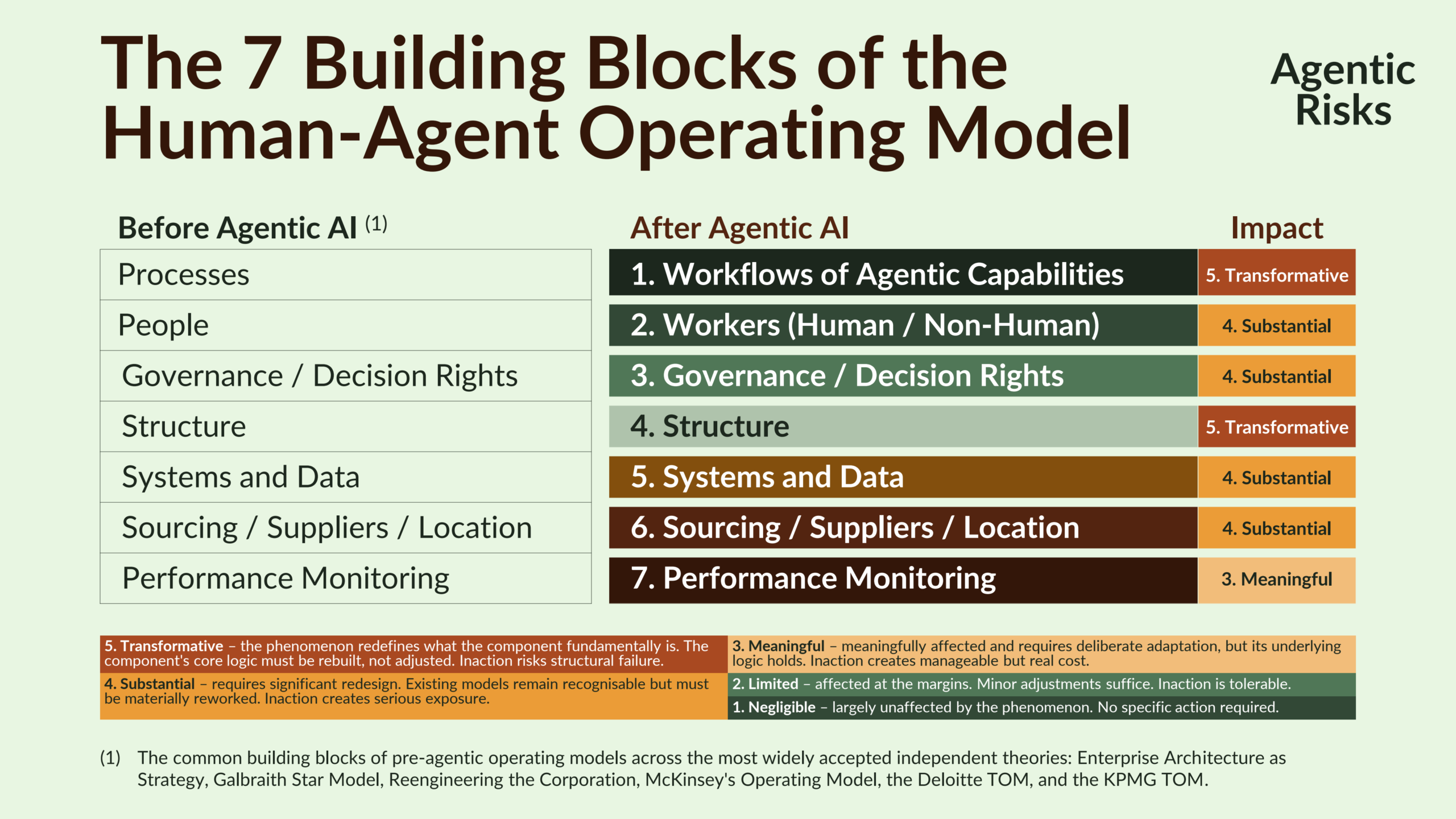
To create a window into the Human-Agent Operating Model, we identified the common operating model building blocks across the most widely accepted independent theories of pre‑agentic models and assessed the impact agentic AI will have on them. Click here for our Methodology, which is at the end.
In brief, the results indicate that the nature and scalability of agent workflows will have a transformative impact, making the Human-Agent Operating Model worthy of executive and board attention.
The 7 Building Blocks of a Human-Agent Operating Model
1. Workflows of Agentic Capabilities
Description of the Building Block
As medium- to high-risk work shifts from a human following a procedure to an agent executing an end-to-end workflow across multiple systems, process maps become machine-readable instructions of boundaries of discretion, scenarios, and dos and don’ts; and controls become encoded and machine enforceable.
Scaling efficiently will require the development of reusable, pre-validated, and governed agentic ‘capabilities’ that you can combine in different ways to achieve new use cases.
These capabilities are the actions the agent will take – basic things like retrieving information, performing a calculation, updating a log, etc, with scalability coming from defining and validating capabilities once and reusing them in different combinations to create new workflows.
Defining the capability set is also a structural act. It settles how work is divided before anyone decides who performs it, and organisations tend, over time, to reorganise themselves around the architecture of the work they have built. We return to this in the Structure component.
Impact of Agentic AI – the core function of information processing will undergo not just adjustment but will be fundamentally ‘transformed’ as agentic capabilities become the base unit of governance for scaling the Human-Agent Operating Model.
Example – an asset manager builds and validates an “extract-and-flag-anomaly” capability once, then reuses it across KYC onboarding, transaction monitoring, and quarterly client reviews. A control embedded in that one capability (mandatory human review above a risk threshold) now governs all three workflows simultaneously, and a single capability update propagates everywhere it’s reused.
Leadership Decisions and Actions
- Identify processes at the ‘sweet spot’ for agentic AI where data-related action across multiple systems requires codable judgement.
- Break down the processes into their base agentic capabilities that you can build, validate, and monitor.
- Record them in an Agentic Capability Catalogue from which you can reuse capabilities in different configurations to scale new and re-imagined agentic workflows.
Regulatory Considerations – existing model risk expectations (e.g. UK SS1/23) provide precedent for treating non-deterministic systems differently – expect early supervisory focus here.

2. Workers (Human and Non-Human)
Description of the Building Block
Having broken work down into agentic capabilities, the next question is who performs them. The most visible change agentic AI will bring to an operating model is the introduction of a second class of general-purpose worker – the non-human agent – that can be given a wide range of tasks, can be instantiated and retired in seconds, and (in the Human-Agent Organisation) remains accountable to a human.
As a result, a ‘Worker’ category comprising humans and non-humans replaces the ‘People’ category common to pre-agentic operating model theories. The Human-Agent Organisation cements humans’ special status through its component on People Management for Agentic AI, which emphasises the importance of humans staying in charge.
Impact of Agentic AI – the impact is substantial rather than transformative because the organisation still needs an entity, human or otherwise, to perform labour, but executives can now choose whether to assign work to a human or a non-human worker.
Example – an investment research function reassigns first-draft equity research from junior analysts to research agents during a hiring freeze. It then scales the agent fleet up for a thematic research push and back down once it’s complete – work that an equivalent headcount change would have taken a quarter to action, with human analysts retained for review, enrichment, and approval throughout.
Leadership Decisions and Actions
- Recognise the profound impact autonomous workers will have on your staff, view your agentic transformation as an organisational change (not a tech upgrade), and engage your HR team early.
- Redesign career and competency frameworks around the Human Worker / People distinction, since developing judgement and accountability is now a deliberately separate exercise from managing an agent’s output.
- Formally adopt Worker as the operating-model vocabulary for ‘who or what performs labour,’ and reserve People for the human subset. This isn’t just terminology: it facilitates the Human-Agent Organisation’s central tenet that humans stay in charge.
- Define every Non-Human Worker’s Span of Agency explicitly and tie it to a named accountable Human Worker, so ‘non-human worker’ never becomes a residual, undefined, or ill-governed category.
- When integrating agents into workflows, consider evidence that users prioritise human involvement and control, as well as agent reliability, safety, transparency, and accountability over increasing levels of automation. This implies that to retain motivated human workers you may need to balance what you could automate against what you should automate.
Regulatory Considerations
The international financial sector’s regulatory frameworks are built around People (accountable individuals), e.g. the UK’s SMCR (Senior Managers and Certification Regime) and Training and Competence regulations. As a result, regulated firms should map which human workers hold accountability for which non-human workers’ span of agency, since supervisors will look for exactly this mapping when assessing whether ‘reasonable steps’ were taken.
In some contexts, ‘worker’ can have connotations of employment status, e.g. labour rights, collective bargaining, and protections. This is not the case here: non-human workers will not receive these rights. Conversely, the term ‘human worker’ means a performer of labour only, with no implication about standing.

3. Governance / Decision Rights
Description of the Building Block – decision rights now split into two: who has authority to decide, and separately, the boundary of an agent’s delegated discretion to act without seeking new authorisation each time. Structure determines where a decision right sits; governance determines how that right is exercised, evidenced and enforced at runtime. Span of Agency therefore appears in both, and we should define it structurally before enforcing it procedurally. Simultaneously, governance needs to achieve three shifts before it is ready for agentic AI:
- Enforcement – from descriptive AI governance (e.g. “We have a policy that prohibits X”) to operational (runtime) AI governance, (e.g. “The system cannot do X because of control Y.”)
- Continuity – from a project with an end state to a permanent, ongoing, and evolving organisational capability built into your operating model.
- Scope – from parallel governance for humans vs AI to unified human-agent governance for ‘combined operations’ that comprise human and non-human workers.
Impact of Agentic AI – traditional governance assumes decision rights map to accountable individuals who can be questioned and held liable. An agent has no liability capacity and, therefore, must report to a responsible human. In the Human-Agent Organisation, the model of human accountability holds, but the volume, granularity, and continuous-maintenance burden of delegating to AI agents will have a substantial impact.
Example – an investment portfolio rebalancing agent proposes or executes hundreds of trades per day within pre-set risk / sector limits. Governance must specify which parameters allow autonomous action versus requiring sign-off, which named human(s) have the capacity to approve expected volumes, and who is accountable if the parameters themselves were badly set.
Leadership Decisions and Actions
- Define a formal taxonomy of delegated agentic discretion (span of agency) per agent.
- Decide function by function where escalation-before-action vs monitoring-after-action applies.
- Assign named accountability for boundary design, separate from in-bounds outcomes.
Regulatory Considerations – SMCR accountability for agent boundary design is untested territory – firms should expect supervisors to probe exactly which senior manager owns it.

4. Structure
Description of the Building Block – we cover this topic in full in the higher-level Structure component, but there is an important linkage between processes and structure that we cover here.
In essence, structure exists to divide and organise an organisation’s core activities, so a change to how work gets done has a direct effect on structural design. Chandler (1962) established that structure follows from what the organisation is trying to achieve, and Mintzberg (1979) refined the point, arguing that structure must fit the work, the environment and the other design choices as a set rather than follow any single driver.
As the new class of non-human workers disrupts the division of labour, new roles will emerge, and org charts and role descriptions will no longer be maps of people alone but must also account for agents and the humans who command them.
Spans of control, reporting lines, oversight capacity ratios, and the location of authority may all come under review when building the combined human-agent workforce.
Impact of Agentic AI – the requirement to divide labour survives, but the unit among which we divide it changes: for the first time, a position in the structure can be held by a non-human worker. Because that changes structure’s founding assumption rather than its content, the component should be rebuilt and not adjusted, which is a transformative impact. We treat Structure in full as a component of the Human-Agent Organisation.
Example – a research function redeploys a group of junior analysts who previously gathered data and drafted first-cut commentary into a new “agent oversight and escalation” role, with its own reporting line into the Head of Research. Each analyst now has direct authority to pause or redirect the agents they supervise, and a standing mandate to propose refinements to agent outputs and investment ideas. This is a layer and a level of authority that didn’t exist in the team’s structure before, and one that lets analysts whose judgement and communication skills outweigh their raw modelling speed demonstrate their skills.
Leadership Decisions and Actions
- Audit roles at the task level (not role level) for agentic-absorption candidates.
- Redefine span-of-control assumptions for managers overseeing mixed human / agent output.
- Explicitly decide whether agent ownership lies with the deploying function or a centre of excellence.
Regulatory Considerations – SS1/23’s model risk governance expectations, the Operational Resilience regime’s mapping of important business services, and SMCR’s conduct accountability lines will each claim partial jurisdiction over agent deployment, with no committee currently mandated to hold all three; expect this gap to surface as a new standing item or sub-committee (e.g. an Agentic AI Approval Body).

5. Systems and Data
Description of the Building Block
Agentic AI is itself a new category of system that doesn’t map onto existing IT architecture categories. This is because it can call other systems autonomously, appreciate in value as it gains experience, as well as drift in behaviour without a code change.
The data agents rely on should also be fit for autonomous consumption because agents do not just read data; they act on it, and small defects compound at every step.
Impact of Agentic AI – MIT CISR’s framework still holds (systems support processes, governed by standardisation / integration choices), but the new properties of agentic AI systems that existing change management processes were not built to capture, creating a substantial impact.
Example – an agent-augmented client reporting system may produce materially different outputs over time as the underlying model updates incrementally or accumulates context, with no visible code deployment for IT change management to track.
Leadership Decisions and Actions
- Create a distinct technology inventory category for agentic systems with its own risk process and new cybersecurity threats and controls.
- Ensure data for autonomous consumption is SCARVeS© – Structured, Current, Authoritative, Rich, Verifiable, and Symmetrical.
- Define what ‘testing’ means pre-go-live for probabilistic systems, ensuring higher-risk agentic workflows undergo pre-deployment red teaming.
- Upgrade your incident management for agentic AI.
- Invest in production-stage behaviour monitoring, not just deployment-stage testing.
Regulatory Considerations – operational resilience regimes (e.g. UK Operational Resilience, DORA) require severe-but-plausible disruption testing – this should explicitly include silent behavioural drift, which most current testing does not cover.

6. Sourcing / Suppliers / Location
Description of the Building Block
A new sourcing category emerges (third-party agents and agent platforms) between traditional outsourcing and software licensing, where the vendor’s underlying model can change behaviour without the buyer’s sign-off.
Location strategies may come under review as there may be potential to delegate lower-context tasks to agents, bringing organisations additional speed and cost benefits.
The jurisdictional location (or diversity of locations) of your chosen LLM(s) will also be a new feature of the Human-Agent Operating Model.
Impact of Agentic AI – current sourcing treatment assumes either a human-delivered service or a static technology platform. An agent is neither, since its behaviour is partly governed by a foundation model that the buyer doesn’t control. However, organisations will still make strategic choices about location and delegate tasks to external parties who will still deliver a service, so the change is substantial but not transformative.
Example – a mid-sized insurer’s agentic claims-triage tool drifts in behaviour when the vendor’s underlying foundation model is updated, without either party flagging it as a release – existing third-party risk frameworks built around discrete software versions miss this.
Leadership Decisions and Actions
- Extend vendor due diligence to ask how model changes are communicated.
- Contractually allocate liability for harm from unannounced model updates vs buyer misconfiguration.
- Build behavioural equivalence testing into exit planning, not just data portability.
Regulatory Considerations – outsourcing rules (e.g. EBA / PRA, DORA) may classify third-party agentic capability as material outsourcing; ensure your outsourcing register addresses this.

7. Performance Monitoring
Description of the Building Block – retrospective monitoring’s purpose and mechanism survive, but agentic variability calls for key changes:
- A shift from the classification of good or bad transactions, days, or months to the identification of incremental changes that could widen problematically.
- The installation of near-real-time automated monitoring, with associated pause / kill switches.
- Agentic KRIs that reside in the layer where their risk signal lives, that is, in the model, orchestration, or an application in your environment.
Impact of Agentic AI – performance monitoring was always meant to catch what controls miss, with a delay. Agentic execution increases the volume, speed and variety of things that can go wrong in ways current KPIs and spot-checking may not surface, requiring meaningful change. It is complicated by the fact that each layer can see risk signals that the others cannot:
- Some indicators require data from a single layer, while others cannot function without data from multiple layers.
- As a result, effective agentic AI risk management requires a deliberate, multi-layer monitoring capability that also accounts for handoffs between layers.
- Monitoring built on functional layers is therefore less likely to have coverage gaps than a framework tied to a single platform.
- However, not every platform offers a multi-layer monitoring capability, making this a platform selection decision in the design phase of an agentic workflow.
Example – a retail bank’s agent-handled customer service has a low average error rate, yet it nonetheless includes infrequent, harmful interactions that monthly sampling is statistically unlikely to catch.
Leadership Decisions and Actions
- Move from periodic sampling to continuous runtime monitoring for tail-risk detection on agent-touched processes.
- Define leading indicators (override rate, escalation rate) alongside lagging outcome metrics.
- Assign clear ownership (risk, ops, or new function) for agent performance management.
Regulatory Considerations – the UK’s Consumer Duty’s focus on outcomes for small numbers of affected customers, not just aggregates, gives firms an existing regulatory mandate to justify the granular monitoring agentic processes require.

Human-Agent Operating Model Services
If navigating this transformation still lies ahead for you, we offer a range of services to help you proceed with confidence.
If you expect organisational change from agentic AI but want to know where to start, our Agentic AI Transformation Workshop will help your colleagues and you define the direction and develop the right plan.
If you understand agentic risk but want to know which controls to implement, our Agentic AI Controls Design Workshop and proprietary ‘Statement of Applicability’ methodology will help you design the controls that keep humans in charge.
If you want to know your current state of readiness so a roadmap based on it will be achievable, our Agentic AI Readiness Assessment will give you a complete view of your firm’s strengths, weaknesses, and prioritised next steps.
Methodology
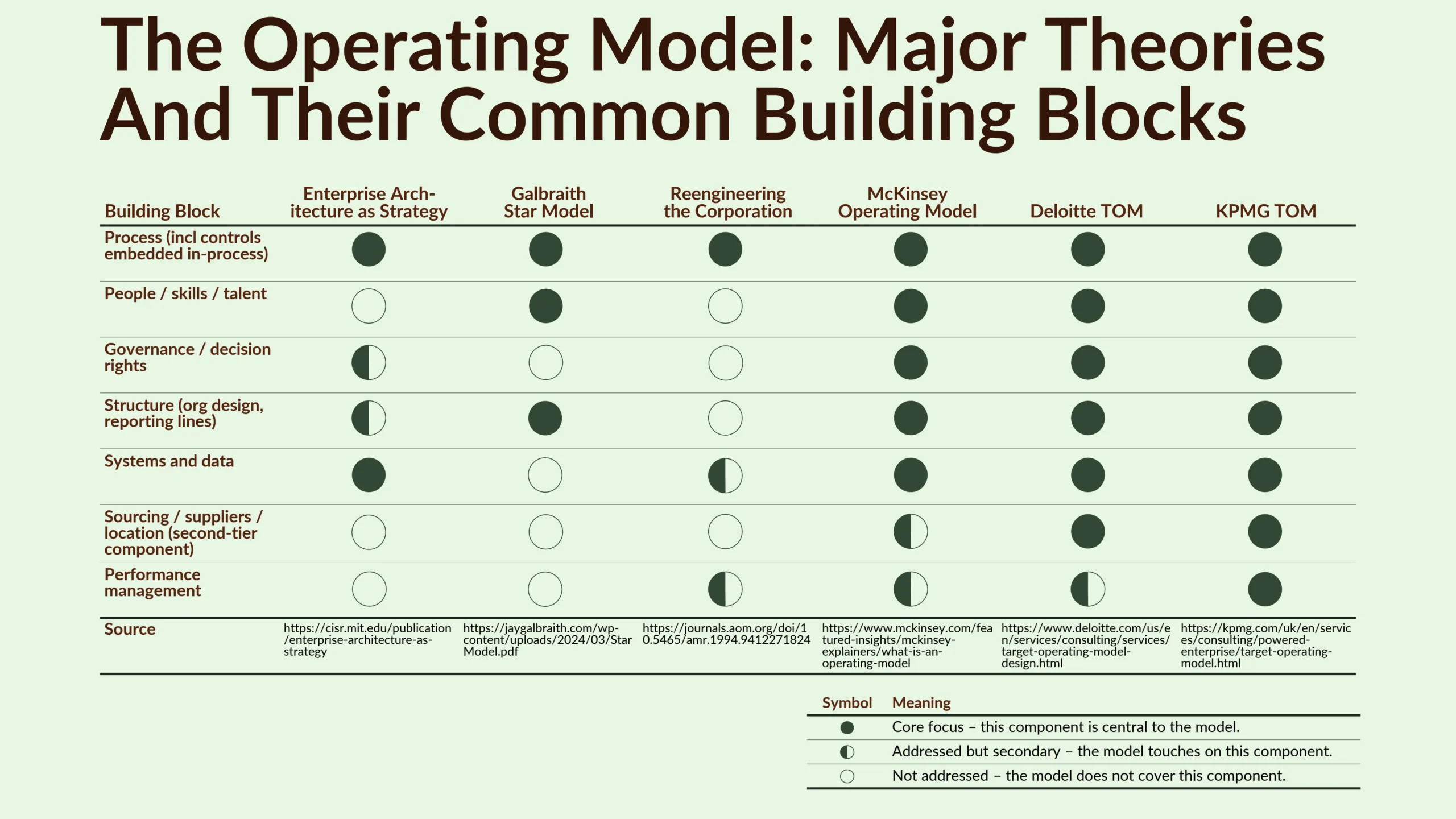
To create a window into the Human-Agent Operating Model, we identified the common operating model building blocks across the most widely accepted independent theories of pre-agentic operating models and assessed the impact agentic AI will have on them.
Using five pre-defined levels of impact, we then assessed the impact the Human-Agent Organisation will have on each building block to indicate the impact agentic AI will have on the modern digital operating model:
- Negligible – largely unaffected by the phenomenon. No specific action required.
- Limited – affected at the margins. Minor adjustments suffice. Inaction is tolerable.
- Meaningful – meaningfully affected and requires deliberate adaptation, but its underlying logic holds. Inaction creates manageable but real cost.
- Substantial – requires significant redesign. Existing models remain recognisable but must be materially reworked. Inaction creates serious exposure.
- Transformative – the Human-Agent Organisation phenomenon redefines what the component fundamentally is. The component’s core logic must be rebuilt, not adjusted. Inaction risks structural failure.
This gave us a picture of where the modern digital operating model will feel the effect of agentic AI, and to what extent. In general, the impact of agentic AI on an organisation’s Processes will be high, but the specifics will differ from firm to firm, so our aim is to explore all changes in equal depth.
Frequently Asked Questions
A Human-Agent Operating Model is an operating model designed for organisations where human workers and autonomous AI agents work together under a single governance, process, and accountability framework. Rather than treating AI as a separate technology initiative, a Human-Agent Operating Model integrates agentic workflows, human decision-making, governance, systems, organisational structure, suppliers, and performance monitoring into one coordinated model.
As organisations deploy more agentic AI, they should redesign how work is coordinated, governed, and monitored so they can exploit greater information-processing capacity while maintaining human accountability. The Human-Agent Operating Model provides that blueprint.
Organisations need a Human-Agent Operating Model because agentic AI changes both the amount of information an organisation can process and the speed at which decisions can be executed. Without redesigning the operating model, much of that additional capability could be wasted.
At the same time, faster and more autonomous execution introduces new coordination risks, including agent-to-agent handoffs, error propagation, behavioural drift, and reduced human visibility. A Human-Agent Operating Model enables organisations to capture the productivity benefits of agentic workflows while preserving governance, oversight, and accountability.
Traditional operating models assume that work is performed by people following defined business processes. A Human-Agent Operating Model assumes work is shared between human workers and autonomous AI agents.
Instead of designing processes solely around people, organisations design agentic workflows built from reusable agentic capabilities. Governance also changes from written policy statements to coded controls that agents must follow automatically. Human accountability remains, but organisations gain a scalable operating model that combines human judgement with autonomous execution.
No. An AI operating model describes how an organisation manages AI more generally, which may include analytics, predictive models, generative AI, or machine learning.
A Human-Agent Operating Model is specifically designed for organisations deploying agentic AI. Its focus is coordinating human workers and autonomous AI agents through shared governance, reusable agentic capabilities, clear decision rights, and continuous runtime monitoring. It is therefore a specialised operating model for the emerging Human-Agent Organisation.
The article identifies seven building blocks of a Human-Agent Operating Model:
- Workflows of agentic capabilities
- Workers (Human and Non-Human)
- Governance and decision rights
- Structure
- Systems and data
- Sourcing, suppliers and location
- Performance monitoring
Together these building blocks describe how organisations should redesign their operating model to support a combined human-agent workforce while maintaining governance and accountability.
Traditional operating models assume everyone performing work is a person, so “People” becomes shorthand for the workforce. A Human-Agent Operating Model cannot make that assumption. It introduces Workers as the category for anything that performs labour – human or non-human – while reserving People exclusively for humans, preserving all of our dignity. This is more than a change in terminology. It reinforces the Human-Agent Organisation’s central principle that humans remain accountable, retain decision-making authority, and stay in charge even as autonomous AI agents become part of the workforce.
The first major change is usually the redesign of business processes into agentic workflows.
Instead of viewing a workflow as a sequence of human tasks, organisations decompose work into reusable agentic capabilities such as retrieving information, performing calculations, updating records, or escalating exceptions. These validated capabilities can then be combined in different ways to build new use cases efficiently while maintaining consistent governance.
An agentic capability is a reusable unit of work performed by an AI agent. Examples include retrieving information, updating a system, performing a calculation, or applying a business rule.
Rather than validating every new use case independently, organisations validate individual agentic capabilities once and then reuse them across multiple agentic workflows and use cases. This makes the capability the fundamental unit of governance, allowing controls, testing, monitoring, and evidence requirements to scale much more efficiently. So, don’t stop at, “what are our agentic use cases?” Go further by exploring, “what are the underlying agentic capabilities we need to build and in what order to implement our use cases?”
An Agentic Capability Catalogue records validated agentic capabilities that can be reused across multiple workflows and business use cases.
Instead of rebuilding governance for every deployment, organisations select pre-validated capabilities from the catalogue and combine them into new agentic workflows. This improves consistency, accelerates deployment, reduces duplicated validation effort, and supports a scalable Human-Agent Operating Model.
Governance changes in three important ways.
First, governance moves from written policies to coded controls that agents enforce automatically during runtime. Second, governance becomes a permanent organisational capability rather than a one-off implementation project. Third, governance shifts from managing humans and AI separately to governing combined human-agent operations under one framework.
This allows organisations deploying agentic AI to maintain human accountability while managing increasing levels of autonomous decision-making.
Before deploying agentic AI, executives should identify the processes best suited to autonomous execution, define reusable agentic capabilities, determine which decisions remain with humans, assign accountability for every AI agent, establish governance and monitoring arrangements, and prepare the organisation for changes to roles, structures, and operating models.
Treating deployment as an organisational transformation rather than simply a technology project provides a stronger foundation for a successful Human-Agent Operating Model.