Table of Contents
Executive Summary
AI agent supervisor development becomes a material workforce issue when AI agents take on judgement-intensive work, gain meaningful autonomy, and operate where mistakes matter while people remain accountable.
The need rises further when agents absorb the work through which junior professionals once built experience and judgement.
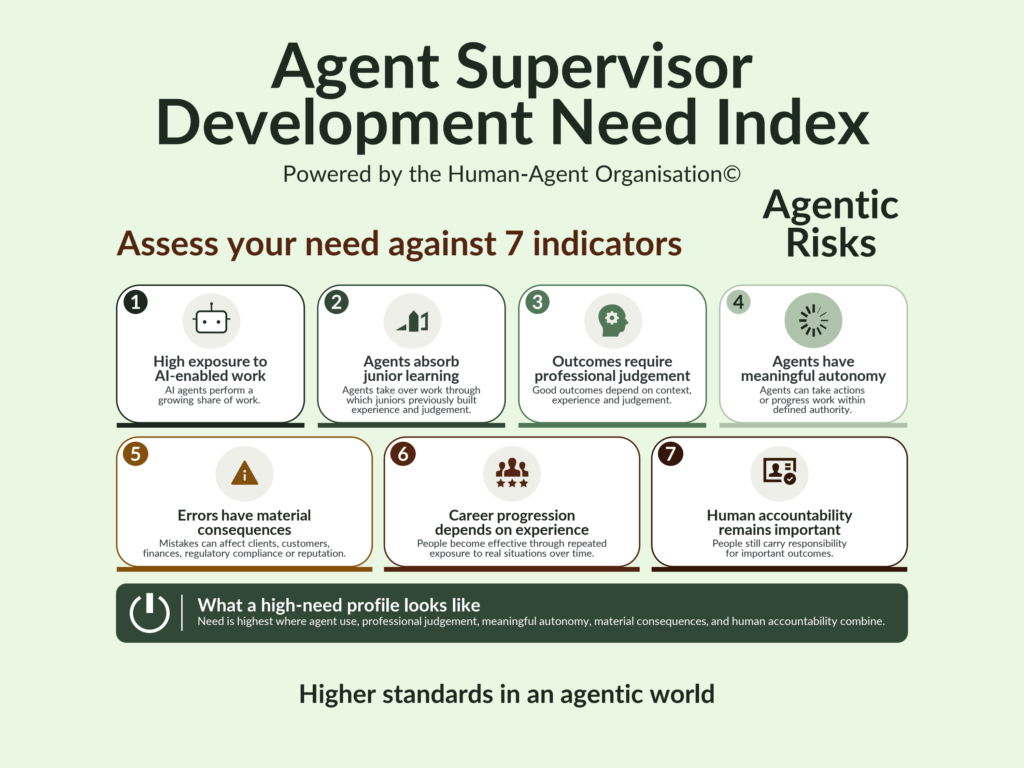
Our Agent Supervisor Development Need Index assesses seven indicators to show whether your organisation faces a high, emerging, or lower need.
Where the need is high, organisations should develop the AI agent supervisor skills to delegate, set boundaries, monitor, challenge, intervene, and escalate with professional judgement.
Use this page to assess your need against seven indicators, explore the Agent Supervisor Development Programme, and talk to us about AI agent supervisor training.

Does Your Organisation Need To Develop Agent Supervisors?
AI agents will perform more work while people remain accountable for the outcomes.
The need for AI agent supervisor development rises where agents take on judgement-intensive work, hold meaningful autonomy, and operate in environments where mistakes matter.
It rises further where agents absorb work through which people previously developed professional experience and judgement.
The Agent Supervisor Development Need Index helps you assess whether this is becoming a material workforce issue for your organisation.

The Seven Indicators of the Need to Develop AI Agent Supervisors
1. High exposure to AI-enabled work
Ask yourself: How much of your organisation’s work will AI agents perform?
X Lower need: Agents support a small number of administrative tasks.
✓ Higher need: Agents perform a growing share of operational or professional work.
2. Agents absorb work that previously developed junior capability
Ask yourself: Will agents perform work through which less-experienced people previously learned their profession?
X Lower need: The automated work contributed little to professional development.
✓ Higher need: The work helped people build experience, judgement, and confidence.
3. Outcomes require professional judgement
Ask yourself: Can people check an agent’s work by applying simple rules?
X Lower need: Outputs are largely objective and mechanically verifiable.
✓ Higher need: Good outcomes depend on context, experience, and professional judgement.
4. Agents have meaningful autonomy or authority
Ask yourself: How much can agents do without seeking human approval?
X Lower need: Agents mainly produce suggestions for people to review.
✓ Higher need: Agents can take actions, make decisions or progress work within defined authority.
5. Errors can have material consequences
Ask yourself: What happens when an agent gets something wrong?
X Lower need: Errors are easy to reverse and have limited impact.
✓ Higher need: Errors can affect clients, customers, finances, regulation, reputation or important decisions.
6. Career progression depends on experience-based learning
Ask yourself: Do people become effective professionals by gaining progressively harder experience?
X Lower need: Capability depends mainly on knowledge that people can learn directly.
✓ Higher need: Expertise develops through repeated exposure to real situations over time.
7. Human accountability remains important
Ask yourself: Will people remain responsible for important outcomes produced with the help of agents?
X Lower need: Agent work has limited consequence and narrow scope.
✓ Higher need: People remain accountable for decisions, actions or outcomes even when agents perform much of the work.

How to Interpret Your Position
High need
Your organisation probably needs AI Agent Supervisor Training if several of the higher-need conditions apply, particularly where:
- Agents exercise meaningful autonomy.
- Outcomes require professional judgement.
- Mistakes have material consequences.
- People remain accountable.
The need becomes stronger again where agents also absorb work that previously developed professional experience.
Emerging need
Your organisation has an emerging need where you can already see some of the higher need indicators and agent use is increasing, or if you expect to be in that situation soon.
This is the point to define what effective AI agent supervision requires and how people will develop the capability before agent use scales further or stumbles owing to inadequate supervision.
Lower need
Your current need is likely to be lower where agents perform low-consequence administrative work, autonomy remains limited, outputs are easy to check, and little developmental experience is displaced. If this changes, you can re-assess now you know this web page is here for you.

Where Demand is Strongest
The combination of professional judgement, regulatory accountability, experience-based development and growing agent use is making the issue particularly relevant to:
- Law firms.
- Audit and accounting firms.
- Consultancies.
- Banks.
- Insurers.
- Asset managers.

Why This Matters
Assigning a person to oversee an agent does not show that the person can supervise it effectively. Organisations need to know who is competent to supervise this agent, doing this work, within this level of authority.
That requires people with the AI agent supervisor skills to decide what to delegate, set boundaries, monitor performance, challenge outputs, intervene when needed, and escalate when a decision exceeds their authority.
It also requires a way for those people to keep developing professional judgement as agents perform more of the work.
The Agent Supervisor Development Programme
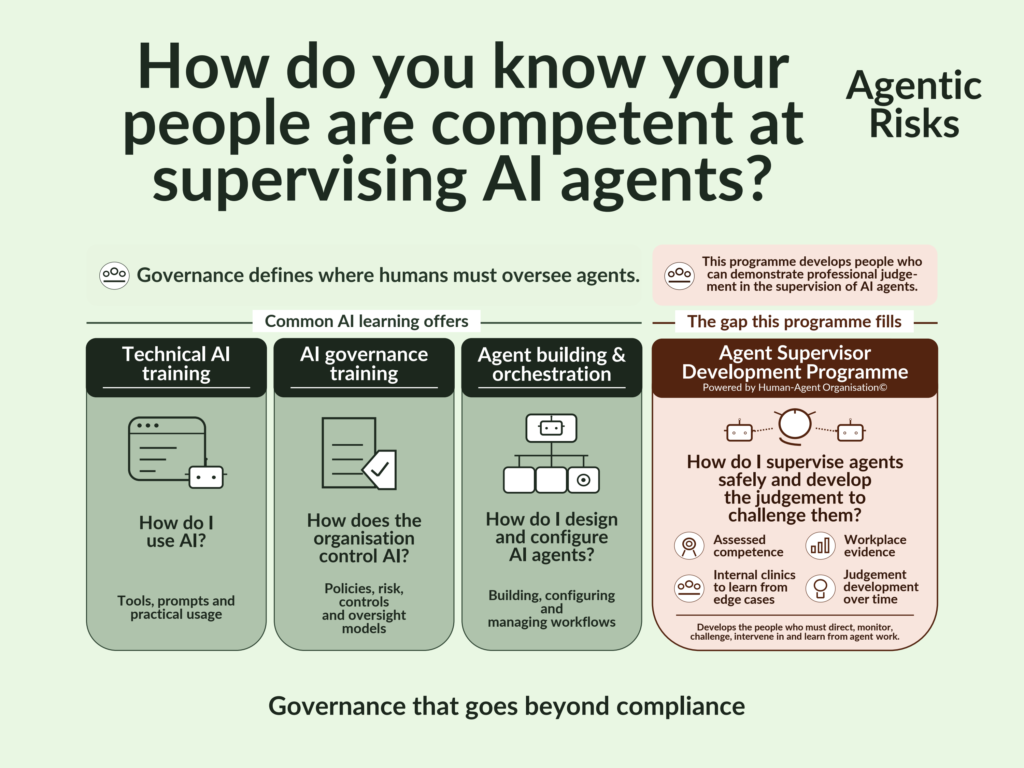
The Agent Supervisor Development Programme, powered by Human-Agent Organisation©, develops people who can demonstrate professional judgement in the supervision of AI agents.
It combines:
- A Two-Day Agent Supervision Course – where participants develop and test the essential skills of agent supervision.
- Competence Assessment – evidence-based assessment against defined learning outcomes and responsibility levels, so you know who in your organisation is competent and to what level.
- A Workplace Development Pathway – that shows participants can apply the capability in real work.
- Internal Agent Supervision Clinics – where your cohort of participants will learn from edge cases to build judgement across the organisation.
Participants progress through four levels of competence, from Foundation to Senior Agent Supervisor as they demonstrate greater competence and responsibility.

What Should You Do Next?
If several of the higher-need conditions describe your organisation, you should consider how you will develop the people who will supervise your agents.
We are currently inviting a small number of organisations to become Founding Partners of the Agent Supervisor Development Programme.
FAQ: AI Agent Supervisor Development
AI agent supervisor development builds the skills and judgement people need to supervise AI agents effectively: deciding what to delegate, setting boundaries, monitoring performance, challenging outputs, intervening when needed, and escalating beyond their authority.
Organisations need AI agent supervisors most when agents exercise meaningful autonomy, outcomes require professional judgement, errors have material consequences, and people remain accountable. The need rises further when agents absorb work that previously developed junior capability.
The essential AI agent supervisor skills are delegation, boundary-setting, monitoring, challenge, intervention, and escalation, applied with professional judgement.
Professional judgement in AI agent supervision helps supervisors recognise when an agent’s output is wrong or unsuitable, understand the consequences, and decide when to challenge, intervene or escalate.
To develop AI agent supervisors, organisations should combine taught skills with evidence-based competence assessment, workplace application, and continued learning from edge cases. The Agent Supervisor Development Programme combines these elements in a two-day course, workplace pathway and internal clinics.
AI agent supervision in regulated industries is especially important where professional judgement, accountability, experience-based development, and growing agent use combine, including sectors like law firms, audit and accounting firms, consultancies, banks, insurers and asset managers.