Table of Contents
Executive Summary
As firms adopt agentic AI, agents will perform more work while people remain accountable. But how do you know your people are competent at supervising AI agents?
Agentic Risks provides AI agent supervisor training that develops people who can direct, monitor, challenge, intervene in and learn from agent work while building professional judgement.
It combines a two-day AI Agent Supervision Course, competence assessment, workplace evidence and internal clinics using real and simulated edge cases. Participants progress from Foundation to Senior Agent Supervisor as their competence and responsibility grow.
Powered by the Human-Agent Organisation© the programme helps organisations scale AI agents safely while preserving the experience through which people develop judgement.
Founding Partnerships are available for firms moving quickly into agentic AI, offering early access, preferential pricing, influence over simulation topics, access to a longitudinal study, and evidence supporting training and competence regimes.

AI Agents Are Changing Who Does The Work
AI agents can take on increasing amounts of routine work, make decisions within defined authority, and complete tasks that people previously performed themselves.
That creates an obvious opportunity. Organisations can increase productivity, move faster, and allow people to spend more time on higher-value work.
It also creates a workforce challenge. People will remain accountable for outcomes while agents perform more of the underlying work. They will need to know what to delegate, what boundaries to set, as well as how to challenge outputs, intervene when something goes wrong, and escalate when a decision exceeds their authority.
At the same time, agents will absorb some of the work through which people traditionally developed professional experience and judgement. This creates a difficult question: how do you know your people are competent at supervising AI agents?
And behind it sits another: how will they develop the professional judgement they need to recognise when an agent gets something wrong?
The better agents become at performing work, the less experience their supervisors may gain by performing that work themselves. Yet effective supervision still requires enough expertise to recognise errors and enough judgement to know how to respond.
AI changes the apprenticeship through which people develop judgement. As a result, organisations need an alternative pathway for training people to supervise AI agents.

There Will Be Winners And Losers
The strongest organisations will capture the productivity benefits of agents while developing people who can supervise them effectively.
Their people will know when to trust an agent, when to verify its work, when to intervene, and when to escalate. They will keep building professional judgement even as agents perform more routine work.
Other organisations will face a growing capability gap, with the challenge being greatest where several conditions coincide:
- Agents perform work on which junior staff previously developed capability.
- Outcomes require professional judgement.
- Agents hold meaningful autonomy or authority, meaning mistakes have material consequences.
- Career progression depends on knowledge of a process someone may never have performed.
- People remain accountable for outcomes.
This makes AI agent supervision particularly relevant to regulated industries – such as banks, insurers and asset managers – and professional services – like law firms, audit and accounting firms, and consultancies.
For organisations in these sectors, human oversight of AI agents depends on more than assigning a person to supervise an agent. Oversight needs competent people.

The Opportunity: Scale Agents While Strengthening Human Capability
The goals are straightforward: agents should perform work where they add value; and people should learn to direct and supervise that work while continuing to develop the judgement their professions require.
The Human-Agent Organisation© can create a new development pathway, because people can learn through supervision itself.
They can compare their judgement with the agent’s, challenge its reasoning, analyse disagreements, learn from failures and edge cases, and receive feedback from experienced colleagues.
This provides the apprenticeship in a new way, rather than losing it and the benefits it brings.
It also allows organisations to scale agent use with greater confidence because they can answer a basic governance question with evidence: who is competent at supervising this AI agent, doing this work, within this level of authority?
Where the Agent Supervisor Development Programme Fits
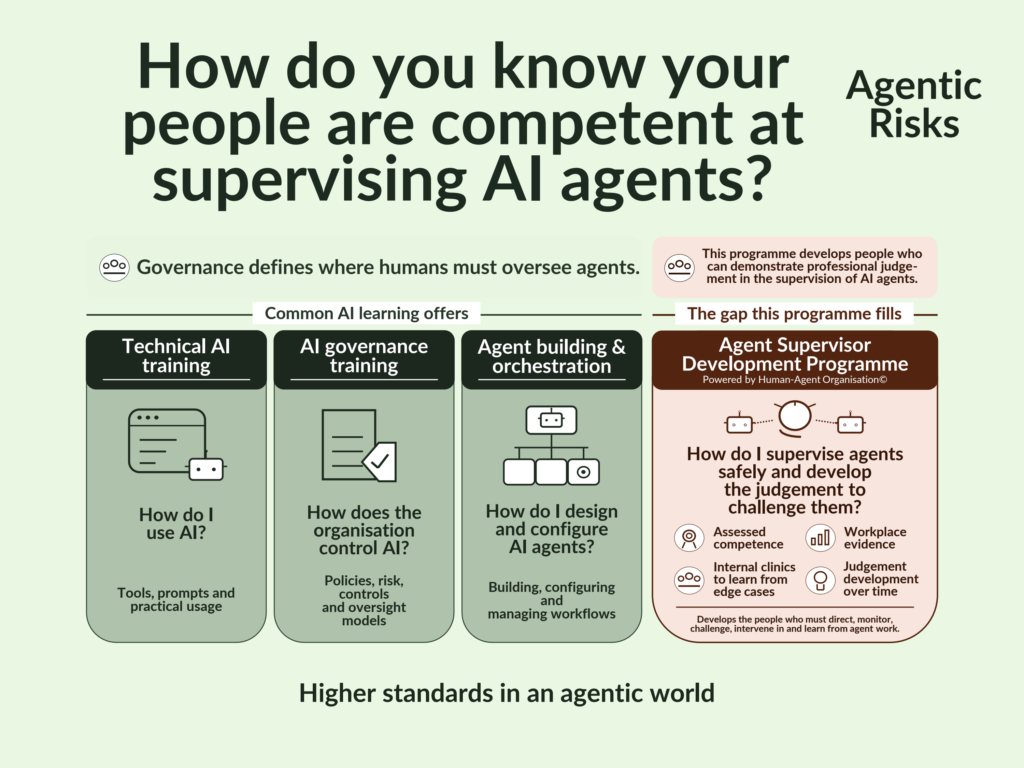
Technical AI training teaches people how to use AI.
AI governance training helps organisations control AI.
Agent-builder and orchestration training teaches people how to design and configure AI agents.
The Agent Supervisor Development Programme provides AI agent supervisor training to develop people who can demonstrate professional judgement in AI agent supervision.

A Development Pathway Built Around Demonstrated Competence: 4 elements
We designed the programme around assessing competence (not just attendance), so it combines four elements that balance taught sessions, practiced skills, and assessed capabilities.
1. A Concentrated 2-day AI Agent Supervision Course
Participants learn and practise the essential AI agent supervision skills through progressively harder exercises and realistic simulations.
They learn how to assess delegation, understand an agent’s operating context, set boundaries, monitor proportionately, challenge outputs, calibrate reliance, intervene, escalate, and account for their decisions.
The course culminates in an individual simulation that tests all 12 programme learning outcomes.
As in the real-world, unsafe decisions can override stronger performance elsewhere, meaning that participants can fail the assessments.
2. Evidence of Competence
The programme records evidence against each learning outcome and identifies the highest of four levels of competence that it supports:
- Level 1 – Foundation.
- Level 2 – Supervised Agent Supervisor.
- Level 3 – Independent Agent Supervisor.
- Level 4 – Senior Agent Supervisor.
Higher levels require workplace evidence, giving organisations a defendable record evidence of the responsibility they can safely entrust to each person.

3. Workplace Development
After the AI Agent Supervision Course, participants apply what they learned to real agent supervision and we look to their managers to create suitable opportunities, observe performance, and verify evidence.
As a result, participants build experience through real delegation decisions, monitoring, output challenge, intervention, and escalation.
Through this process, work becomes part of the programme, which is important for training and competency regimes.
4. Internal Agent Supervision Clinics to Learn from Edge Cases
In their day-to-day work, individuals may not encounter every difficult situation, so our internal clinics turn one person’s experience into learning for others within their organisation.
Participants examine real or simulated supervisory cases, make their own judgement before hearing colleagues’ views, compare decisions, and identify what they would do differently next time.
Level 3 supervisors can also use the clinics to help less experienced colleagues and demonstrate their readiness for progression to Level 4 – Senior Agent Supervisor.
The organisation gains too:
- Repeated cases expose patterns in its agents, controls, workflows, and supervisory arrangements.
- An alternative development pathway where AI agents change the apprenticeship through which people develop judgement, avoiding workforce pipeline risks.
Together, these four elements address both sides of the problem: develop competent Agent Supervisors now, while creating a new pathway through which professional judgement can continue to grow.

Become a Founding Partner
We are preparing the first Founding Partner cohorts of the Agent Supervisor Development Programme.
They are intended for organisations that already use AI agents, or expect to do so soon, and want a systematic way to develop and demonstrate their people’s competence at supervising AI agents.
Founding Partnerships are particularly valuable to firms moving quickly into agentic AI, as they offer early access, preferential pricing, influence over simulation topics, access to a longitudinal study, and provide evidence for training and competence regimes.
If you are asking, “how do we know our people are ready to supervise AI agents?”
We should talk.

Our Credentials
The Agent Supervisor Development Programme is powered by Agentic Risks’ work on the Human-Agent Organisation©: our framework for understanding how organisations change when AI agents become non-human workers operating under human accountability.
That work has examined the implications for organisational structure, operating models, people management, culture, governance and professional development. The Agent Supervisor Development Programme turns one of its most important conclusions into a practical development system.
Agentic Risks also provides agentic AI training to major professional bodies:
- We are the Investment Association’s approved training provider on agentic AI.
- We delivered the Institute of Risk Management’s webinar series on agentic risk management.
The programme also combines agentic AI expertise with deep leadership development experience, with our Leadership Director bringing more than two decades of military and civilian leadership experience, including developing people for demanding operational environments, together with executive coaching and university teaching in leadership, ethics and professional practice. He is an experienced Master Coach and has received national recognition for his service.
That combination matters. Agent supervision requires knowledge of agents, controls and governance. It also requires judgement, leadership, decision-making, reflection and the ability to act under uncertainty. We have designed the programme around both.
Frequently Asked Questions About AI Agent Supervisor Training
AI agent supervisor training develops people to direct, monitor, challenge, intervene in and learn from AI agent work while remaining accountable. In this programme, the training sits within a wider development pathway combining a two-day course, competence assessment, workplace evidence and internal clinics.
Training people to supervise AI agents starts with delegation, operating context, boundaries, proportionate monitoring, output challenge, reliance, intervention, escalation and accountability. Participants then practise these skills in realistic simulations, apply them to real agent supervision, where managers observe performance and verify evidence, and confer in clinics on edge cases.
Core AI agent supervision skills include judging what to delegate, setting boundaries, monitoring proportionately, challenging outputs, calibrating reliance, intervening, escalating and accounting for decisions. Supervisors also need enough expertise and professional judgement to recognise when an agent is wrong and decide how to respond.
AI agent supervisor competence should be demonstrated, not inferred from attendance. The programme records evidence against each learning outcome, uses an individual simulation, and requires workplace evidence for higher competence levels. Unsafe decisions can override stronger performance elsewhere, so participants can fail the assessment.
Human oversight of AI agents requires more than assigning a person to watch an agent. Effective supervision depends on knowing when to trust, verify, intervene or escalate. Professional judgement in AI agent supervision helps people recognise errors, understand their consequences and act within the authority they retain.