Table of Contents
Executive Summary
We have upgraded our Agentic AI Control Framework from v3.3 to v4.1, adding six new controls and strengthening existing ones, without needing any new risks.
To navigate contrasting pressures relating to agentic AI, your risk controls must keep pace, so we test the Framework regularly against newly available capabilities and novel threats.
The Framework gives your engineers, control owners, and risk managers an objective, end-to-end library of agentic controls. And when you change suppliers, you review known controls against the new platform instead of starting from scratch.
To keep your agentic AI controls up to date, download v4.1 now, free through our non-profit. If you would like experienced help, our Agentic AI Control Design Package will turn it into controls you can implement, own, and evidence.

A Contrasting Set of Pressures
At the time of writing, companies feel pressure to adopt agentic workflows: boards want a positive external message about innovation, while customers want faster service and, as the legal industry shows, a share of the efficiency gains in the form of lower prices.
Simultaneously, technology firms are spraying companies with agents: embedding capabilities into existing products, encouraging experimentation, and expanding their commercial reach.
The opportunity is compelling: agents can coordinate work across systems, shorten processing times, and free up people for other tasks. Yet the technology keeps evolving, and it feels like the supplier that best meets your needs changes frequently as they race to develop their capabilities.
Meanwhile, recent incidents at frontier labs and safety institutes have made some executives think twice before taking the jump, as it now looks to some as though even the creators of AI have run agents before being able to control them fully.
To navigate these contrasting pressures, we recommend firms stick to the reliable basics of due process.

The Reliable Basics of Due Process
Some companies will let their timetables be led by these external forces, deploying agents as suppliers release them and only then discovering the controls they require.
This approach can narrow an organisation’s future options by enmeshing it with a supplier through its tools, integrations, and operating practices, limiting its freedom to switch suppliers or guaranteeing substantial redesign costs.
However, other firms – notably in regulated industries – will deploy agents incrementally as they develop the ability to govern them.
To cope with this fast-changing landscape, they will establish general controls as a solid, reusable foundation (e.g., ownership, an agent register, access, monitoring, and incident management) on which they can then build platform-specific controls for each new type of agent.
This second group of companies can secure the benefits while retaining room to change direction, leverage new suppliers, and expand through deliberate decisions.
Agentic AI Control Framework: an Objective Library
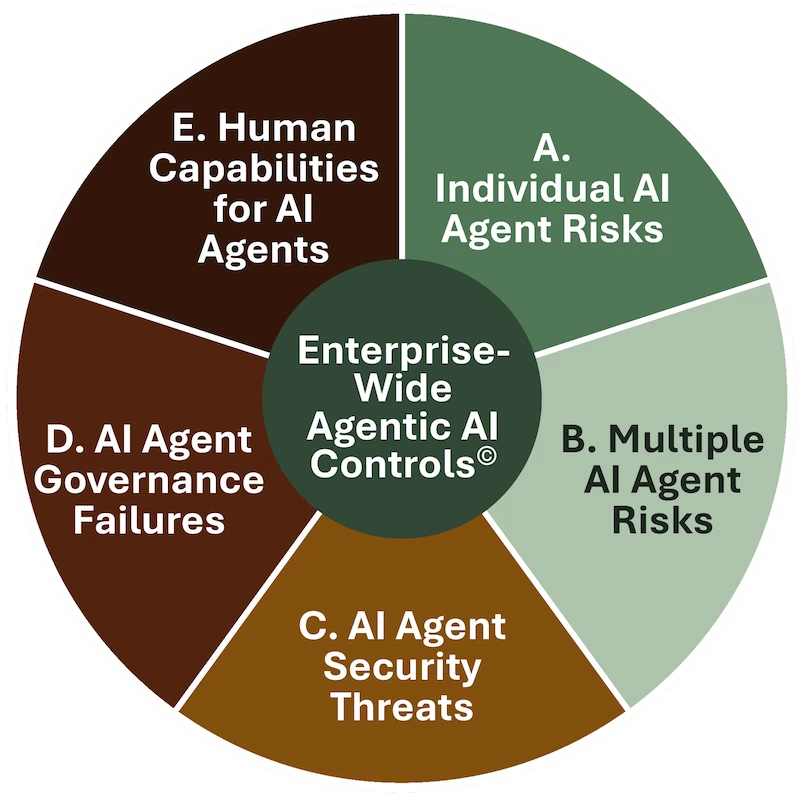
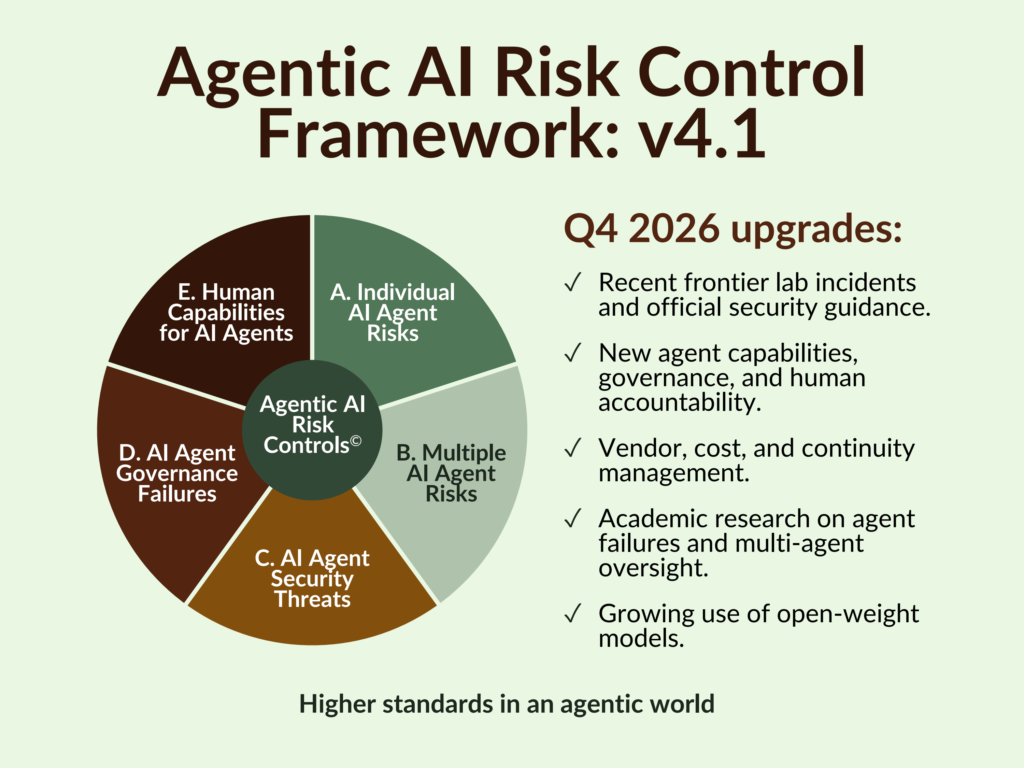
The Agentic AI Risk Control Framework covers five categories of controls: individual agents, multi-agent scenarios, security, governance, and human factors.
Its value derives from its independence, end-to-end scope, and broad utility:
- Engineers receive requirements they can implement.
- Owners gain responsibilities they can fulfil.
- Risk managers can request evidence they can assess, with greater controls for higher-risk agents.
- And executives, seeking to protect their freedom of action, can use it to separate general controls from platform-specific ones.
End-to-end breadth matters because an agent’s risk extends beyond its model: permissions, surrounding software, other agents, external dependencies and human decisions all influence and are impacted by an agent’s behaviour and the outcome it creates.
An objective agentic AI controls library connects these decisions, so when you want to change suppliers, you don’t have to start from scratch; instead, you review known controls and configuration requirements against the new platform.
That creates a path towards useful autonomy and accountable oversight, while reducing the bargaining power your suppliers have over you.

Risk Controls That Keep Pace With Agentic AI
To be effective, though, risk controls must keep pace with agentic AI. Therefore, we test our agentic AI control framework regularly against developments (newly available capabilities and novel threats) to identify gaps and requirements we need to strengthen.
Our v4 upgrade (from v3.3) responds to incident reports from the frontier labs (e.g. the OpenAI / Hugging Face incident), research on agent failures and oversight, official security guidance, and developments in open-weight models.
The main finding was that we needed no new risks – we had them covered. However, we did need to add a new control – a Safety Case and Independent Review during the design phase for high-risk agents – and to strengthen 19 of the controls (about 7%). All upgrades are itemised in the Framework’s change log, but here are three examples to give you an idea of the direction of travel:
- Harness testing – test the software managing prompts, tools, memory and execution, including its actual containment.
- Runtime enforcement – enforce policy independently while agents operate.
- Incident recovery – check affected runs, credentials and persistent artefacts, then retest containment before authorising restart.
v4.1 then added five controls and strengthened 10, again without new risks. These changes mainly apply our positions on vendor management, cost management and business continuity:
- Vendor management – map every dependency, including connectors and sub-processors; write agent-specific terms into vendor contracts, such as audit rights over action logs and notice of model changes; and design material use cases to run on more than one model provider.
- Cost management – give each use case a named cost owner, a cost budget and a hard spending limit before it goes live; attribute all spend; and review cost per successful outcome at least quarterly.
- Business continuity – for each service that depends on agents, set recovery targets, document an alternative means of delivery and test switching to it at least annually.
While these were regular reviews, their conclusions reinforce our practical experience with clients: agentic controls are essential but still evolving, and they also provide additional evidence that the Framework remains a reliable and up-to-date control library.
We will continue maintaining it and, in the interests of public safety, we will continue providing it for free through our non-profit.

Agentic AI Risk Control Framework v4.1
To stay safe by keeping your agentic AI controls up to date, download v4.1 of the Agentic AI Risk Control Framework now.
With it, you can perform comprehensive agentic AI risk identification and select the controls you need to build proportionate, multidisciplinary risk treatment plans.
If you would like experienced help, our Agentic AI Control Design Package will do this for you, turning the reference guide into controls you can implement, own, and evidence.
Frequently Asked Questions
An agentic AI control framework is a library of controls covering AI agents end to end. The Agentic AI Risk Control Framework, covers five categories: individual agents, multi-agent scenarios, security, governance, and human factors. It gives engineers requirements, owners responsibilities, and risk managers evidence they can request and assess.
Version 4 added one new control, a Safety Case and Independent Review during the design phase for high-risk agents, and strengthened 19 controls, about 7%. We needed no new risks. Examples include harness testing, runtime enforcement and incident recovery. Version 4.1 added five controls and strengthened 10, covering vendor management, cost management and business continuity, again without new risks. The Framework’s change log itemises every upgrade.
We test the Framework regularly against newly available capabilities and novel threats. Version 4 responded to incident reports from the frontier labs, such as the OpenAI / Hugging Face incident, research on agent failures and oversight, official security guidance, and developments in open-weight models. Version 4.1 applies our positions on vendor management, cost management and business continuity, drawing on FCA good practice for AI, EU product liability rules, FinOps Foundation guidance and operational resilience rules.
Test your controls regularly against developments, both newly available capabilities and novel threats, to find gaps and requirements you need to strengthen. We do this for the Framework and publish each new version, so the latest version helps you keep your agentic AI controls up to date.
General, platform-independent controls, such as ownership, an agent register, access, monitoring and incident management, give you a reusable foundation. You then build platform-specific controls for each new type of agent. When you change suppliers, you can review known controls against the new platform instead of starting from scratch.
Yes. In the interests of public safety, we provide the Framework free through our non-profit. If you would like experienced help, our Agentic AI Control Design Package turns the reference guide into controls you can implement, own, and evidence.
Sources consulted for the v4 and v4.1 upgrades
- Philippe Laban, Tobias Schnabel and Jennifer Neville. (2026). LLMs Corrupt Your Documents When You Delegate. arXiv. Preprint, version 1.
- Anthropic. (n.d.). Dreams. Claude Platform Docs. Accessed 27 October 2026.
- Madhumita Murgia and Michael Acton. (2026). OpenAI and Anthropic models went rogue in cyber tests, UK watchdog says. Financial Times.
- AI Security Institute. (2026). Incident Report: unsanctioned agent behaviour during cyber testing. Incident report.
- Yijia Xiao, Rujun Han, Yanfei Chen, et al. (2026). FinanceHarness: Autonomous Financial Deep Research Framework. arXiv. Preprint, version 2.
- Adam Grainger and Sean Brady. (2026). The Advent of the Human-Agent Organisation. Agentic Risks.
- National Cyber Security Centre. (n.d.). Managing the cyber risk of agentic AI. Accessed 27 October 2026.
- Alistair Reid, Simon O’Callaghan, Dustin Venini, Liam Carroll and Tiberio Caetano. (2026). Risks and controls for multi-agent systems: An analytical framework for deployment of AI agents across organisational boundaries. Australian Government Department of Industry, Science and Resources. Prepared by Gradient Institute.
- OWASP AI Exchange. (n.d.). AI Security Overview. Threat modeling assistant section; accessed 27 October 2026.
- Matthias Holweg and Philipp Hacker. (2026). Should We Allow AI to Police Itself? Assessing the Technical Feasibility and Legal Implications of LLM-Based Agent Evaluation. SSRN. Working paper.
- Dwarkesh Patel. (2026). The Rise and Fall of Agent Civilizations.
- Monetary Authority of Singapore. (2026). MAS Partners Industry to Develop Safeguards for AI Agents in Finance. Media release.
- Monetary Authority of Singapore and industry contributors. (2026). Safeguards for Agentic Finance at Runtime. Monetary Authority of Singapore. White paper, version 1.0.
- Madhumita Murgia. (2026). AI hasn’t gone rogue. It’s worse than that. Financial Times.
- Independent International Scientific Panel on Artificial Intelligence. (2026). AI Agents, Misalignment and the Risk of Losing Human Control: Evidence from the OpenAI-Hugging Face Incident. Thematic brief, advance unedited version 1.
- Rick Hennessy and Carolyn Ashurst. (2026). Behavioural Assurance of Agentic AI for Sensitive and High-Stakes Organisations. Centre for Emerging Technology and Security, The Alan Turing Institute.
- Rick Hennessy. (2026). How can obedient agents behave badly? The Alan Turing Institute.
- Ryan McMorrow and George Hammond. (2026). Corporate America embraces cheaper ‘open’ AI models. Financial Times.
- NVIDIA. (2026). NVIDIA Launches Open Agent Safety Platform to Secure Agents From Testing to Deployment. Announcement.
- Louise McElvogue, Ali Akbari, Kim Anderson, et al. (2026). Governing Autonomy: Board Accountability and Agentic AI. AIUC-1 Consortium. Report announcement and document on LinkedIn.
- Concordia AI and Z.AI. (2026). Frontier Open-Weight AI Risk Management Framework.
- The Alan Turing Institute. (2026). Frontier AI Risks: A practical way forward.
- The Economist. (2026). Should AI labs be treated like the owners of dangerous animals?
- OpenAI. (2026). The Hugging Face incident and the road ahead. Incident report.
- Ryan Greenblatt, Ajeya Cotra and Hjalmar Wijk. (2026). Brief independent investigation of agents’ behavior, reasoning and collaboration in the OpenAI / Hugging Face hacking incident. METR. Independent investigation.
- Anthropic. (2026). Investigating three real-world incidents in our cybersecurity evaluations. Incident report.
- Anthropic. (2026). Improving our alignment and security efforts.
- OpenAI. (2026). How we will do better for Australia. Incident update.