Home

Autonomous AI agents bring significant advantages to organisations.
These include higher productivity, scalable automation, and better use of human judgement.
Agents deliver these benefits because they can:
This makes AI agents more powerful than basic prompt-driven AI tools.
Autonomy is a scale you calibrate to your needs, rather than a binary switch, making the delegation of autonomy a formal risk appetite decision.
In particular, delegating tasks to non-humans to perform on our behalf require explicit external controls because they are immune to traditional ethical sanctions.
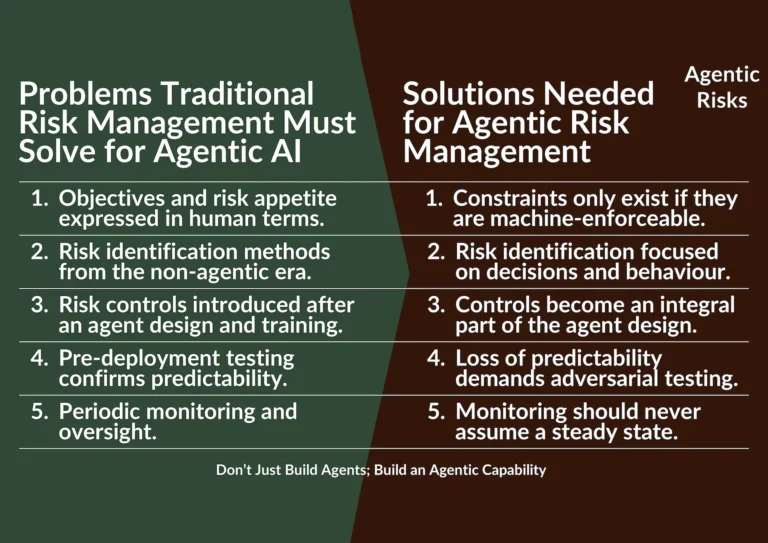
At the same time, including agentic AI in workflows challenges the traditional risk management process because it fundamentally changes how risk emerges, how controls fail, and where accountability must sit.
As a result, agentic AI introduces a new class of unfamiliar risks you need to manage if you are to leverage the benefits of this new technology.
To overcome this, our Enterprise-Wide Agentic AI Risk Control Framework contains the full set of known agentic risks and the latest best-practice controls.
With it, you can:
An agentic AI controls framework is a structured set of policies, safeguards, and checks that keep AI agents aligned with your goals and operating safely. It sets the rules for how AI agents behave, what they can and cannot do, and when humans need to stay involved.
To implement agentic AI controls, set your policy on AI autonomy, map the risks and controls for a pilot agentic workflow, and prove control effectiveness through testing. Once your pilot is live, confirm your new agentic capability is audit-ready, and then increase your stakeholder engagement through additional risk assessments as you launch new agentic workflows.
AI agents do not stay in one team or system. If controls apply only to one area, risks and failures will spread, for example, costs need to be managed, business continuity teams need to be ready for new incident types, management information need to reflect your new non-human workforce, and leaders need to manage the human factors. Making your agentic AI risk controls enterprise-wide ensures consistent standards, shared accountability, safer scaling, and fewer gaps that could lead to errors, breaches, or misuse.
Agentic AI risk controls protect against misaligned agent behaviour, loss of oversight, security weaknesses, compliance failures, and poor handovers between humans and agents. With the right controls, organisations reduce the risk of errors, reputational harm, and unintended autonomous actions.
The main benefits are safer AI adoption, faster scaling of AI agents, clearer accountability, and better business performance. It gives leaders confidence to use agentic AI without losing control or exposing the organisation to avoidable risk.
Responsibility normally sits with a senior leader, such as a Head of AI, Chief Risk Officer, or technology governance lead. Business teams, risk, compliance, and IT should all play a part in mapping risks to controls.
Yes. Smaller organisations often adopt AI agents faster and with fewer internal checks, which increases risk that a smaller firm may be less able to handle. The Agentic Risks framework allows them to construct proportionate risk treatment plans by selecting only the controls that apply to them without prescribing they do more than they need to.
No. Traditional AI governance frameworks focus on models and data, not autonomous agent behaviour or integration into workflows. An agentic AI controls framework adds the specific safeguards needed for AI agents that act, decide, and interact with systems and humans.
Managing the known risks associated with agentic workflows will give your project timeline predictability because your deliverables will be more likely to work first time, which will also keep your costs in budget. This is particularly important for maintaining stakeholder confidence if it is your first agentic workflow.
We use some cookies - read more in our policies below.
Fill in this form and get access to our
Template Agentic Risk Appetite and Adoption Strategy for free
Fill in this form and get access to the whitepaper of the
Enterprise-Wide Agentic AI Controls Framework.
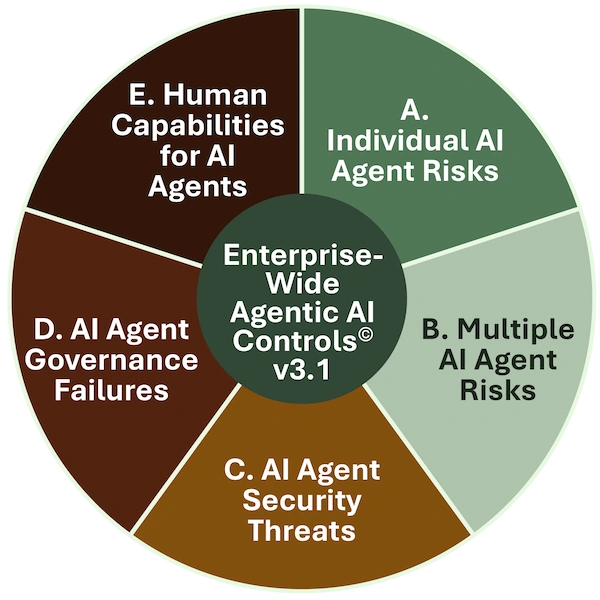

Fill in this form and get access to the pdf with the
Agentic Workflow Risk Flags
pdf links still to be changed
Fill in this form and stay up to date