Table of Contents
Executive Summary
For centuries, organisations have been human-only. AI agents bring the first non-human workers, introducing a new paradigm: the Human-Agent Organisation.
Vast information-processing capacity will re-engineer how we coordinate tasks; reusable agentic capabilities become the base unit of governance, making agentic AI an organisational change.
As agents enter org charts and absorb the routine work on which previous generations built judgement, organisations will value people for directing and supervising work, while remaining accountable for outcomes.
Culture will remain a human domain, but behavioural norms, practices, and informal information flows will evolve, and power will shift towards the people who best direct and govern agents.
If navigating this transformation still lies ahead for you, we offer a range of services to help you proceed with confidence. Skip to this section.

The Human-Agent Organisation
For centuries, the organisation has been a human structure. In our companies, public institutions, schools and universities, we hired people, gave them roles, set them in reporting lines, and held them to account. In contrast to these human-only organisations, AI agents are bringing about the first transformation in which the delegated workforce is non-human.
This introduces a new organisational paradigm – the Human-Agent Organisation. A Human-Agent Organisation is a management system in which humans and AI agents jointly perform work within a system of human governance, oversight, accountability, and intervention. In this setting, non-human workers leverage new information-processing capacity and speed to influence and execute decisions within a system of human collaboration, governance, oversight, and intervention.
In the Human-Agent Organisation, we will see machines as collaborators (rather than tools), our decision-making capacity will shift gear from slow (human pace) to fast (human pace expedited by machine speed), and in the same way as human performance can improve or deteriorate over time, so too can an AI agent’s, stimulating a move from static to dynamic risk management techniques.
What happens to the concept of the organisation when it stops being just a collection of humans and becomes a human-agent workforce?
It is an important question because it makes agentic AI an organisational change, not just a technology upgrade, and to navigate a change safely we need a clear destination to begin with. Describing this destination is Sean Brady’s and my goal for our new blog series and forthcoming book, ‘Humans in Charge: The Human-Agent Organisation©.’

Implications of Decisions Made By Non-Humans
In recent decades, the offshoring and business process outsourcing phenomena gave us, as a society, experience of delegating and overseeing on a large scale.
This time, however, the delegated workforce is non-human – unable to bear legal, regulatory, or moral accountability, operating at machine speed, and scaling elastically.
According to one prediction (Gartner), by 2028, at least 15% of day-to-day work decisions will be made autonomously through agentic AI, up from 0% in 2024. The words are more important than the number: ‘decisions made by non-humans’ is a strategic innovation and a departure from anything we have experienced in our human-only institutions.
The implication is that AI agents will have a tangible impact on the organisation as we know it today. This matters because every existing delegation-governance tool – SLAs, supervision ratios, conduct frameworks, escalation protocols – assumes a delegate that is slow, accountable, and finite.
Yet, AI agents are fast, unaccountable, and scalable. Indeed, as agents become increasingly capable of executing work, leaders will need to redesign roles, decision rights, oversight models, accountability structures, skills frameworks, training programmes, and performance management processes.
As a result, the Human-Agent Organisation requires new arrangements rather than extensions of existing systems.
Agentic AI Is An Organisational Change, Not Just A Tech Upgrade: Implications for Organisational Design
Navigating to a destination requires a map. So, we assessed the impact of the Human-Agent Organisation on the generic modern digital organisation to identify where its effect will be felt and how strongly.
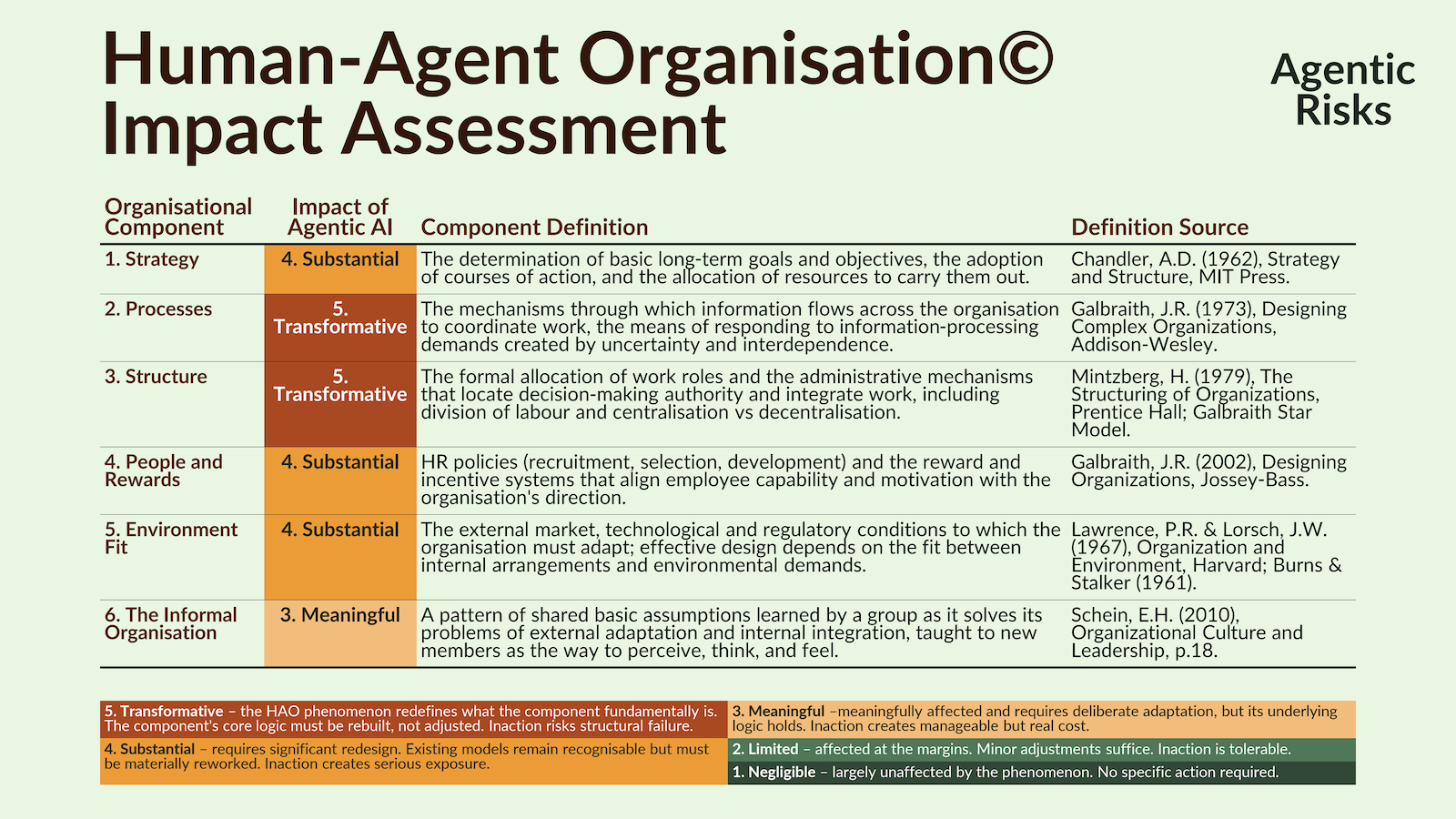
Our analysis finds that a shift to combined collaboration between humans and agents will disrupt all six components of organisational design for agentic AI (methodology at the end). In our opinion:
- Structure and Processes will see a transformative impact (level 5), because how work is divided and coordinated is precisely what agents change.
- Meanwhile, Strategy, People and Rewards, and Environment Fit will undergo substantial change (level 4), while changes in shared assumptions have a meaningful impact (level 3) on culture and the Informal Organisation over time.
- The changes in all six components will also interact with each other and some of interactions will be sequential while others will be in parallel.
The uneven impact is important because it shows that the change will be concentrated on the two components most directly related to HOW work gets done.
Therefore, an executive decision to adopt agentic AI is not about whether to implement a technology upgrade; it is about accepting a paradigm shift in how the organisation will complete work in the future, as well as what work we perform and for what purpose.

A Summary of Agentic AI’s Impact on Organisational Design
This being the first in a series of blogs, each subsequent article will examine in detail a component of organisational design for agentic AI:
- How we define the organisational component and justify our impact assessments.
- What key decisions and actions business leaders should consider and why.
- Any additional considerations for firms in regulated industries.
As a taster of what lies ahead, here are brief justifications for our impact ratings to help you understand our view of the direction of travel.
It is our evaluation – shared freely – and we welcome other views, including where you think a component should rate higher, lower, or differently from how we have placed it.
1. Strategy: The Unit of Strategic Capability Shifts from Headcount and Time to the Quality of an Organisation’s Operating Model
When the human and AI agent workforce collaborates, the binding constraint on execution shifts from an organisation’s headcount and time to the quality of its combined human-agent operation.
As a result, the strategy must now determine which work to delegate to agents, where competitive advantage is created or eroded by that delegation, and how value migrates as agentic capability becomes a market default available to competitors.
These are existing functions of the strategy component so, assuming the organisation’s business model remains viable, the component remains intact as the direction-setting compass (goals, resource allocation, basis of advantage), but its content must be materially reworked for the Human-Agent Organisation. This is redesign, not reinvention, so the impact is substantial rather than transformative.
In some circumstances, a business model may no longer be viable creating a transformative impact, but this will be the combined effect of two forces – agentic AI plus existing business model risk. The strategy component as we currently know it will be the way to navigate away from this scenario.
For this reason, as a general guide for all organisations, our impact assessment is level 4 – substantial.

2. Processes: Vast New Capacity Re-Engineers How We Coordinate Tasks
Galbraith’s position is that organisations design processes to match their information-processing demand.
With agents essentially bringing vast information-processing capacity, responsible users will want to engineer governance mechanisms around their agents that, in turn, create coordination risks (e.g. agent-to-agent handoffs, error propagation, loss of human visibility).
Best practice favours combining different configurations of reusable and pre-validated agentic capabilities to achieve new use cases. Because these capabilities form an underlying base unit of governance, the core logic of information processing will undergo not just adjustment but a fundamental transformation.
We call this the Human-Agent Operating Model and we explore this component in detail here.
3. Structure: Division of Labour Gets Transformed Because The Org Chart Will Soon No Longer Only Feature Humans
Mintzberg (1979) defines structure as the sum total of the ways an organisation divides its labour into distinct tasks and then achieves coordination among them. We assess the division of labour and the location of decision-making authority here, under Structure, and we assess the coordinating mechanisms themselves under Processes, following Galbraith’s distinction between an organisation’s anatomy and its physiology.
The Human-Agent Organisation introduces a new class of non-human workers into the division of labour and enables decision-influencing work to occur at machine speed and scale.
Because of this, org charts and role descriptions can no longer be maps of people alone. They must account for agents that plan, coordinate, and execute, as well as the humans who command them.
As a result, agentic AI will reshape organisational structure – spans of control, oversight capacity ratios, reporting lines, and the location of authority all require rebuilding around a combined human-agent workforce, while accountability (we believe) will inevitably remain with the human.
As agentic AI evolves, it is entirely possible that structures may change more than once, with organisations developing their agentic capabilities and refining how they govern the Human-Agent Organisation.
What changes is not the content of the division of labour but its unit. Every structural theory since Weber has assumed that the occupant of a position is a person, while Weber’s deeper principle – that authority attaches to the office rather than to the individual – is precisely what makes a non-human occupant conceivable. Because the component’s founding assumption changes rather than its content, this is a rebuild and not an adjustment, meeting our criteria for a transformative impact.

4. People and Rewards: The ‘Agent Supervisor’ and How The Human Role Shifts From Producing Work to Supervising It
Some agents will be more effective than others and as they perform more work, the human role shifts toward getting the most out of them.
Directing, monitoring and challenging agents, judging their work, handling exceptions, and knowing when to intervene or escalate will become sought-after skills.
In this environment, people are increasingly rewarded for the quality of the work they direct and supervise, not only for the work they personally produce. For people whose roles include supervising agents, contribution increasingly depends on the quality of work they direct and supervise.
Required capabilities, role definitions, performance measures, and reward structures must be reworked.
Supervising an agent is different from managing people, and managers who lead Agent Supervisors will need additional capabilities too. The net result is that people management for agentic AI will undergo critical impacts and people with different skills will rise to the top.
For people whose roles include supervising agents, contribution increasingly depends on the quality of work they direct and supervise.
The HR architecture remains recognisable (still recruitment, development, reward), but its content is materially reshaped. In our assessment, this impact will be substantial rather than transformative, which we explain at the link above.
5. Environment Fit: The Availability of a New Workforce is an External Shock
The availability and presence of AI agents is a change in the environment that every firm faces: agentic capability is becoming a market default, competitors are adopting agentic AI, and regulators are actively developing expectations for it.
By Lawrence and Lorsch’s logic, an external shift of this magnitude will force a corresponding change in the organisation’s internal arrangements. This is because the organisation needs to maintain its fit with its external environment and ensure continued interaction with external parties as they also become Human-Agent Organisations, e.g. clients and suppliers.
Even if a firm chooses not to adopt agents, it cannot opt out of the environmental shift, which is what gives the phenomenon its urgency.
This component’s logic is unchanged – congruence between an organisation and its environment – but the required internal adaptation is significant, so our impact rating is substantial.

6. The Informal Organisation: How to Trust and Challenge a Machine?
The Human-Agent Organisation confronts prior assumptions about who (or what) does the work, how much to trust machine-performed output, and where responsibility lies.
We expect these assumptions to be deep-rooted because the human-only organisation is all everyone has ever known, aligning them with Schein’s taken-for-granted assumptions that shift only slowly.
The impact of agentic AI on organisational culture is real and demands deliberate cultural work (e.g. trust calibration, norms for relying on and checking agents, psychological safety to challenge agent output) as behavioural norms, practices and informal information flows evolve.
As AI agents absorb routine work, they will change the ‘apprenticeship’ through which previous generations developed knowledge and judgement, creating a need for alternative development pathways.
Ultimately, culture’s underlying logic and shared learned assumptions still hold and it will remain a human domain.
This is meaningful and requires intervention, but not a redefinition of the component.
Human-Agent Organisation Services
If navigating this transformation still lies ahead for you, we offer a range of services to help you proceed with confidence.
If you expect organisational change from agentic AI but want to know where to start, our Agentic AI Transformation Workshop will help your colleagues and you define the direction and develop the right plan.
If you understand agentic risk but want to know which controls to implement, our Agentic AI Controls Design Workshop and proprietary ‘Statement of Applicability’ methodology will help you design the controls that keep humans in charge.
If you are introducing agents and need to develop the people who will supervise them, our Agent Supervisor Development Programme develops people who can demonstrate professional judgement in the supervision of AI agents. It combines a two-day Core, competence assessment, workplace evidence and internal clinics to learn from edge cases.
If you want to know your current state of readiness so a roadmap based on it will be achievable, our Agentic AI Readiness Assessment will give you a complete view of your firm’s strengths, weaknesses, and prioritised next steps.
Methodology for the Human-Agent Organisation Impact Assessment
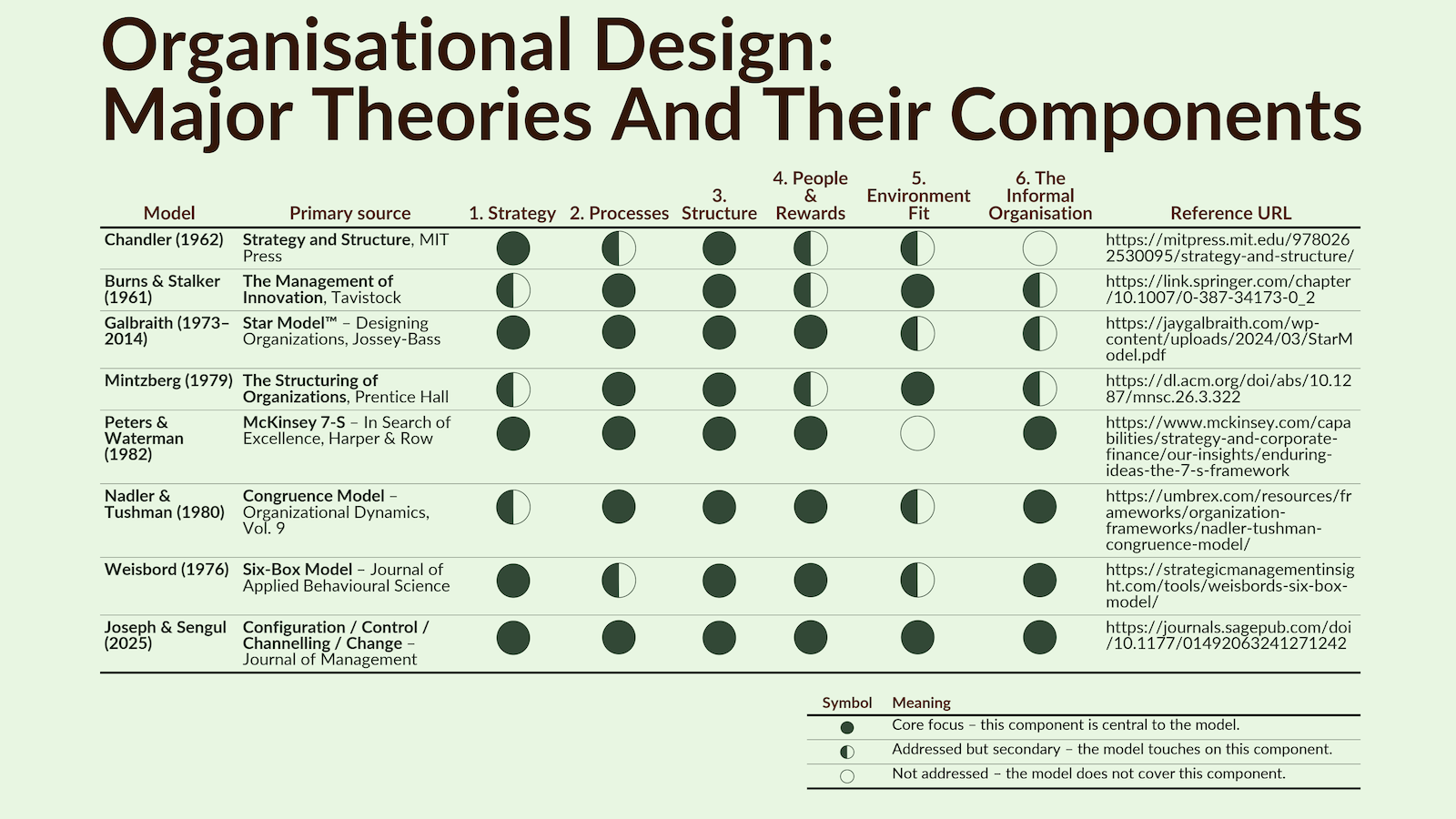
We took what we consider to be the eight most widely accepted models of organisation design and identified the general features of an organisation common to the models as a group.
This gave us six unbiased ‘components’ of organisation design – strategy, processes, structure, people and rewards, environment fit, and the informal organisation.
We did not want to build the measure to fit the results, so, as a further safeguard against bias or contemporary hype, we used the models’ definitions of each component, which pre-date AI agents by decades, e.g. Mintzberg’s 1979 definition of organisational structure.
As our hypothesis, we then defined the Human-Agent Organisation as described in the first section of the blog, and, in case we are right about the arrival of the Human-Agent Organisation, we assessed the impact it will have on each of the six components in the context of a generic modern digital company using five pre-defined levels of impact.
This gave us a picture of where the modern digital organisation will feel the effect of the Human-Agent Organisation, and to what extent. We report the one component it touches lightly as readily as the ones it reshapes.
The Counterargument and Our Response
Not everyone agrees that humans can – or should – remain in charge. In a recent Science paper, “Agentic AI and the next intelligence explosion,” James Evans, Benjamin Bratton, and Blaise Agüera y Arcas argue that the future of AI is not a single controllable machine but a plural, social ecology of agents that specialise, deliberate, and constrain one another like organisations, courts, and markets.
Their most pointed claim, for our purposes, is the idea of human-AI “centaurs”: hybrid human-and-agent actors whose collective agency, they suggest, comes to transcend individual control.
On that view, clean lines of individual human accountability are not the natural state of these systems but something that tends to dissolve as they scale – and the answer they reach for is “institutional alignment,” building checks and balances into the system itself rather than relying on any one person to stay in command.
It is a serious argument made by people deep in frontier AI, and we take it seriously.
The Human-Agent Organisation proposes a different idea – not a rejection of theirs, but an alternative. Yes, collective agency will tend to outrun individual control unless something is done about it.
That is precisely the problem a Human-Agent Organisation exists to solve. Where they describe control dissolving by default, a Human-Agent Organisation re-anchors it by design: through scoped agent roles, deliberate decision rights, span of agency, and an explicit accountability architecture that keeps a named human answerable for what agents do.
In other words, human accountability, is not a fact we can assume. Instead, it is a property a firm must engineer and maintain deliberately – and the firms that fail to engineer it will find the Science authors were right about them.
The articles that follow set out, component by component, what it takes to build an organisation in which humans stay in charge – not because control is automatic, but because it has been deliberately designed in.
Frequently Asked Questions
A Human-Agent Organisation is an organisation in which humans and AI agents jointly perform work within a system of human governance, oversight, accountability, and intervention. Unlike traditional organisations, part of the workforce is non-human, allowing decisions and tasks to be performed at machine speed and scale while accountability remains with people.
Traditional organisations are designed around a workforce composed entirely of people. A Human-Agent Organisation combines human workers and AI agents within the same operating model. This changes how work is divided, coordinated, supervised, and governed because AI agents can perform tasks continuously, operate at machine speed, and scale more rapidly than human teams.
Agentic AI changes more than the tools an organisation uses. It affects how work is performed, how decisions are made, how accountability is assigned, how teams are structured, and how performance is managed. Because it alters multiple components of organisational design, it represents an organisational change rather than merely a technology upgrade.
Agentic AI affects organisational design by changing how work is divided, coordinated, supervised, and governed. In our assessment, all six major components of organisational design are affected: strategy, processes, structure, people and rewards, environment fit, and the informal organisation. However, the greatest impact is on structure and processes because these determine how work is performed.
The most significant impact is the introduction of a non-human workforce capable of influencing and executing decisions. This changes the traditional assumptions that workers are human, accountable, and limited by time and capacity. As a result, organisations must redesign how work is allocated, supervised, and governed.
Not necessarily. Organisations will still require governance, accountability, leadership, and decision-making structures. However, organisational hierarchies may evolve because some work previously performed by people will be delegated to AI agents, requiring new reporting relationships, oversight models, and spans of control.
As AI agents perform more work, human roles increasingly focus on directing, supervising, challenging, and governing agentic processes. Important skills may include defining objectives, monitoring performance, handling exceptions, managing risk, intervening when necessary, and evaluating the quality of agent-generated work. The Agent Supervisor Development Programme provides a structured pathway for developing and demonstrating these capabilities.
Although AI agents may influence or execute decisions, accountability remains with the organisation and its people. AI agents cannot bear legal, regulatory, or moral responsibility. Organisations therefore need governance arrangements that ensure human oversight, intervention, and accountability remain in place.
A Human-Agent workforce consists of human employees working alongside AI agents that perform tasks, make recommendations, coordinate activities, or execute decisions. The workforce therefore includes both human and non-human contributors operating within the same organisational system.
Leaders should assess how AI agents affect organisational design, governance, accountability, workforce skills, operating models, and decision-making processes. Preparing early helps organisations adopt agentic AI deliberately rather than allowing organisational structures and governance arrangements to evolve unintentionally.