Table of Contents
Executive Summary
Agentic AI separates what people produce from what they remain accountable for, making people management for agentic AI at least as important as the technological rollout.
The greatest impact is on human capabilities: agents can absorb the routine work through which people have historically built professional and industry-specific judgement, forcing firms to compensate for this by redesigning learning and career paths.
Individual discretion, workload, motivation, and performance also change as agents influence which decisions humans make, concentrate non-routine (harder) exceptions on them, risk obscuring expertise, and complicate attribution.
Because human behaviour and software-enforced controls jointly determine whether humans stay in charge, fairness, psychological safety, and policy consistency become governance issues.
If the nine impacts describe work that still lies ahead for you, we offer a range of people management services for agentic AI to help. Skip to this section.

Introduction to People Management For Agentic AI
In The Advent of the Human-Agent Organisation ©, we assessed the impact of a combined workforce of humans and AI agents (AI systems that can perform tasks with some autonomy) on the six components of organisation design.
In the Human-Agent Operating Model, we drew a deliberate distinction: at operating model level, ‘Worker’ is the category for any human or non-human that performs labour, while ‘People’ is retained at organisation level for the human subset. The distinction follows Weber’s principle that authority attaches to the office, making a non-human occupant conceivable while accountability remains with a named person.
This article, therefore, is about people management for agentic AI: managing people with AI agents in the workforce.
The Human-Agent Organisation’s central claim is that humans remain accountable and stay in charge. Individual objectives, competence, discretion and reward – people management – are vital tools for implementing that claim and protecting the supremacy of humans, necessitating people management techniques change.
To examine people management for agentic AI, we identified nine components common to widely accepted independent theories of people management and assessed how agentic AI – the use of such agents – affects each. Our methodology, including the full mapping of the theories, is near the end of the article.
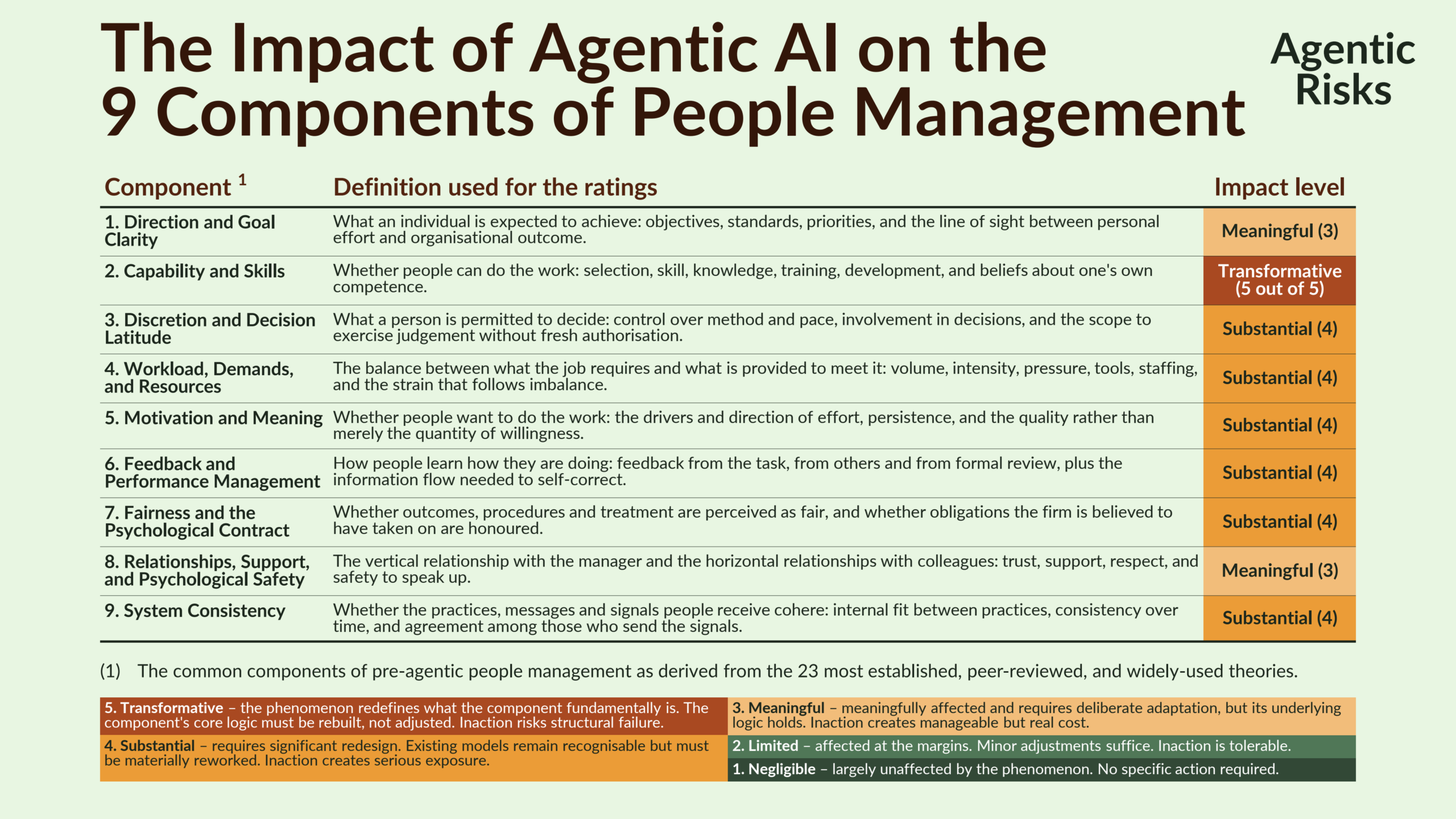
Applying the five-level impact assessment scale we use in all articles in the Human-Agent Organisation series, the impact on people management averaged at Level 4 ‘Substantial’, consistent with our organisation-level assessment of the People and Rewards component. That average includes one Level 5 (transformative) impact, which relates to what humans must be capable of, and how they become capable.
In this article, we describe each component, justify its impact assessment, outline key decisions and actions leaders should take, and note any considerations for regulated firms.
The 9 Components of People Management for Agentic AI
1. Direction and Goal Clarity
Description of the component
‘Direction and goal clarity’ covers what an individual must achieve: objectives, standards, priorities, and the link between personal effort and organisational outcome. Research has repeatedly supported Locke and Latham’s goal-setting theory, which holds that specific and difficult goals accompanied by feedback outperform simply telling people to do their best.
In the Human-Agent Organisation, what a person is ‘accountable for’ separates from what they ‘produce’. This makes the component distinct from performance management. Objective setting is where a manager translates the firm’s model of who is responsible for what into something an individual can act on.
For HR, treating direction separately matters because objectives are the earliest and cheapest way to detect a role change. For example, an output-volume target (a target for how much work gets done) that an agent now fulfils signals change months before a potential drop in engagement or rise in staff turnover.
Impact of Agentic AI – ‘Meaningful’ (Level 3 of 5) – in the era of agentic AI, the objective-setting mechanism will remain intact. Specific, difficult goals supported by feedback will continue to outperform vague ones. What changes is goal content. Measures of output volume become unreliable stand-ins for contribution once agents produce the output, and the assumption that greater effort should lead to better outcomes becomes less direct. The underlying logic holds, but the necessary adaptation makes the impact meaningful.
Asset management example – a bond investment team’s analyst objectives specified how many reviews of borrowers’ creditworthiness analysts should complete per quarter. With a research agent now producing first drafts, the team meets the same target in a fraction of the time, and it no longer distinguishes strong from weak performance. The team has rewritten objectives around the quality of challenge analysts apply to agent drafts, the rate at which analysts catch material errors before publication, and each analyst’s contribution to refining the instructions and limits they give the agent. The measure of a good quarter changed from how much the team produces to what would have gone wrong without this person.
Legal example – a commercial law firm still measures junior associates partly by billable hours and first-draft volume. Once a legal research and drafting agent produces first drafts in minutes, those targets reward activity the agent performs rather than the judgement the lawyer contributes. The firm shifts objectives toward the quality of instructions associates give the agent, the legal issues they identify, the errors they catch, and the quality of advice they ultimately deliver to the client.
Leadership Decisions and Actions
- Commission a review of objectives across functions that use agents to identify output-volume measures that an agent now satisfies and treat them as evidence that a role changed without redesign.
- Require objectives to distinguish what individuals produce from what they are accountable for; in a Human-Agent Organisation these are different (see Component 2 below).
- Mirror the governance distinction in objectives: set goals on the quality of the boundaries people set for the agent, such as whether its instructions and limits were clear, separately from outcomes the agent produces within those boundaries.
- Task HR with maintaining objective-setting guidance in step with agentic deployments.
Regulatory Considerations – Training and Competence rules require firms to show evidence that people are competent for the roles individuals perform. A mismatch between documented objectives and a person’s actual work weakens the evidence supporting that judgement. Under the Senior Managers and Certification Regime (SMCR), a senior manager’s statement of responsibilities should match the objectives that manager sets for the people under their supervision; make sure that match survives an agentic deployment.

2. Capability and Skills
Description of the component
Capability covers whether people can do the work: selection, skill, knowledge, development, and belief in their competence. It is the ‘Ability’ element in Appelbaum and colleagues’ Ability-Motivation-Opportunity (AMO) framework, and the object of Bandura’s finding that self-efficacy – a person’s belief that they can succeed – predicts persistence independently of ability.
The Human-Agent Organisation brings two simultaneous changes:
- Everyone becomes a supervisor – the first is a new category of skills – human workers of all levels of seniority now need to set out and delegate work (for agents), supervise the production of work, decide what to do when they disagree with an output, and how to refer difficult cases for review.
- Supervising the supervisors – the second involves managing teams of people who supervise agents, where managers supervise people whose own job is to supervise agents.
The second change is more fundamental and less visible. In professional firms, apprenticeship has always developed judgement: juniors acquired professional and industry-specific judgement by doing routine work under supervision, risking low-cost errors and gradually earning more trust. But agents will absorb that routine work through which apprenticeships created acumen through experience.
This raises one of the most important HR implications of agentic AI: a workforce planning problem that may emerge over three to five years, while its longer-term effects may persist beyond the immediate business case for an agentic transformation.
Impact of Agentic AI – ‘Transformative’ (Level 5 of 5) – this is a fundamental change to required skills, because it removes the mechanism that historically formed professional judgement. For a few years, organisations can hire experienced practitioners, but then what? They must rebuild how they develop capability: a transformative impact.
Investment example – an asset manager’s career path for investment analysts assumed roughly three years of data gathering, model building and initial commentary before the firm trusted analysts to make investment recommendations. Research agents now perform that work in hours. The firm rebuilds the pathway around deliberately planned experience: analysts rotate through reviewing agent recommendations and deciding whether to accept them into investment portfolios carrying progressively more risk, the firm records each judgement call and outcome and uses that documented record to inform promotion. The firm must now design, schedule, and document learning that previously happened automatically through the work.
Accounting example – an audit firm has traditionally developed junior auditors through reconciliations, evidence matching, and first-pass testing before asking them to exercise judgement on harder audit issues. An agent now performs much of that routine work. The firm creates a structured progression in which juniors review agent-selected samples, investigate exceptions and explain their conclusions to a manager, so they still build the judgement that routine audit work once developed.
Leadership Decisions and Actions
- Commission a planned way to develop judgement to replace learning by doing the work, and cease assuming seniority will produce judgement through time served.
- Add agent-supervision skills – giving agents clear instructions, deciding between human and agent judgements, and escalating problems – to skills frameworks as a distinct skill set in its own right.
- Identify and develop the capability to manage teams of people who supervise agents. Established frameworks describe supervisory layers in form; this new layer is distinctive because its members primary work is supervising non-human workers. We return to this in the Structure component.
- Identify the work to retain for humans to preserve vital capability; record the decision and reasoning, and review it annually.
- Make agentic AI workforce planning part of the business case: direct HR to model the future pipeline of managers and senior managers and monitor it post-deployment.
Regulatory Considerations – Training and Competence rules assume that firms build and demonstrate competence through supervised experience. Where agents absorb that experience, firms should expect to justify how staff develop and evaluate competence. Under SMCR’s Certification Regime, firms must make an annual formal confirmation that a person is fit and proper for their role; firms confirming the competence of individuals whose underlying experience has always involved agent assistance will need to explain what evidence supports that confirmation.

3. Discretion and Decision Latitude
Description of the component
Discretion (or ‘autonomy’) covers what a person may decide: control over method and pace, involvement in decisions, and the scope to exercise judgement without fresh authorisation. Autonomy is one of five features of a job in Hackman and Oldham’s model and among the most consistent predictors of motivation and satisfaction in research on how jobs are designed.
The Human-Agent Organisation delegates a proportion of autonomy from humans to AI agents. As a result, human freedom to decide becomes what remains once the firm sets an agent’s span of agency – the boundary of an agent’s delegated discretion to act without seeking fresh authorisation each time. Discretion therefore changes from a feature of a role that manager and job holder shape together to a setting the firm fixes when it configures the agent. Where that boundary sits is a structural question and how it is enforced is a governance question; here we are concerned only with its effect on the job holder.
This matters to HR because technology, risk or change functions often set that configuration, so HR needs a role in considering its effect on the job holder. Treating it distinctly lets HR intervene at the decision point.
Impact of Agentic AI – ‘Substantial’ (Level 4 of 5) – humans still need to exercise judgement, and autonomy still predicts the same outcomes. What changes is that whoever defines the span of agency must now deliberately divide autonomy between human and non-human workers. A particular outcome to avoid is when a role gains difficulty while losing control, which is a combination research on job design identifies as the least favourable. Existing models remain recognisable but require material rework, making the impact substantial.
Operations example – an operations team that checks different records match held wide latitude over how to investigate mismatches, in what order, and how long to spend. An agent that handles unusual cases now resolves routine cases and routes the rest. On paper the team’s work looks richer and more challenging: every item is non-routine. In practice the agent’s routing rules determine what reaches the team and in what sequence, so control over method and pace has narrowed as the mental difficulty of every item has risen. So, while the deployment records a richer, more exciting job, in practice, the team has less influence over more demanding work.
Legal example – a contract-review agent classifies clauses, proposes fallback language, and sends only exceptions to lawyers. The lawyers now see fewer routine clauses but more difficult ones, while the agent determines which issues reach them and which negotiating options appear first. The firm therefore defines which decisions the agent may make, which options lawyers must see, and when lawyers can override the agent.
Leadership Decisions and Actions
- Treat the allocation of decision-making freedom as an owned business design decision: require every span-of-agency decision to state the human discretion that remains and have the accountable manager approve it.
- Give agent supervisors genuine authority to pause, override and redirect agents, and require evidence that supervisors exercise that authority.
- Review roles that use agents for rising difficulty combined with falling control and treat that pattern as a design problem that leaders must fix.

4. Workload, Demands, and Resources
Description of the component
This component covers the balance between job demands and resources: volume, intensity, pressure, tools, staffing, and strain when demands outrun resources. Bakker and Demerouti’s Job Demands-Resources model is the most developed theory centred on this balance, building on earlier demand-control work, and it is the only theory in our set that treats that balance as its central subject.
People management in the age of agentic AI must account for both the mix and quantity of work. Agents absorb many routine tasks that required relatively little mental effort and leave exceptions, judgement calls, and difficult cases for humans. As a result, a day that previously alternated between demanding and undemanding work could become uniformly demanding. AI agents also create a new demand: continuous supervision of output that agents produce independently, faster and at greater volume than humans ever managed manually.
For HR, this component is most likely to generate visible failures that firms wrongly blame on other causes. Measurements planned before an agentic deployment help HR trace later increases in sickness absence, error rates and turnover back to the deployment.
Impact of Agentic AI – ‘Substantial’ (Level 4 of 5) – total task volume may fall, making the change look harmless if firms judge it only by staff numbers or output volume. But the nature of work intensifies: low-demand work that previously provided some relief and respite disappears, and a new need for sustained attention appears. Firms can still use existing workload and staffing models, but they must rework them to measure both the mix and volume of work, making the impact substantial.
Onboarding example – a client onboarding team keeps staff numbers unchanged while an agent absorbs document collection, data entry and initial screening. The team’s day once mixed straightforward processing with difficult cases; now it contains only difficult cases, plus reviewing several times more agent decisions than it ever processed manually. Output increases and error rates hold. Eighteen months later, sickness absence and voluntary turnover in the team are materially above the firm’s average and their prior trendline, even though the firm still records the deployment as a technical success.
Accounting example – during a year-end audit, an agent completes routine reconciliations, evidence matching and first-pass testing overnight. The audit team arrives to a queue composed almost entirely of exceptions, judgement calls, and agent outputs requiring review. Although the number of manual tasks falls, the day becomes more mentally demanding, so managers cap how much agent output each reviewer can safely oversee.
Leadership Decisions and Actions
- Measure both the mix and volume of work before and after deployment, capturing the mental effort required and the distribution of demanding and undemanding tasks across the day.
- Set limits on how many agent decisions one person can meaningfully review, and enforce them as firm limits on deployment.
- Treat recovery between tasks as a requirement of the redesigned role or risk burning out the staff who know how to operate your agents.
- Instruct HR to track absence, turnover, and error rates in teams that use agents for twelve to eighteen months and report them alongside deployment efficiency benefits.
Regulatory Considerations – Operational resilience rules depend on humans’ ability to detect and respond to disruption within the limits on disruption the firm has said it can tolerate (its impact tolerances). An oversight function operating beyond sustainable capacity is a weakness in operational resilience that the firm’s maps of which important business services depend on which people and systems may miss because it appears staffed. Firms should consider whether their scenarios for severe but plausible disruption include the loss of effective human oversight.

5. Motivation and Meaning
Description of the component
Motivation covers whether people want to do the work and the quality as well as quantity of that willingness. Self-Determination Theory, applied to work by Gagne and Deci, holds that three needs sustain motivation: autonomy (freedom to decide), competence (feeling capable) and relatedness (feeling connected to others).
Deploying agents affects all three:
- Competence – a person’s sense of competence can weaken when an agent takes over work they were demonstrably good at.
- Autonomy – how the firm allocates decision-making freedom reshapes autonomy.
- Relatedness – people’s sense of connection changes if teams shrink, reconfigure, or move from working together to produce output to supervising separate agents in parallel.
There is also the question of visible evidence of expertise. The status a task gives someone is a major source of meaning at work, and the two can be easy to confuse when deciding what to automate. Preprint evidence that users prioritise human involvement, control, reliability, and accountability over increasing automation suggests a gap between what firms could automate and what they should automate.
Impact of Agentic AI – ‘Substantial’ (Level 4 of 5) – motivation theory remains valid, while sustaining motivation requires change because agent deployment can threaten employees’ need to feel competent. Does the HR profession have an established playbook for that? Existing models of employee engagement remain valid but need material rework, making the impact substantial.
Reporting example – a team that analyses performance welcomed an agent that removed a tedious monthly reporting cycle, then disengaged steadily over the following two quarters. The prior tedium was real making its removal initially popular. The monthly report had also made the team’s expertise visible to the rest of the business. The deployment removed that signal, and within a year three of the team’s five members had moved to roles where their contribution was visible again.
Consulting example – a strategy team adopts an agent that drafts research summaries, market scans, and first-draft slides. Consultants welcome losing repetitive production work, but junior staff soon find that fewer moments remain to demonstrate synthesis and insight to managers and clients. The firm redesigns project roles so consultants still own visible problem framing, challenge, and client-facing recommendations.
Leadership Decisions and Actions
- Direct HR to identify where each function demonstrates competence and specify what will replace that signal once the task moves to an agent.
- Require deployment proposals to distinguish what the firm should automate from what it could automate, recording why when the answers differ.
- Treat early enthusiasm as a poor predictor of sustained motivation, and measure engagement when the agent goes live and again at six and twelve months.
- Make retaining motivated human workers an explicit measure of deployment success, weighted alongside efficiency.
Regulatory Considerations – regulatory conduct rules assume that individuals are motivated to raise concerns and challenge poor outcomes. If motivation falls, so too will willingness to challenge agent output, weakening a control the firm relies on. This makes motivation both an HR issue and a legitimate concern for the risk function because it affects whether a regulatory safeguard works.

6. Feedback and Performance Management
Description of the component
Feedback covers how people learn how they perform: from the task itself, from colleagues and managers, and from formal review. Two important cautionary findings sit here:
- Kluger and DeNisi’s meta-analysis (a study combining results from many other studies) found that over a third of attempts to improve performance through feedback reduced performance, with effectiveness falling as attention moves away from the task and toward the self.
- DeNisi and Murphy’s review of a century of research concluded that improved individual appraisal has no established link to improved firm performance.
A core challenge in people management for agentic AI is attribution – deciding who is responsible for an outcome. When a human and an agent jointly produce an outcome, it is unclear whose performance the firm should appraise. The available answers are unsatisfactory. Attributing an agent’s error to the human penalises them for a system they may not have built. Attributing it to the agent removes the human incentive to review carefully.
Monitoring of agents makes available far more performance data. The temptation to feed it all back is strong, but evidence indicates doing so is likely to worsen performance.
Impact of Agentic AI – ‘Substantial’ (Level 4 of 5) – feedback after an event remains necessary. What changes is that what or whom the appraisal evaluates becomes contested, and the volume of available performance data rises sharply as research suggests firms should be selective. Appraisal systems remain recognisable but require material redesign to make responsibility clear, making the impact substantial.
Client reporting example – an analyst’s client report contains an error from an agent’s data gathering that survived the analyst’s review. Appraising the analyst on the outcome attributes a system failure they could not reasonably have prevented at scale. Calling it an agent failure removes the incentive to review carefully. The firm instead appraises the analyst’s process: did the analyst perform a check, focus the sample appropriately on higher-risk cases, and refer the unusual result for further review? The firm records the outcome but judges the method the analyst used.
Leadership Decisions and Actions
- Decide before deployment whether appraisal judges the final output and / or the process the human used and then apply it consistently across roles that use agents.
- Separate feedback on how people set the agent’s boundaries from feedback on outcomes within those boundaries, mirroring the established split in governance of agents.
- Keep feedback volume and frequency even when monitoring of agents provides more data.
- Require managers to review data from monitoring agents for attribution before appraisal.
Regulatory Considerations – the UK Consumer Duty’s focus on outcomes for small numbers of affected customers, not overall averages alone, implies that firms should identify which person exercised judgement in each outcome. An appraisal model therefore needs a clear rule for assigning responsibility. Where firms link pay to performance, unresolved attribution itself creates conduct risk – risk arising from how people or the firm behave.

7. Fairness and the Psychological Contract
Description of the component
This component covers whether employees perceive outcomes, procedures, and treatment as fair, and whether the firm honours obligations employees believe it has taken on:
- Colquitt’s work established four types of organisational justice – meaning fairness of outcomes (distributive), processes (procedural), treatment (interpersonal) and explanations (informational).
- Rousseau’s research on the psychological contract – the unwritten expectations between employee and employer – established that breaking an obligation employees believe existed predicts withdrawal from work more strongly than dissatisfaction.
Deploying agents creates many events likely to raise fairness concerns in a short period: who receives agent support and who does not; whose role the firm redefines; whom it redeploys and on what basis; and whether unwritten expectations about career progression survive removal of the work they relied on.
Firms often fail on explanation, yet it is the cheapest dimension to fix. A decision that is fair on every measurable dimension may still seem unfair if the firm explains it poorly.
Impact of Agentic AI – ‘Substantial’ (Level 4 of 5) – the mechanism is unchanged; feeling unfairly treated still predicts withdrawal from work. What changes is the volume and visibility of events that raise fairness concerns; many may touch unwritten career expectations, which firms have far less practice renegotiating than pay or process. Existing ways of managing employee relations need material rework, making the impact substantial.
Investment research example – a firm deploys research agents to its equity team but not to its credit team, on cost alone. The credit analysts read the decision as a statement of their relative importance. The firm based the allocation on cost but left the rationale unexplained, allowing the analysts’ interpretation to persist.
Leadership Decisions and Actions
- Treat every deployment decision as a communication decision and require an explanation for all affected functions.
- Identify where the implied career bargain has changed and renegotiate it explicitly with staff.
- Apply consistent, stated criteria for deciding which functions receive agents, and show how leaders applied them.
- Direct HR to monitor the number of concerns raised and grievance patterns in functions that use agents as an early sign that employees feel the firm has broken the unwritten bargain.
Regulatory Considerations – perceived unfairness makes people less likely to raise concerns, yet regulatory conduct rules depend on people raising concerns effectively. Firms should test whether arrangements for raising concerns and whistleblowing cover agent-related concerns and make that coverage clear to staff. Where deployment triggers redundancy or material role change, existing consultation obligations will apply in full regardless of its technological origin.

8. Relationships, Support, and Psychological Safety
Description of the component
This component covers the relationship with a manager and relationships with colleagues: trust, support, respect, and the safety to speak up. Three well-established areas of research apply here:
- Graen and Uhl-Bien’s Leader-Member Exchange research shows that managers form different quality relationships with different team members, and that the quality of those relationships predicts outcomes.
- Rhoades and Eisenberger’s review combining results from many studies established employees’ sense that the organisation supports them as an important factor.
- Edmondson’s psychological safety research explains when people feel safe to take risks in interactions with others.
The relationships remain between humans, so the established theory still applies. What changes is psychological safety’s function:
- In a human-only organisation, failing to raise a concern about a colleague’s work causes a delay.
- In a Human-Agent Organisation, failing to voice a concern about an agent’s behaviour lets an error spread (as before) but faster and potentially further.
Psychological safety therefore moves from something that helps performance to a safeguard against risk, and it belongs on the formal list of risks as well as the engagement survey.
Impact of Agentic AI – ‘Meaningful’ (Level 3 of 5) – the relationship remains human to human, the established theory still holds, and managers matter for the same reasons. What changes is the consequence of failure: silence now lets the effects spread faster. This requires adaptation of how firms measure and act on psychological safety, but the underlying logic is undisturbed, making the impact meaningful.
Operations example – a junior operations analyst notices an agent consistently misclassifying a transaction category. A member of the executive committee sponsored the agent, and leaders cite it internally as an early success. The analyst stays silent for two months. The failure is cultural; any competent technical review would catch the issue. The team’s psychological safety was too weak to support a challenge to an executive-sponsored system, and the role lacked an explicit expectation to escalate concerns.
Leadership Decisions and Actions
- Make challenging agent output a named role expectation and write it into the description of every role that uses agents.
- Separate executive sponsorship from oversight by giving those best placed to identify problems an independent reporting line.
- Measure psychological safety within teams that use agents and treat low results as risk issues requiring leadership action.
Regulatory Considerations – regulatory supervision of conduct and culture treats the willingness to raise concerns as evidence of an effective system of safeguards. Unreported agent errors may trigger scrutiny of the firm’s culture. Senior managers relying on staff challenge – staff being willing to question decisions or outputs – as a safeguard to reduce risk should show that this challenge happens in practice.

9. System Consistency
Description of the component
System consistency covers whether practices, messages and signals fit together and reinforce one another, consistency over time and agreement among those sending them. Bowen and Ostroff’s work on HR system strength – how clearly and consistently HR practices send the same message – establishes the condition: HR practices only produce the intended effect when they are distinctive (easy to notice and understand), consistent and consensual (those delivering them support them), so that people share an unambiguous understanding of what the firm expects and rewards.
The Human-Agent Operating Model introduces a second way of sending signals. Governance for agents moves from written policy to coded enforcement – rules built directly into software – substantially improving reliability. But the organisation now signals through two channels:
- Policies for people.
- Software-enforced controls for agents.
If they diverge, software-enforced rules will win because people infer rewards from what the firm permits. This creates a distinctive challenge when managing a human-agent workforce. The organisation may then look to HR to keep messages consistent with governance rules owned elsewhere and difficult to inspect, making early HR involvement essential.
Impact of Agentic AI – ‘Substantial’ (Level 4 of 5) – the condition for HR effectiveness remains as demanding as Bowen and Ostroff described. Meeting it now requires keeping the two sets of signals aligned with different owners, vocabularies and rates of change. This significantly redesigns how firms develop and check people policies, making the impact substantial. It is also where theory is thinnest, addressed below.
Expense approval example – a firm’s stated values emphasise professional judgement and considered decision making, and its performance appraisal system rewards both. Its deployment of agents builds a software rule that automatically approves anything below a set financial amount without human review. Staff infer what the firm values from the control. The stronger, software-enforced signal contradicts the weaker written one, and the values statement loses force.
Consulting example – a consulting firm tells engagement leaders that professional judgement should determine how teams allocate work, while a staffing agent automatically assigns people to maximise utilisation and margin. Managers quickly learn that actual staffing follows the software rule. The firm either changes the software rule or changes the policy so both send the same message.
Leadership Decisions and Actions
- Assign named accountability for the consistency of the combined human and agent message and give HR a formal role in governance design for agents because software-enforced controls are among the firm’s strongest signals to people.
- Commission regular checks for conflicts between stated people policy and software-enforced agent controls and treat divergence as an issue with a named owner and deadline for fixing it.
- Require HR to review any software-enforced control that affects how people work for effects on people policy before deployment.
Regulatory Considerations – regulatory supervision of culture and conduct looks for alignment between a firm’s stated and actual incentives. Software-enforced controls give regulators direct, inspectable evidence of actual incentives, and firms may find them harder to present favourably than a values statement. When judging culture, regulators can be expected to read controls as well as policy.

People Management For Agentic AI – Services
If the nine components above describe work that still lies ahead for you, these three services are where firms usually begin.
The smallest step establishes who is answerable for what. Our Agentic Workflow Accountability Mapping audits one or two workflows at the task level: the tasks a deployment creates as well as removes, the human accountable for each non-human worker, and a Span of Agency for each agent. It identifies the role descriptions and statements of responsibility that need updating to match the work.
If your agents are live, the next question is whether the human supervisors can cope. Our Agent Oversight Capacity Measurement measures agent-to-agent handoffs per supervisor, review quality, and the shift in work mix once agents absorb the routine tasks that once provided recovery in the day. You finish with defensible and stress-tested review limits.
Further out, and requiring a larger commitment, agents absorb the routine work that formed the apprenticeships through which junior staff build judgement. Our Agent Supervisor Development Programme counteracts that by adding agent-supervision skills to your skills framework as a distinct skill set, and building the new management layer whose members mainly supervise non-human workers.
Methodology
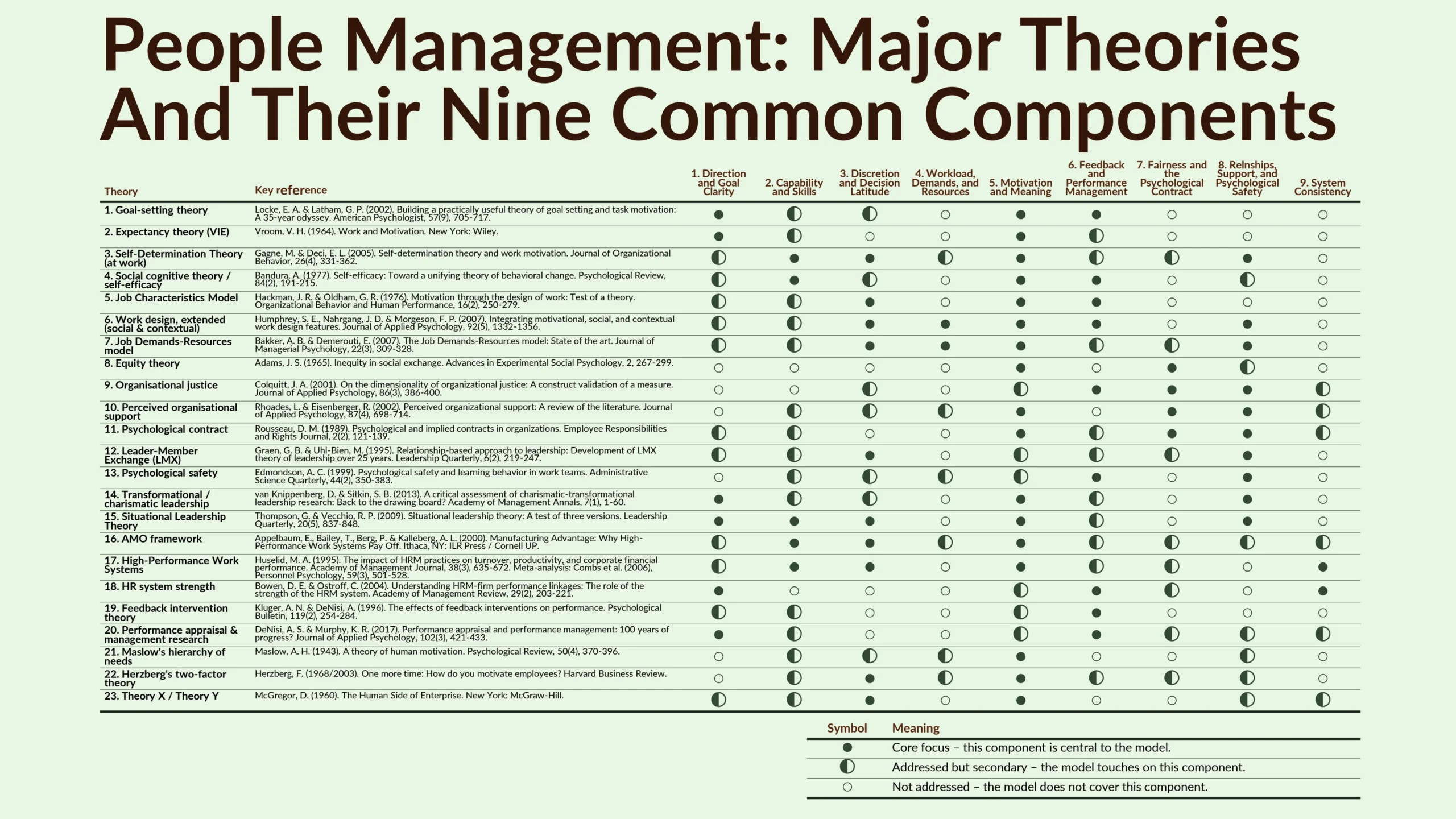
We selected people management theories using two tests: how well established they are in peer-reviewed research based on observed data, or how widely practitioners and educators use them. Twenty-three qualified, spanning motivation, work design, demands and wellbeing, exchange and fairness, leadership, and strategic human resource management. We cite each to its most authoritative published source or, where researchers dispute a theory, its strongest critical assessment.
We derived the nine components of people management by restating each theory’s main claims in plain, non-theory-specific language and comparing the underlying ideas, which yielded nine recurring concerns. Reward sits within Feedback and Performance Management, where attribution determines what the firm can defensibly reward, and within Fairness and the Psychological Contract, where distributive justice governs how people judge the result. We then rated each theory as having a core or secondary focus on a component (noting any blanks as ‘not addressed’).
Four entries (Maslow, Herzberg, Situational Leadership and transformational leadership) have weak or disputed research evidence and we marked them accordingly. We retained them because practitioners widely use them. Since broadly worded theories can appear to fit almost any framework, we tested how much they influenced the result and found that removing all four leaves the pattern unchanged: every component remains a core focus of at least two theories developed independently and the two thinnest remain thin. Therefore, we include the four as evidence of prevailing beliefs in the field.
We then assessed each component against the Human-Agent Organisation’s five-level impact scale: Negligible, Limited, Meaningful, Substantial and Transformative. The nine components yield one Level 5 impact, six Level 4s and two Level 3s: 3.9 on average, rounding to the organisation-level People and Rewards assessment of Level 4 Substantial.
Three limits apply:
- Because we derived the components by looking for recurring themes, recurrence is partly built into the method.
- We drew the set from mainstream theories developed mainly in the UK and US.
- These theories were developed around human workforces; we offer the nine components as a testable structure for a workforce combining human and non-human workers.

Two Hypotheses For Where the Theory Is Thin
Mapping the nine components against the body of theory produced an unexpected finding. Two components have markedly less support from established theory than the rest, yet both receive a Substantial impact assessment. ‘Workload, Demands and Resources’ and ‘System Consistency’ are main focuses in only two of the twenty-three theories we assessed, versus seventeen for motivation and ten each for discretion and relationships.
The two components where established people management theory offers the least guidance are those hit hardest by agentic AI. These gaps matter for people management for agentic AI because practitioners facing these questions will have limited well-established research to draw on. We therefore set out two hypotheses and how to test them.
The Demand Displacement Hypothesis
We hypothesise that agentic AI changes the mix of human work more than it reduces workload, adversely in ways current measures miss.
Specifically: agents remove many routine tasks requiring relatively little mental effort while concentrating judgement and oversight requiring high mental effort, plus handling unusual cases. Under the Job Demands-Resources model, which looks at the balance between work demands and the resources available to meet them, the total amount of work may fall while strain rises, because agents also absorb routine work that provided recovery within the day. If this holds, engagement and strain will move together after deployment rather than apart, contrary to the current model.
Testing requires four things:
- Measure the same people or teams before and after deployment using established Job Demands-Resources (JD-R) questionnaires, creating longitudinal evidence beyond the single point captured by typical engagement surveys.
- A workload measure that separates task volume from mental effort, since existing staffing models treat them as the same thing.
- We need to create and test a measure of agent-oversight workload.
- Comparison across functions at materially different levels of agent use within the same firm, allowing for other changes happening during the transformation.
Firms deploying at scale over the next two years will inadvertently run the real-world test that could answer this. They should recognise this and plan measurements before deployment.
The Signal Divergence Hypothesis
We hypothesise that the conditions needed for HR practices to send clear and consistent messages become materially harder to meet once software automatically enforces part of governance.
Bowen and Ostroff formulated their requirements for clear, consistent messages supported by those delivering them for organisations whose signals to people travelled through forms people could read. Software-enforced governance is a stronger signal because it determines actual outcomes more directly than written policy. Where the two diverge, we expect the clarity and consistency of the HR system to weaken even with well-designed HR practices, because software enforces half the signals beyond the direct visibility of the people affected.
A second tension may also be present. Well-supported Leader-Member Exchange theory, which examines the different relationships managers form with individual team members, holds that the quality of those relationships predicts outcomes. Also, well-supported HR system strength theory, which examines whether HR practices send a clear and consistent message, holds that effective HR systems require consistency. These have coexisted uneasily for two decades. Governance of agents forces the issue: software-enforced controls apply in the same way to everyone while managerial relationships remain differentiated, so firms must decide when to treat everyone the same and when different treatment remains legitimate.
Testing this requires adapting existing measures that researchers use to assess HR system strength to capture software-enforced rules and written messages, plus case studies of firms that use software-enforced governance widely, comparing the signals staff report receiving against the rules the software actually enforces. We would expect the gap to predict the same outcomes as weak HR systems.
We will consider both hypotheses as our work on people management for agentic AI progresses, and we encourage firms to test either against their deployment experience.
Frequently Asked Questions
People management for agentic AI means managing humans in an organisation where AI agents also perform work. It keeps People distinct from non-human ‘workers’ and focuses on human accountability, capability, discretion, workload, motivation, performance, fairness, relationships and policy consistency. It is central to keeping humans in charge in the Human-Agent Organisation and its purpose is to turn human accountability into operational practice.
Agentic AI separates what people produce from what they remain accountable for. It can remove work that builds judgement, change human discretion, concentrate harder work, alter motivation and visible expertise, and complicate performance attribution. And it can create fairness concerns, increase the importance of psychological safety, and make software-enforced controls part of people management.
People need skills in giving agents clear instructions, supervising agent output, deciding between human and agent judgements, and escalating difficult cases. Managers also need to lead people who supervise agents and decide how to delegate tasks between humans and non-humans. If agents absorb routine apprenticeship work, firms need deliberately designed experiences that build and demonstrate judgement.