Table of Contents
Executive Summary
AI agent vendor management starts with recognising that your agents depend on other people’s technology, leaving you accountable when suppliers change, fail or suffer an attack.
In response, we recommend building a defensible position through five components: due diligence, accountability, contracts, verifiability and the freedom to leave.
That means knowing your agentic supply chain, assigning control owners, agreeing agent-ready contracts, testing vendor assurances and maintaining exit plans.
Our Agentic AI Risk Control Framework and Shared Responsibility Model provide practical controls and a way to allocate responsibility, while our Agentic AI Readiness Assessment evaluates your organisation’s maturity in managing these and the other prerequisites.
Download the Agentic AI Risk Control Framework and take our Agentic AI Readiness Assessment.

Your Agents Depend on a Supply Chain of Vendors
All of our AI agents run on other people’s technology. As a result, when a model provider, platform or tool supplier changes, fails, or suffers an attack, your agent will change or fail too – and, if this causes any adverse impact, your clients and regulator will look to you.
We define an AI agent vendor or external dependency as any party or component outside your direct control that your agents rely on to reason, act, remember, or connect, and whose failure, update or compromise could affect what your agents do. That covers six groups, and every subcontractor (sub-processor) beneath them:
- Model providers, including open-weight models and versions modified from them.
- Agent platform providers.
- Tool and connector suppliers, including other agents your agents call.
- Data and knowledge sources.
- Cloud and infrastructure providers.
- Existing suppliers that add agents to products you already use.
The dependence is growing. In UK financial services, third-party systems now make up 53% of high-materiality AI systems, up from 35% in 2024, and 80% of the firms surveyed have agents deployed (Bank of England and UK’s Financial Conduct Authority, October 2026).
Three recent developments raise the stakes for professional services firms:
- First, the connectors that let agents use other systems have become a route for attack. The Cloud Security Alliance advises firms to list every connector, check where it came from, run it in isolation and alert on any change to it. OWASP lists agentic supply-chain weaknesses among its top ten risks for agent applications.
- Second, regulators have spelled out who stays accountable. The FCA has put it plainly: “Firms can outsource AI services, but remain responsible for them.” Similarly, the Solicitors Regulation Authority’s August warning notice makes clear that using AI does not transfer a firm’s professional responsibilities.
- Third, EU liability rules now apply to software. From 8 December 2026, the EU’s new Product Liability Directive extends its rules on defective products to software, including AI systems.
The same facts create an opportunity. If you can show who controls each link in your chain, you can adopt agents faster and answer regulators’, clients’ and insurers’ questions with evidence.

Rely on Assurances, or Build Your Defences?
Who pays when an agent causes harm remains an open question. The EU withdrew its proposed AI Liability Directive in 2025, leaving fault-based claims to national law. The Law Commission of England and Wales warns that complex AI supply chains can make it hard to determine who should be responsible.
A working group convened by Singapore’s Infocomm Media Development Authority (IMDA) found that contracts allocate risk only between the parties who sign them, reflect each side’s bargaining power, and leave open who bears the loss when an agent acts in unforeseen ways.
One early case could be a sign of things to come: a Canadian tribunal held an airline liable for its chatbot’s wrong advice and rejected the argument that the chatbot was responsible for its own actions.
That leaves every firm with a choice:
- We could rely on our vendors’ assurances and standard terms. If an agent then causes harm, we would carry the accountability without the evidence to show we took reasonable care. For example, the FCA names reliance on untested vendor assurances as an area for improvement.
- Or we could build a defensible position, providing evidence that we took reasonable steps within our control. The IMDA group judged whether a party met its standard of care by the safeguards it applied within its own area of control – for a deployer, that includes the choice of use case. At Agentic Risks, we believe this second route is the one that will let our clients scale agents with confidence and the lowest risk of post-deployment issues.

The 5 Components of Defensible AI Agent Vendor Management
This makes it important, therefore, to define a ‘defensible position’ so that we can help our clients achieve it. For us, at Agentic Risks, it comprises five components – each essential, because it creates the evidence you may need on the day something goes wrong, thereby, proactively reducing the probability and impact of any future issues.
1. Due diligence: know your agentic supply chain
For every agent, you should be able to list each model, platform, connector, data source and subcontractor it uses, with a named owner for each relationship. The FCA saw firms keeping inventories of their AI use cases and the models beneath them.
For example: an asset manager’s research agent calls two models, a market-data connector and a document store. When the connector’s supplier announces a change, the relationship owner should be able to see at once which agents it impacts.
2. Accountability: every control has an owner
For each control, you record who runs it: your provider, your build choices, your operations team, or a documented split between you. Where you identify a dependency on a provider, you should maintain up to date evidence – an audit report or a contractual commitment – because a vendor’s certification will only cover their obligations, leaving you to manage yours.
For example: a law firm builds agents on a third-party AI platform. Asked how it protects privilege, it shows which controls the platform runs, with the platform’s audit report, and which controls the firm runs itself.

3. Contracts: your legal agreements fit agents
Your contracts should include these standard terms: no training on your data, control of subcontractors, and liability that matches AI-specific harm. They should also cover what agents add, giving you the facts you will need if something goes wrong:
- Disclosure of the full agent architecture, including sub-agents, chained models and connectors.
- The right to audit action logs.
- Clarity on where the agent’s instructions can be overridden, and by whom.
- Prompt notice of incidents and of material model or service changes.
- Service levels for failure, rollback and exit.
4. Verifiability: you can test what vendors tell you
You should be able to test vendor updates before they reach your users, fix the versions you depend on, run external tools in contained environments and recheck key suppliers at set intervals.
For example: the FCA describes firms using contract terms to get notice of significant model changes, so they could test updates without disrupting services.
5. Freedom: you can leave
For material use cases, your architecture should be able to switch provider. The FCA has also describes one firm that designed its service to work with more than one model, and another that built a product around a single model and had to redesign it when that model was retired.

AI Agent Vendor Management Tools and Controls
The agentic supply chain can be hard to see, so create a dependency map. Control 18.01 of our Agentic AI Risk Control Framework recommends recording every external dependency for each agent component and building fallback logic so agents keep working when one fails. As your checklist, use the six groups listed earlier in this blog.
Liability is unsettled, and each party may assume the other runs a control, so create a shared responsibility allocation.
- Our Agentic AI Shared Responsibility Model gives every control one of four allocations – platform-inherited (run by a provider), builder-owned, deployer-owned or shared – under six rules.
- Two are central: you treat a control as platform-inherited only with named evidence and a contractual basis, and a named person in your firm stays accountable for every control, whoever runs it.
- Control 18.04 of our Agentic AI Risk Control Framework advocates for recording that accountability chain for each deployment, and the model builds on shared-responsibility work by the Cloud Security Alliance and the Coalition for Secure AI from the deployer’s side.
- It also tests when building on a platform makes you the provider of a high-risk AI system under Article 25 of the EU AI Act. It applies the fifth of my twelve criteria for assuring agent deployments.
Standard terms favour the vendor, so prepare an agent-ready contract schedule. Control 18.03 sets out the provisions to require, and our Agentic AI Governance Framework explains why each matters while liability remains unsettled.
Vendors may change things while your agent is running so implement testing and containment controls. Control 18.02 recommends you test vendor assurances before relying on them; 18.07 fixes API versions and alerts you to vendor changes; 18.10 runs agent tools in per-agent sandboxes with outbound access blocked by default; 18.11 keeps a signed registry of prompts, templates and evaluation data and rejects anything unsigned.
Switching looks too costly, so perform a test exit. Control 18.08 advises keeping your designs portable across platforms, tests portability every year and, for material use cases, proposes designing agents to work with more than one model provider; 18.02 maintains tested backup and exit plans.
The UK government’s roadmap for third-party AI assurance names access to developers’ information as a barrier for assurers. Contract for that information before you sign, while you have leverage.
Check Your Organisation’s Readiness for Agentic AI
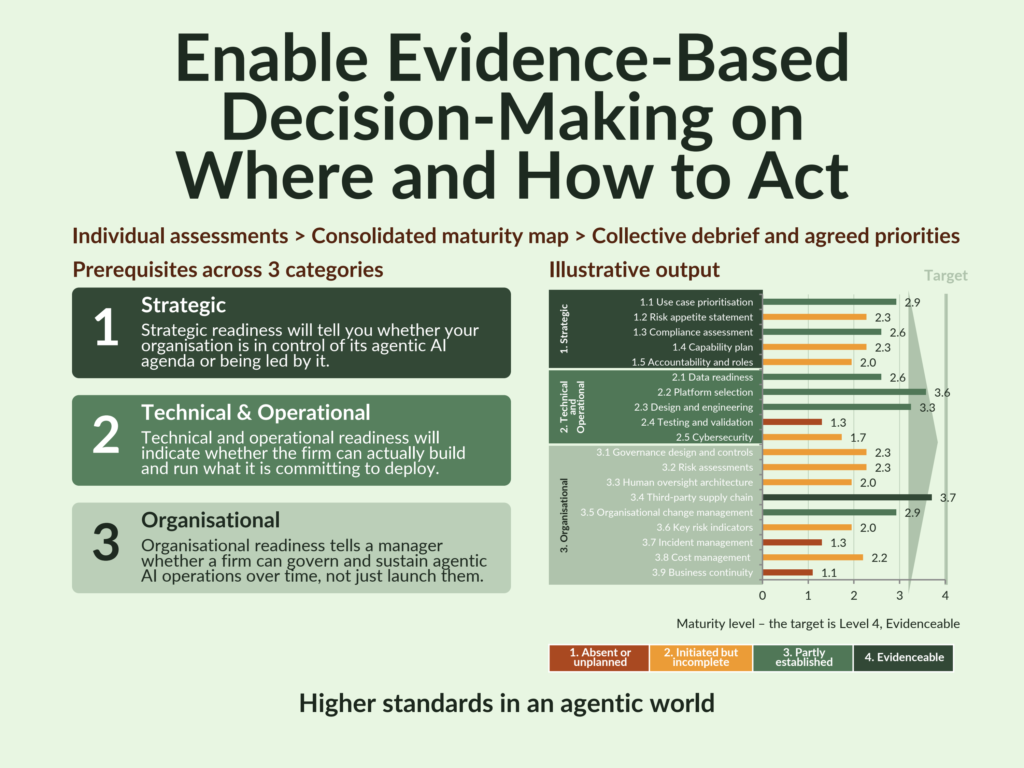
Because agentic vendor management is a prerequisite to becoming an agentic organisation, prerequisite 3.4 (Third-party / supply chain) of our Agentic AI Readiness Assessment evaluates the maturity of your capabilities in this area along with all the other prerequisites.
At the highest level on our maturity scale (“evidenceable”), we see firms that have:
- Identified and documented every material dependency in your agentic supply chain;
- Assessed the risk of each, testing what vendors tell them;
- Implemented contractual protections, an owner for every control, exit plans and ongoing monitoring are in place;
- Instituted evidence-based reviews of third-party risk at defined intervals.
If you can show all four, you are well placed to building a defensible position.
Next steps: download the Agentic AI Risk Control Framework for the controls you need to manage your agent vendors, and take the Agentic AI Readiness Assessment to check your readiness for every prerequisite of becoming an agentic organisation.
Frequently Asked Questions
AI agent vendor management means identifying and managing the external providers and components your AI agents depend on. It covers model providers, agent platforms, tools and connectors, data sources, cloud infrastructure and existing suppliers that introduce agents into their products.
Your agents depend on technology outside your direct control. Supplier failures, changes or security breaches can affect what your agents do. These dependencies create risks involving security, accountability, contractual liability and your ability to maintain services or change suppliers.
For every agent, identify its models, platforms, connectors, data sources and subcontractors, with a named relationship owner. Assess suppliers’ security, compliance and reliability, and test their assurances rather than relying on them alone.
Your contracts should address liability for agent-caused harm, subcontractors, data use, audit rights, incident notification and material service changes. They should also provide appropriate access to information about agent architecture, instructions and action logs, alongside provisions for failure, rollback and exit.
A supplier may change, fail or retire a model your agent depends on. Tested exit plans and portable designs help you maintain services and preserve your ability to change providers. For material use cases, consider whether your agents should work with more than one model provider.