Agentic AI Governance in Financial Services

Agentic AI governance is the discipline of controlling agentic AI systems whose risks emerge through actions and decisions over time, not just individual outputs. In April 2026, Szpruch, et al (University of Edinburgh) published a paper that demonstrates how traditional model risk management (MRM) and AI governance designed for static models have a structural agentic AI governance gap. The paper argues that effective governance should shift to runtime governance – continuous monitoring, enforcement, and intervention while the agent is operating – and that relying on traditional MRM for agentic governance will become hard to defend as supervisory expectations develop. For use cases that demand precision (like many in financial services), the question is no longer whether agentic AI requires a different governance model, but how quickly firms can build one that scales safely.

The Characteristics of Good Agentic AI Training Data 

Agentic AI Training Data-1

With a focus on which use agentic AI case, which vendor, and which oversight committee, it is easy to overlook a key question – whether the data their agents will rely on is fit for autonomous use. Agents do not read data; they act on it, and small defects compound at every step. Over 24 months, we believe two cohorts of firms will emerge: those whose data is Structured, Current, Authoritative, Rich, Verifiable, and Symmetrical – the six SCARVeS© characteristics of good agentic AI training data – and that will absorb the consequences of deploying agents on unchanged data estates. The obstacles between are not technical but governance ones and, as yet, not every firm has the capability to overcome them.

Incident Management for Agentic AI: Upgrade Needed

Once you deploy autonomous agents that can fail in ways that non-agentic alerting was not designed to detect, only incident management for agentic AI will protect you if something goes wrong. Of the 18 steps needed to manage an agentic incident, only 2 survive intact – 3 have no non-agentic equivalent at all, and 13 require material changes – creating operational and regulatory exposure for firms that have already deployed agents. The most effective response plan is to diagnose your gaps, define bespoke upgrades that match your agentic use cases, and sequence implementation to ensure they support other in-flight initiatives. Our three-stage Agentic Incident Management Upgrade service is designed to achieve exactly this for you.

How to Design a Risk-Based Agentic AI Adoption Strategy

A risk-based agentic AI adoption strategy classifies AI agents into risk tiers and applies stronger controls where the risk is highest. In comparison, more blunt approaches have inherent flaws: permissive access with post-event monitoring sacrifices control, and full pre-approval constrains scalability. Instead, the risk-based model assigns low-risk agents a register-and-attest process, medium-risk agents a proportionate review, and high-risk agents full governance, making it productive, enforceable, and defensible at scale. To implement this, add four deliverables to your agentic roadmap: tier criteria, technical enforcement, shadow agent detection, and risk manager dashboards. If you are at the start of an agentic transformation, the Agentic AI Readiness Assessment evaluates your firm’s readiness across all the prerequisites for agentic AI – including those needed to implement this model – in 90 minutes.

New Academic Research Finds Behavioural Drift To Be An Agentic AI Compliance Matter

Agentic AI Compliance

An April 2026 academic paper has confirmed what we advised IRM delegates in January: a low-risk use case does not mean a low-risk agent. The paper establishes that agentic AI compliance under EU law is not limited to the AI Act – it spans GDPR, DORA, NIS2, and sector-specific regulation simultaneously. Critically, behavioural drift is now a live legal obligation, not just a governance preference: firms must trace it, record it, and treat threshold changes as regulatory events. Three standards gaps remain unresolved. Our frameworks already address all three.

Anthropic Just Called It Too: Agentic AI Risk Is A New Category

Agentic AI risk management framework: Anthropic's four-layer agent architecture and the 32 Agentic AI Risk Flags.

A frontier lab has just told the US government what Agentic Risks has been saying since July 2025: agentic AI risk is a distinct category of harm that existing frameworks do not describe. For risk managers, compliance officers and CROs at regulated firms, Anthropic’s 9 March 2026 submission to NIST’s CAISI validates a discipline that standards bodies have yet to catch up with. This post walks through six ways the submission strengthens the approach Agentic Risks has taken, where we believe more is needed, and why we publish our IP and methodologies freely.

Agentic AI Governance for Regulated Firms

Governing Agentic AI - IRM

Agentic AI is already in scope of the EU AI Act despite not being named in it – a foundational challenge for agentic AI governance – and firms building agents in-house for EU operations will be treated as both provider and deployer, with high-risk systems due for compliance by 2 August 2026.

Meeting those obligations is necessary but insufficient because agentic systems break four of the Act’s core assumptions, so an effective governance framework must extend beyond compliance to cover operational realities like agent identity, pre-execution boundaries, reasoning chain integrity, and liability across the value chain.

For organisations governing agents already in production, our 32 agentic AI risk flags provide a fast, defensible way to surface agents operating at a higher risk level than may have been appreciated – on the principle that if you cannot disprove a flag, you have a risk.

Agentic AI Governance Framework: What It Is and What You Need

The Agentic AI Governance Framework is a structured guide to governing autonomous AI systems – what to keep from traditional AI governance, and what new controls you need. It’s essential reading for risk, compliance, and technology leaders whose organisations are deploying, or planning to deploy, agentic AI. It tells you exactly which foundations still hold, which new components you need to add, and how to navigate the areas where the debates remain inconclusive. With it, you can build a governance model that is defensible to regulators, auditors, and boards.

Agentic AI Readiness Assessment

Firms whose adoption strategies succeed are those whose roadmaps are achievable from their current state of readiness. The Agentic AI Readiness Assessment ensures your transformation is evidence-based, achievable, and customised to your situation. It does this by establishing whether each prerequisite is in place (strategic, technical and operational, and organisational), its maturity level, and the extent of work needed to support your target risk tier. Triage-style 90-minute session. Output is a complete and systematic view – strengths, weaknesses, and prioritised next steps – ready within 48 hours for you to discuss with your colleagues.

Agentic Workflow Risk Assessment: How To Map Risks And Controls

Unstructured agent-building is a costly and risky choice, increasing the chance of overlooked risks, security incidents, and scrambled remediation when external stakeholders ask questions.

This is because agentic workflows create new risks that you will need to control and monitor in novel ways.

In response to this situation, I summarise the specific ways risk management needs to evolve for the agentic workflow risk assessment: the novel aspects of the agentic workflow design process, the pre-deployment agentic risk assessment, and how to ensure effective agentic KRIs.

Adopt these techniques to give structure to your agentic transformation, prevent risk, and ensure trustworthy monitoring.

Template Agentic Risk Appetite and Adoption Strategy download

Fill in this form and get access to our
Template Agentic Risk Appetite and Adoption Strategy for free

Agentic AI Risk Appetite Statement and Adoption Strategy

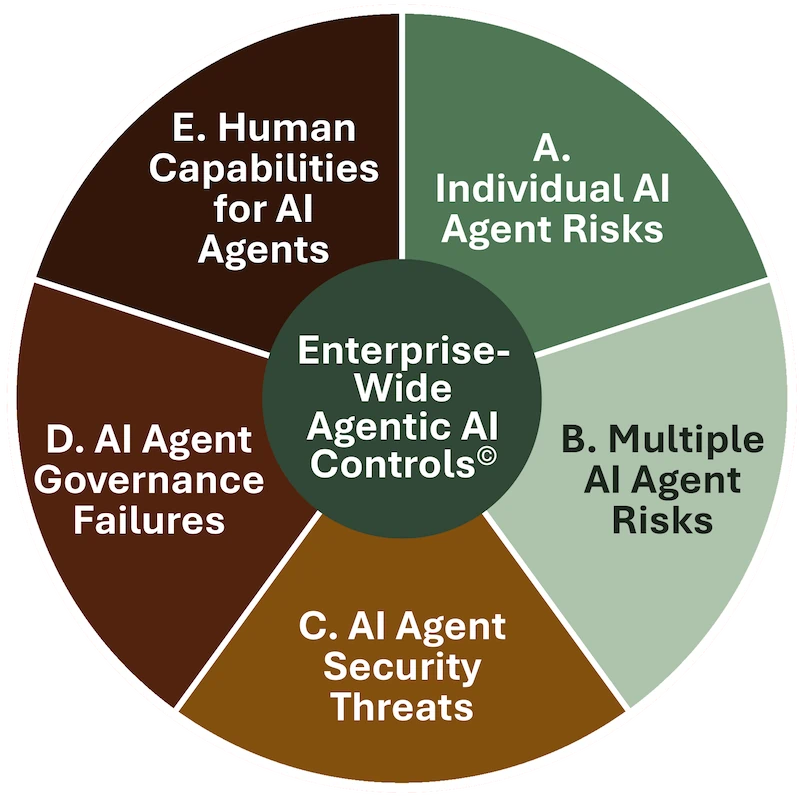
Enterprise-Wide Agentic AI Controls Framework

Fill in this form and get access to the
Enterprise-Wide Agentic AI Controls Framework.

Subscribe to our monthly newsletter

Fill in this form and stay up to date

Get in touch