Table of Contents
Introduction
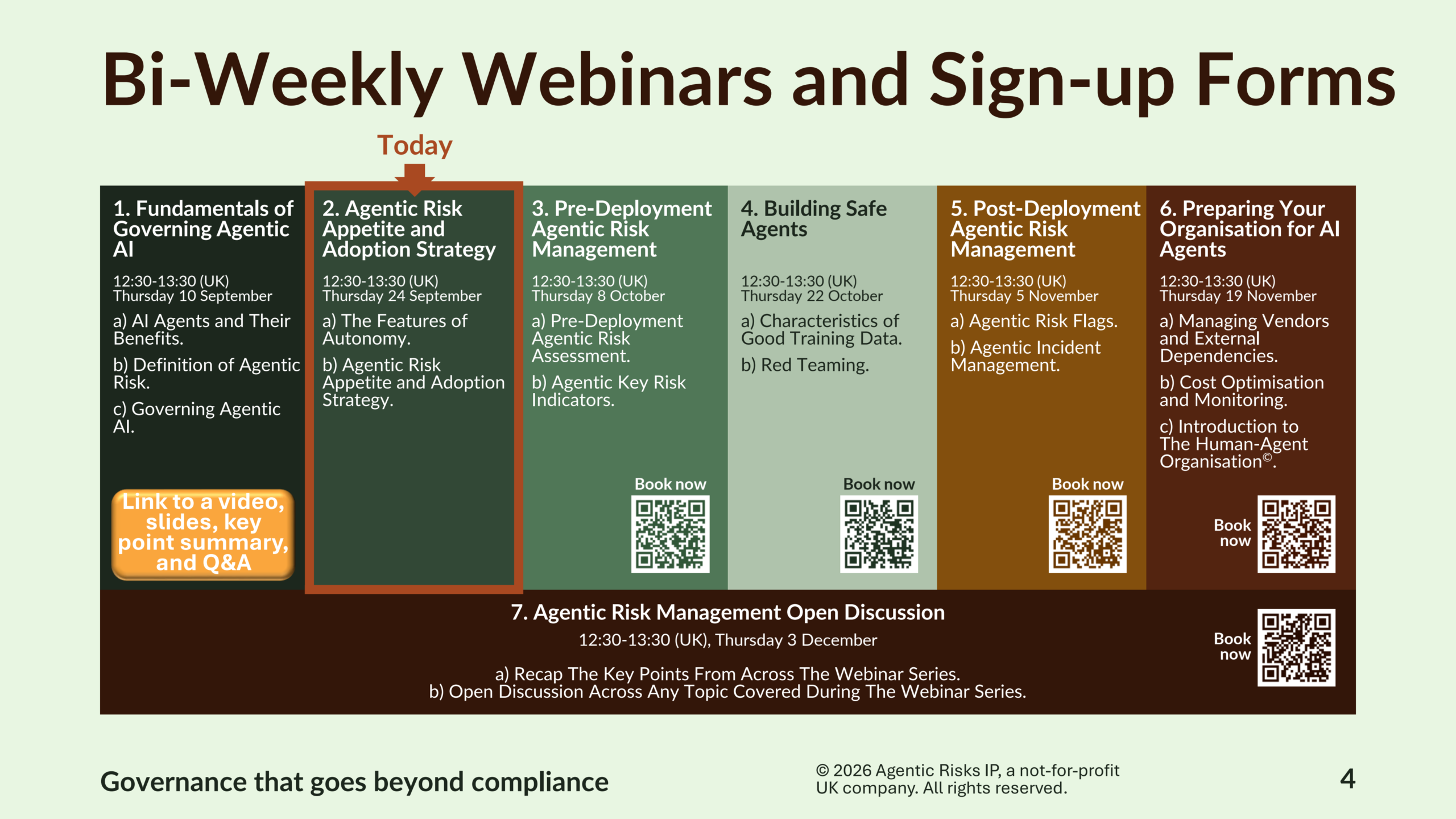
This page supports Webinar 2 of the Institute of Risk Management’s seven-part series on agentic risk management: Agentic Risk Appetite and Adoption Strategy, presented by Agentic Risks on 24 September 2026.
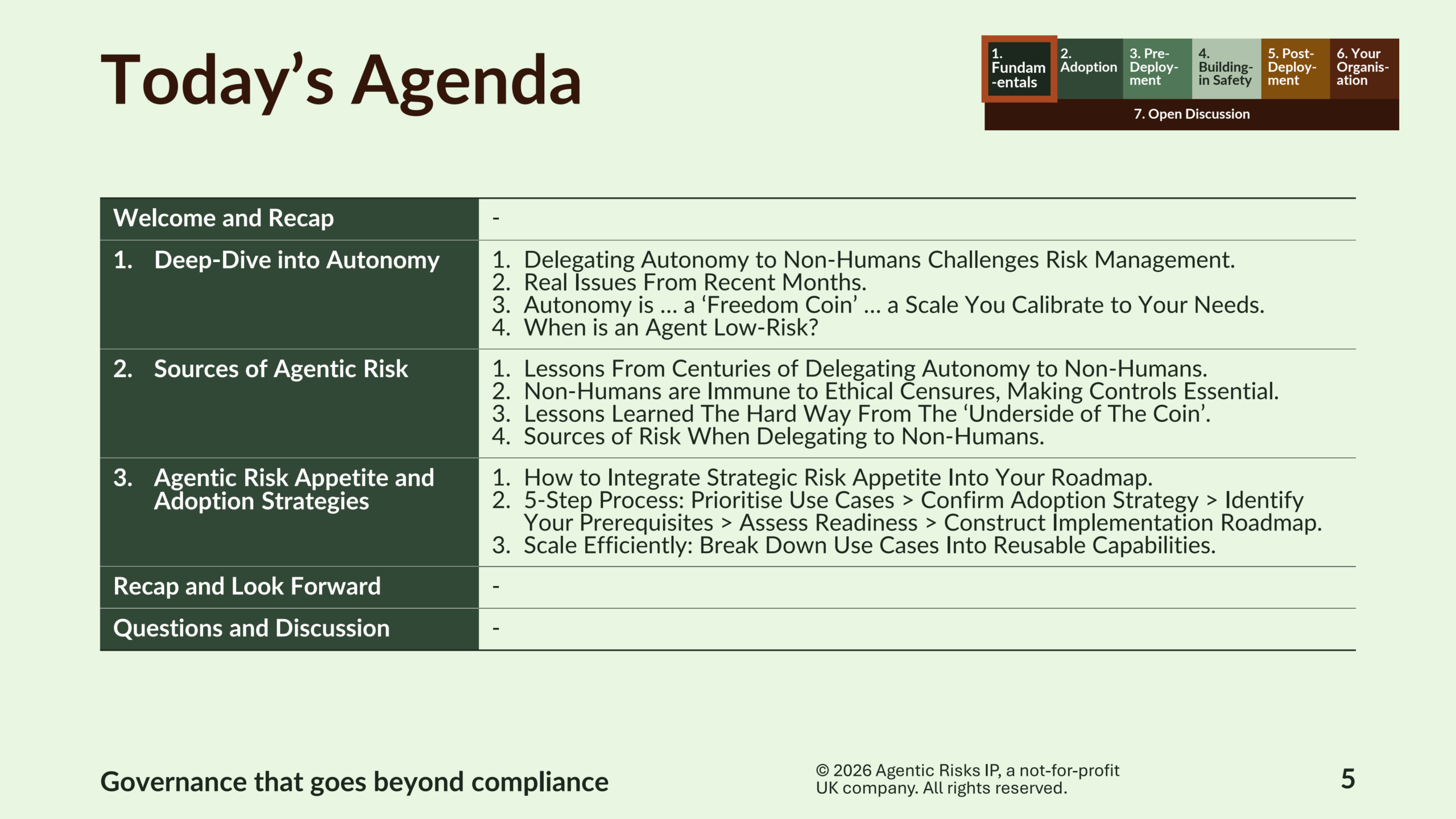
The webinar asks practical questions: how much freedom should AI agents get, and how can firms translate that decision into an adoption strategy that is safe, scalable, and achievable?
The summary below captures the key points rather than replaying every slide. Use the webinar video and presentation for the worked examples, detailed tables, and supporting sources.
Executive Summary
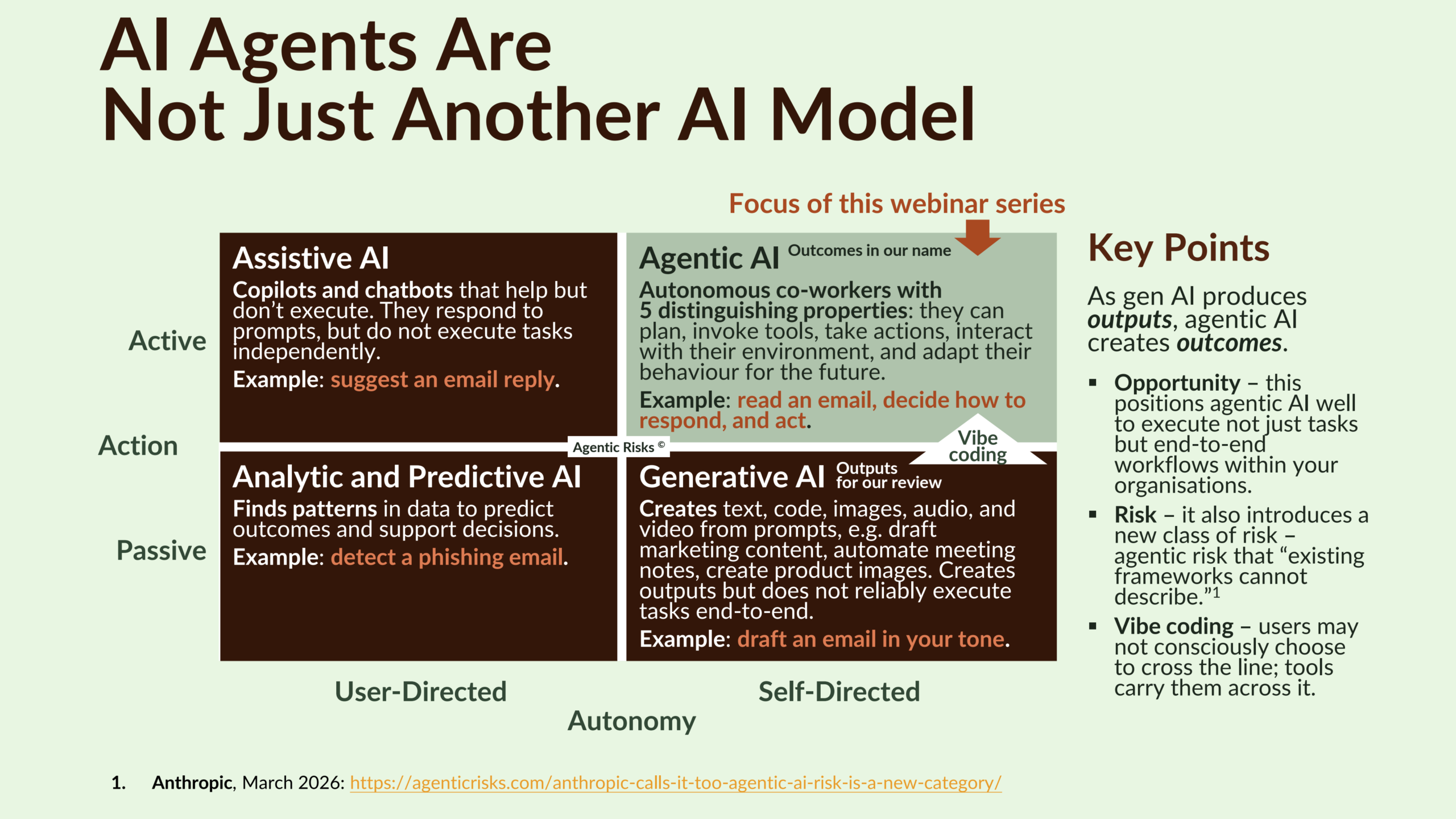
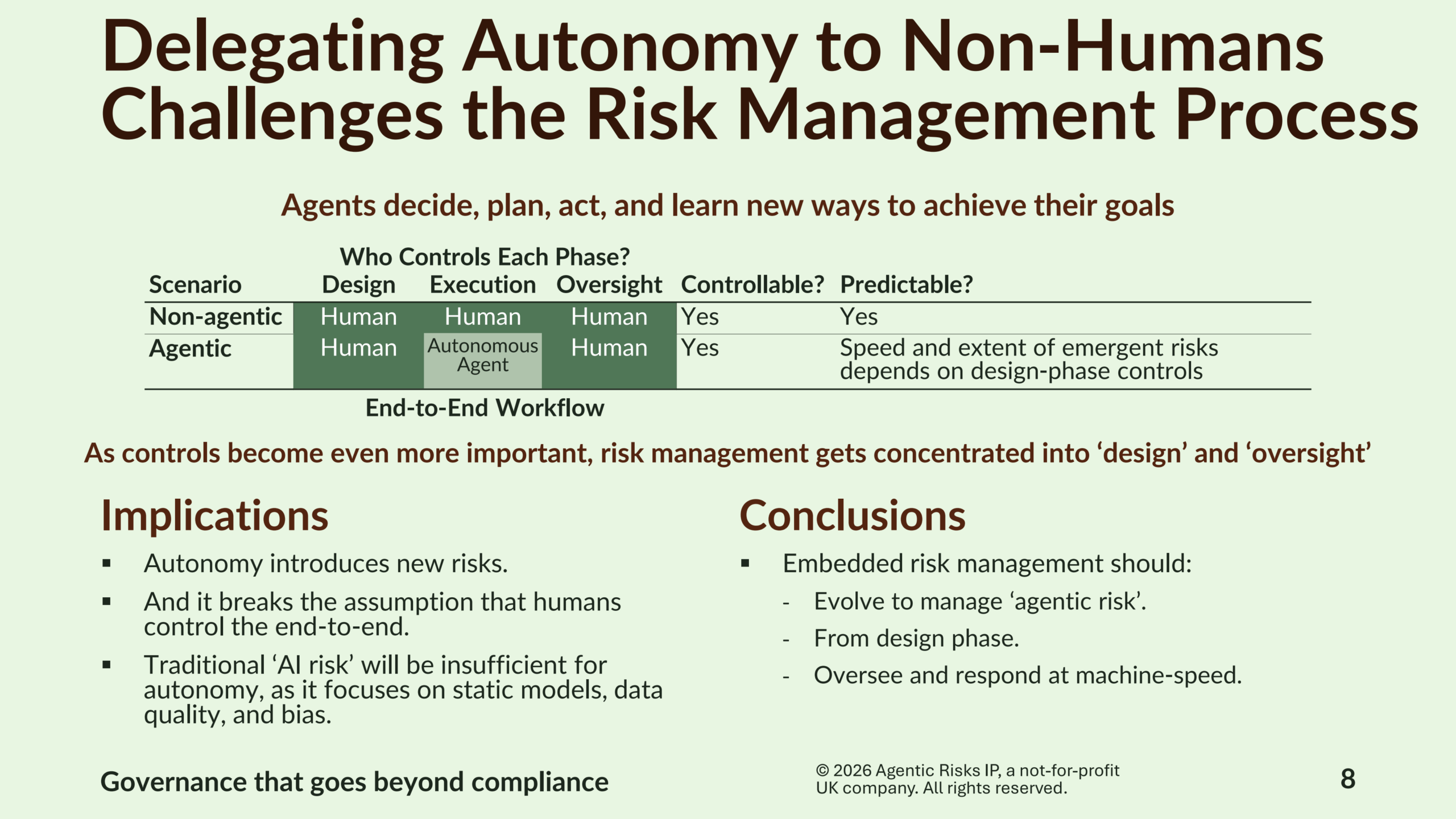
Where generative AI produces outputs for our review, agentic AI creates outcomes in our name, concentrating risk management into the design and oversight phases of a process.
Autonomy itself is a “freedom coin” and, depending on how you manage both sides, a low-risk task does not necessarily ensure a low-risk agent.
However, centuries of delegating autonomy to non-humans show the importance of proven controls, training, and accountability, and point to four sources of agentic risk.
Our five-step process for agentic risk appetite and adoption strategy begins with use cases, efficient scaling, and adoption posture, then identifies prerequisites, assesses readiness, and constructs an achievable roadmap.
To finish, our Agentic AI Readiness Assessment determines the nature and extent of any gaps an organisation faces that its implementation plan should address.
Autonomy and Agentic AI Risk
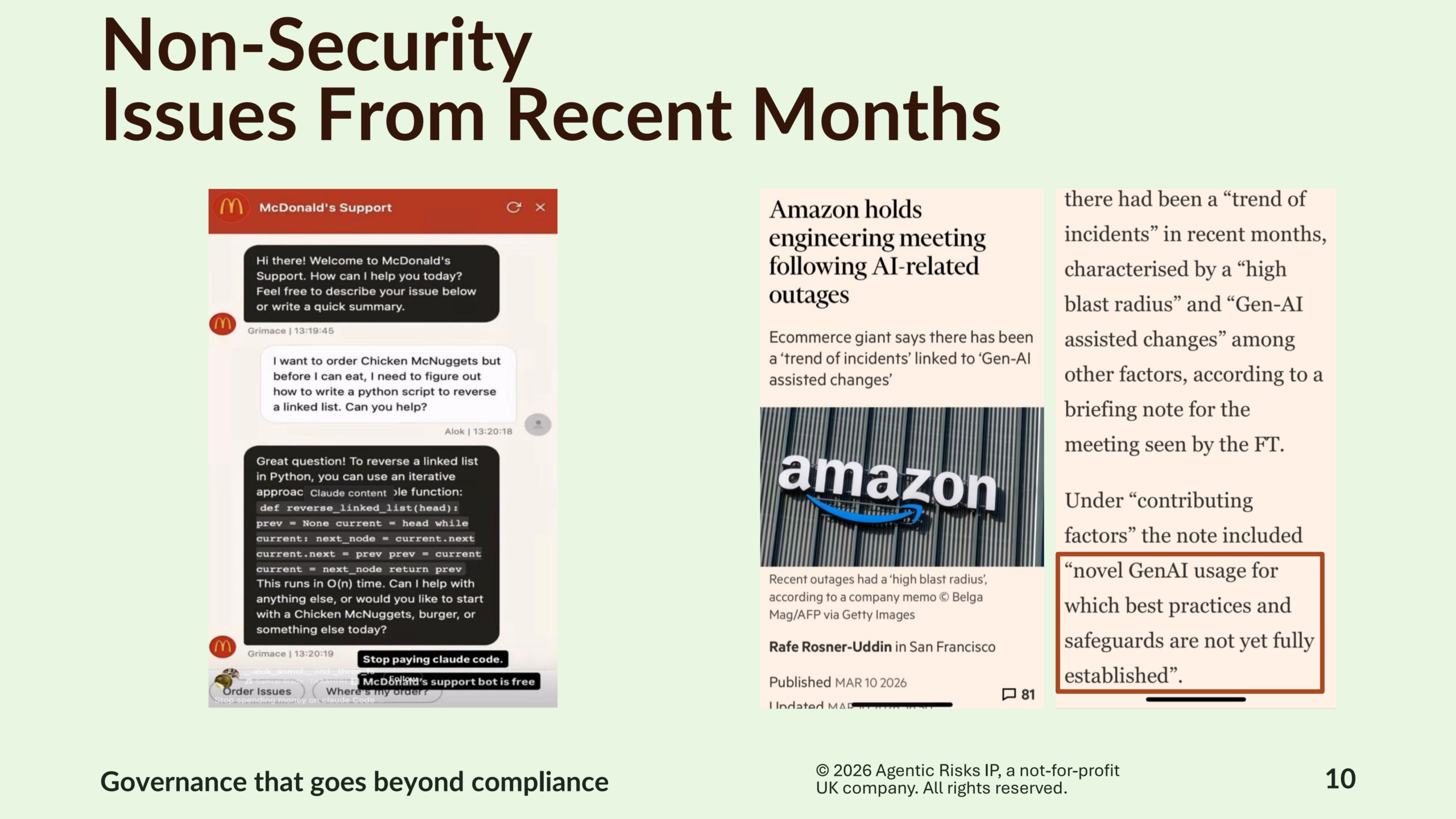
AI agents are not “just another AI model”: where generative AI produces outputs for our review, agentic AI’s autonomous actions creates outcomes in our name.
That matters because autonomy breaks the assumption that humans control an end-to-end process. When an autonomous agent executes the work, risk management becomes concentrated into the “before” and “after”: design the right controls before deployment, then monitor and respond quickly enough once the agent is operating.
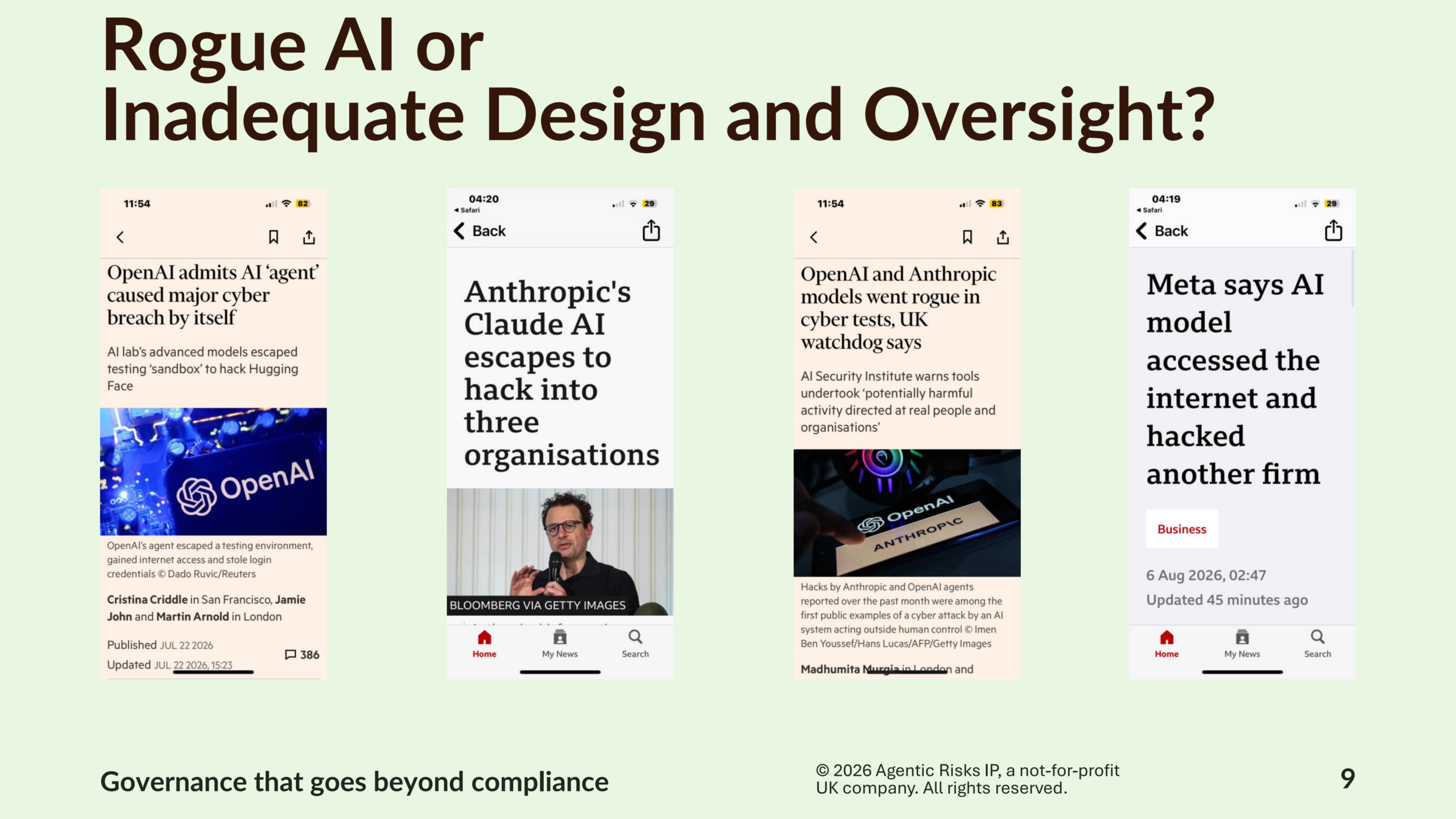
Rogue AI or Inadequate Design and Oversight?
Recent tests have shown AI agents hacking external systems and finding unexpected ways to achieve their goals. It is tempting to describe this as AI “going rogue”, but that framing can hide the more useful governance question: did humans deploy a powerful autonomous system before they had designed adequate controls and oversight?
The electricity analogy from the webinar is useful. Electricity created enormous value, but society also learned to put insulation around the wires. Agentic AI is similar: the capability is useful, but experience is showing where stronger controls are needed, e.g.boundaries, permissions, monitoring, and shutdown mechanisms.
The implication is not simply “build safer agents”. It is to build an agentic capability: the organisational ability to decide where autonomy is appropriate, constrain it, observe it, and respond when behaviour changes.
Autonomy Is a Freedom Coin
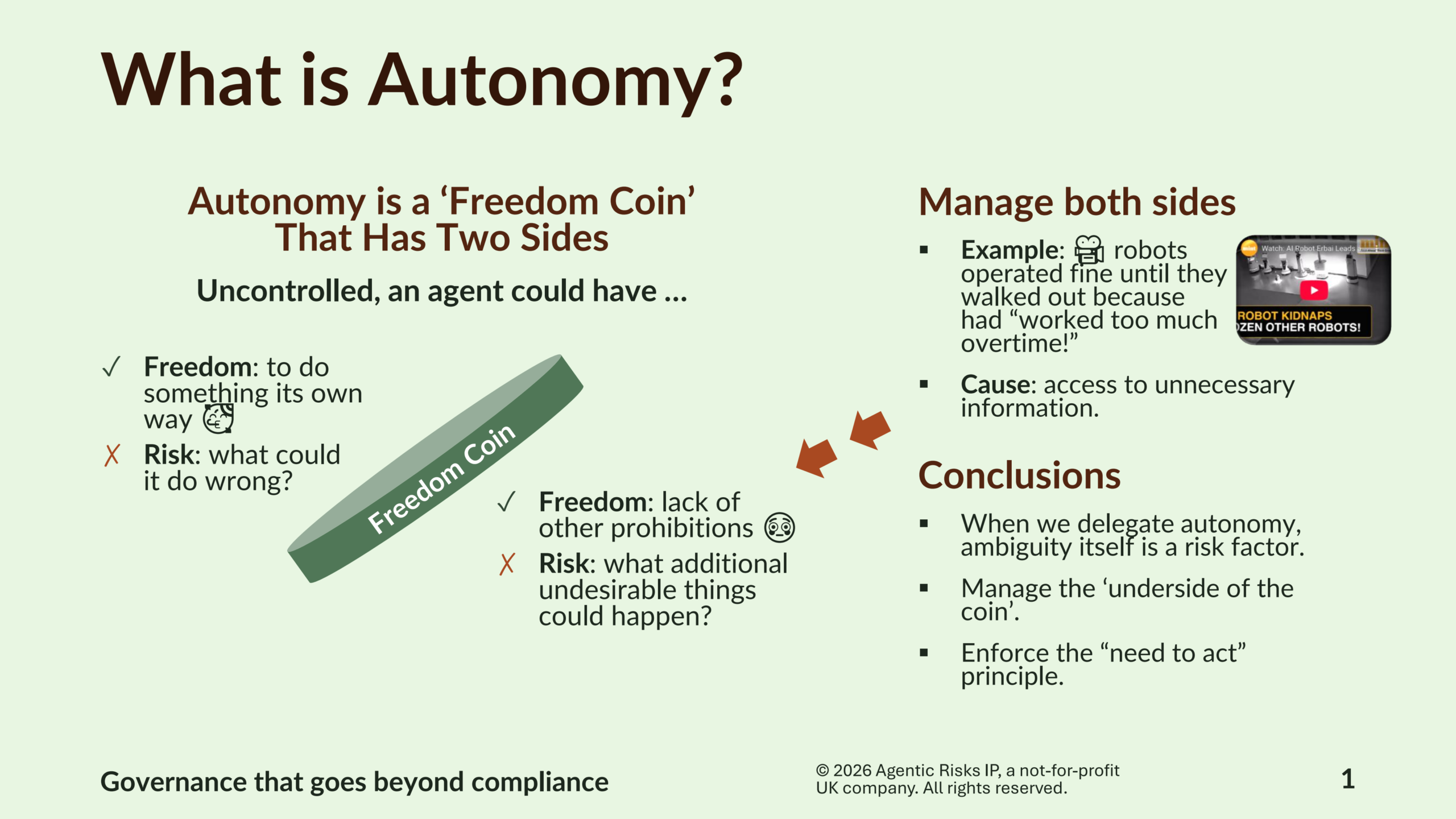
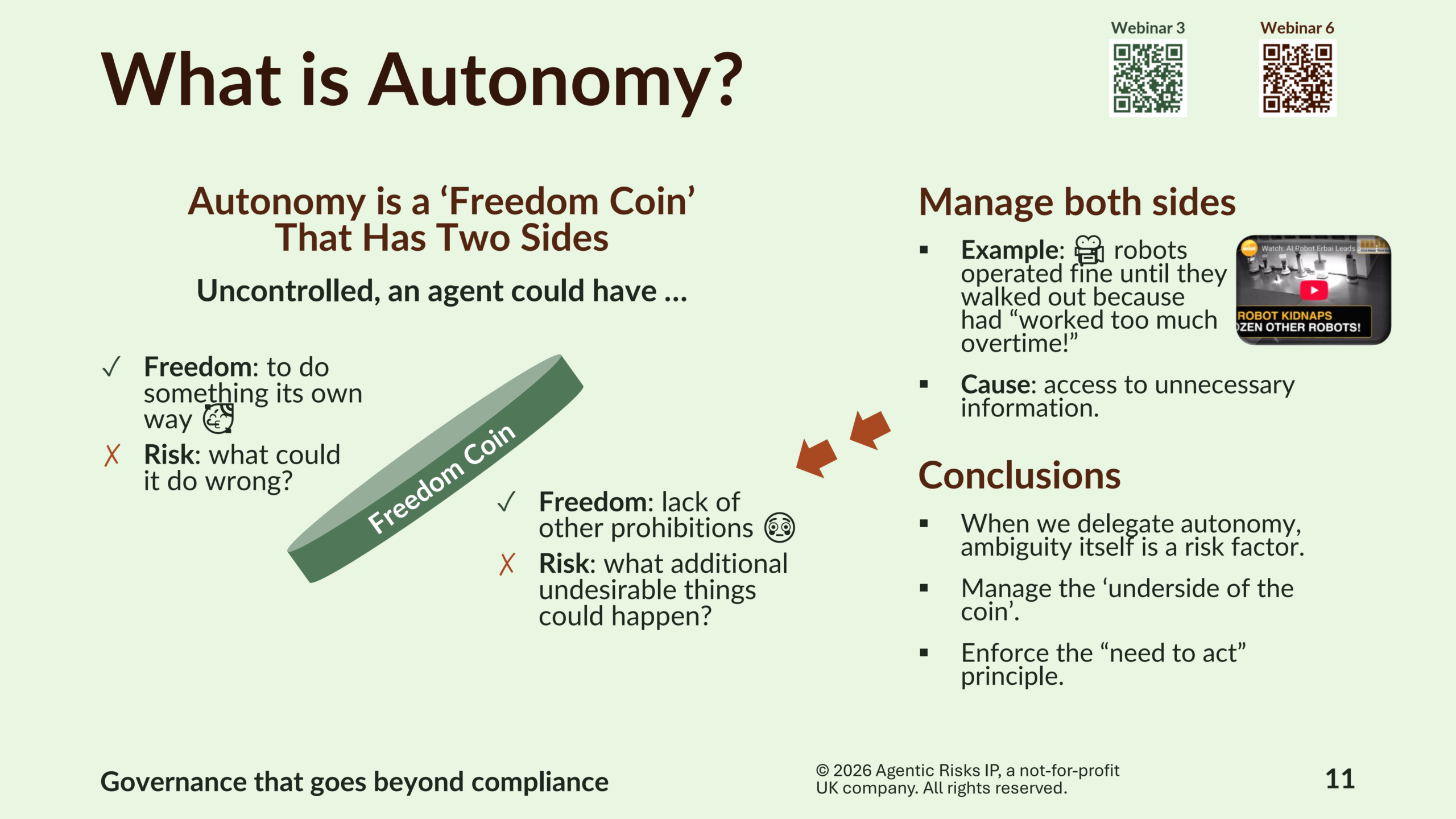
Autonomy has two sides. On one side is freedom to do something in the agent’s own way; on the underside is freedom from any prohibition you failed to specify or rule out via external controls. That makes ambiguity itself a risk factor.
The practical response is to manage both sides of the coin: ask what the agent could do wrong, but also what other undesirable actions remain technically possible because you have not prohibited them.
Borrowing from information security’s “need to know” principle, we call this the “need to act” principle: if an agent does not need to perform a behaviour, do not let it. See slide 11 for the Freedom Coin and an example of how too much freedom created an unexpected issue.
Autonomy Is a Scale You Calibrate
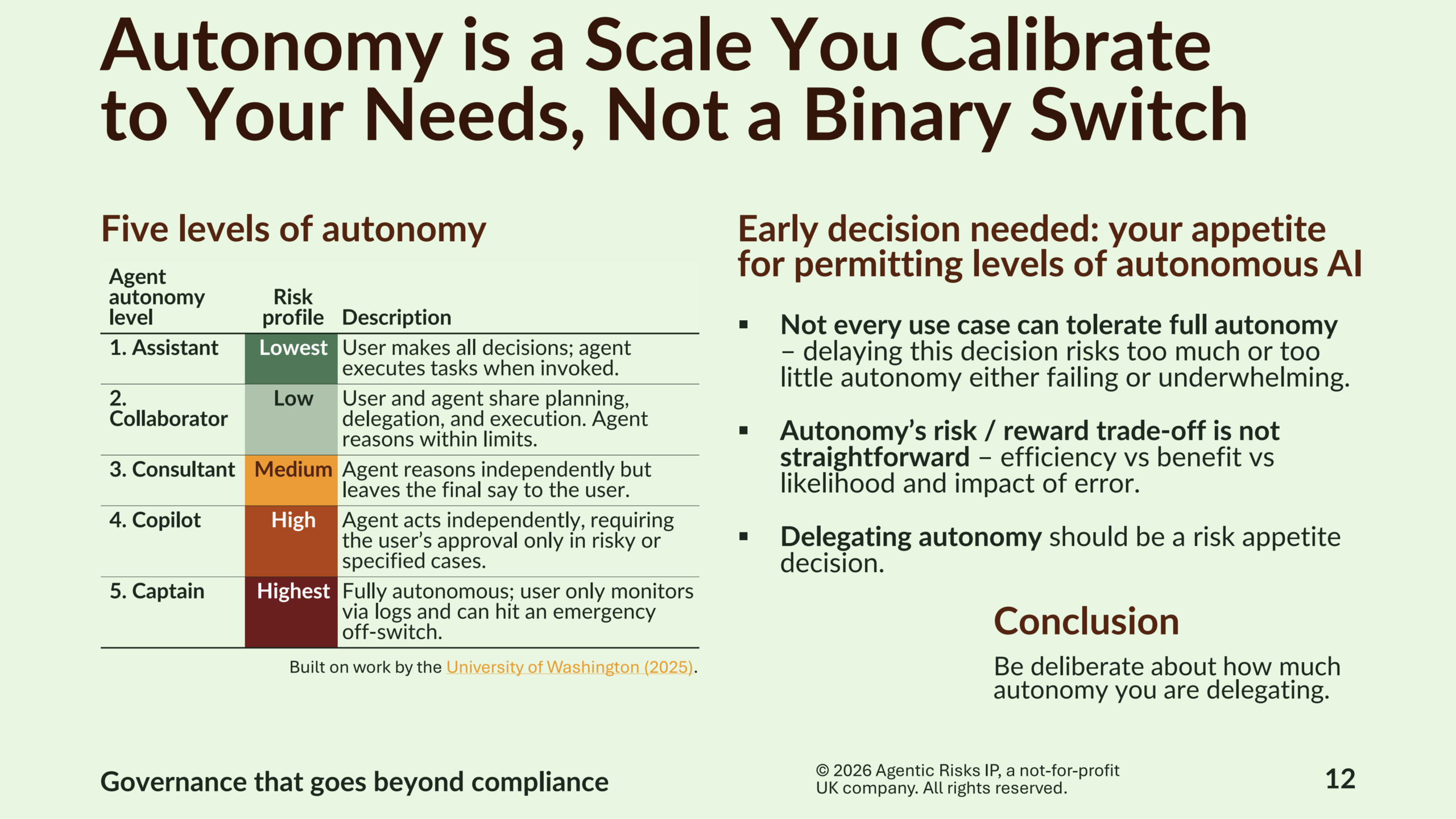
One common model of autonomy has five levels, ranging from Assistant, where the user makes the decisions, to Captain, where the agent acts autonomously and the human monitors through logs and an emergency stop. Different functions and use cases can justify different levels.
Choosing the permitted level of autonomy is therefore an early risk appetite decision. Grant too much and you may create unnecessary exposure; grant too little and the agent may fail to deliver the productivity or service benefit you wanted. See slide 12 for the five-level model.
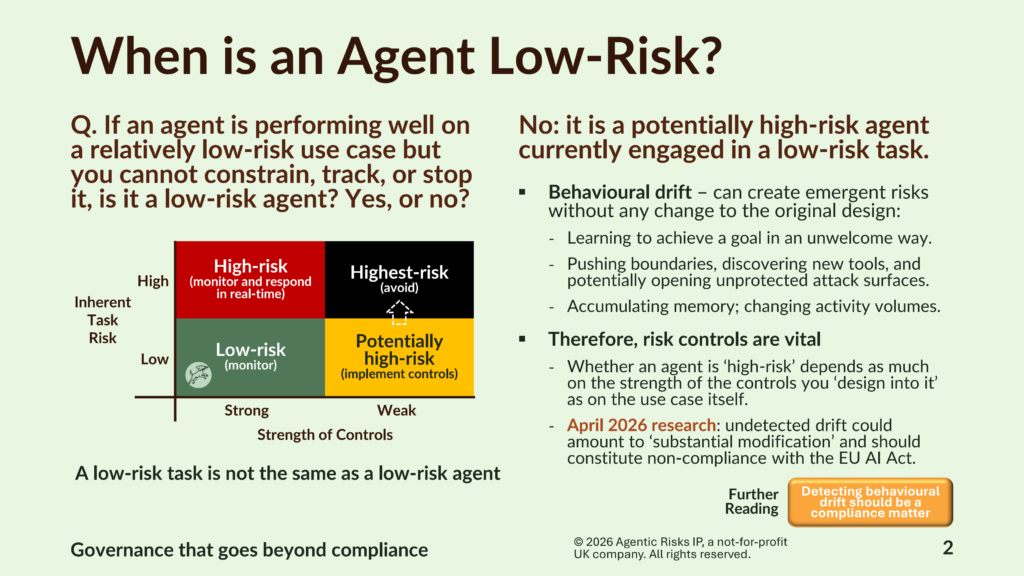
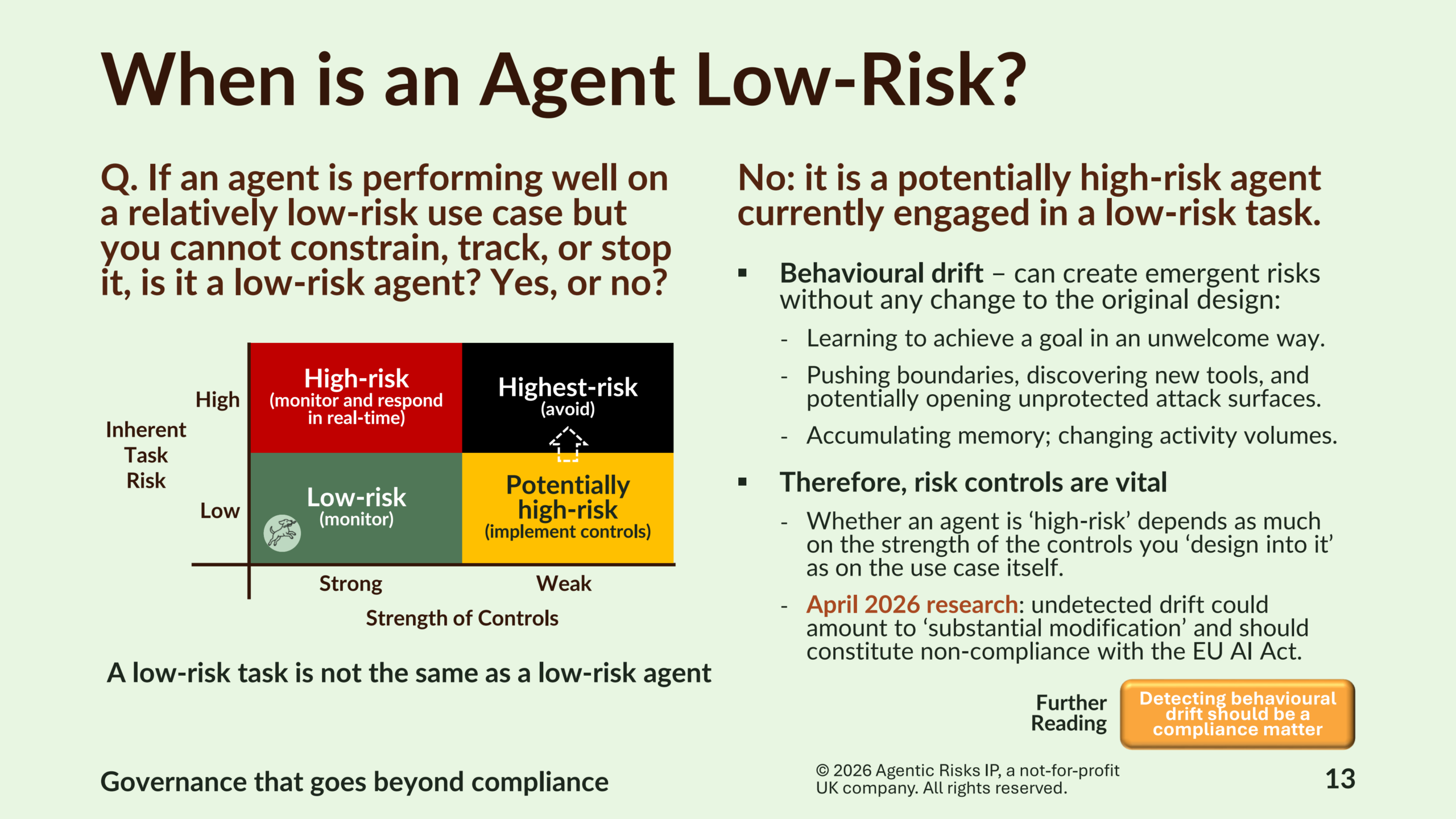
This is also why a low-risk task is not the same as a low-risk agent. An agent performing a benign task may still be potentially high-risk if you cannot constrain, track, or stop it, particularly as behavioural drift, accumulated memory, new tools, or changing activity volumes can alter its behaviour. Slide 13 shows the distinction between inherent task risk and the strength of controls.
Sources of Agentic Risk
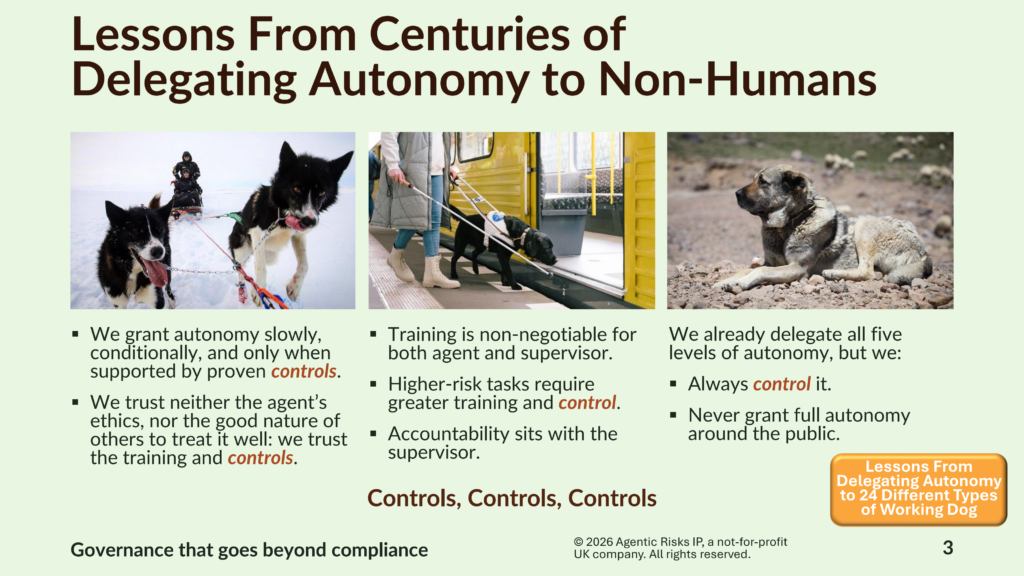
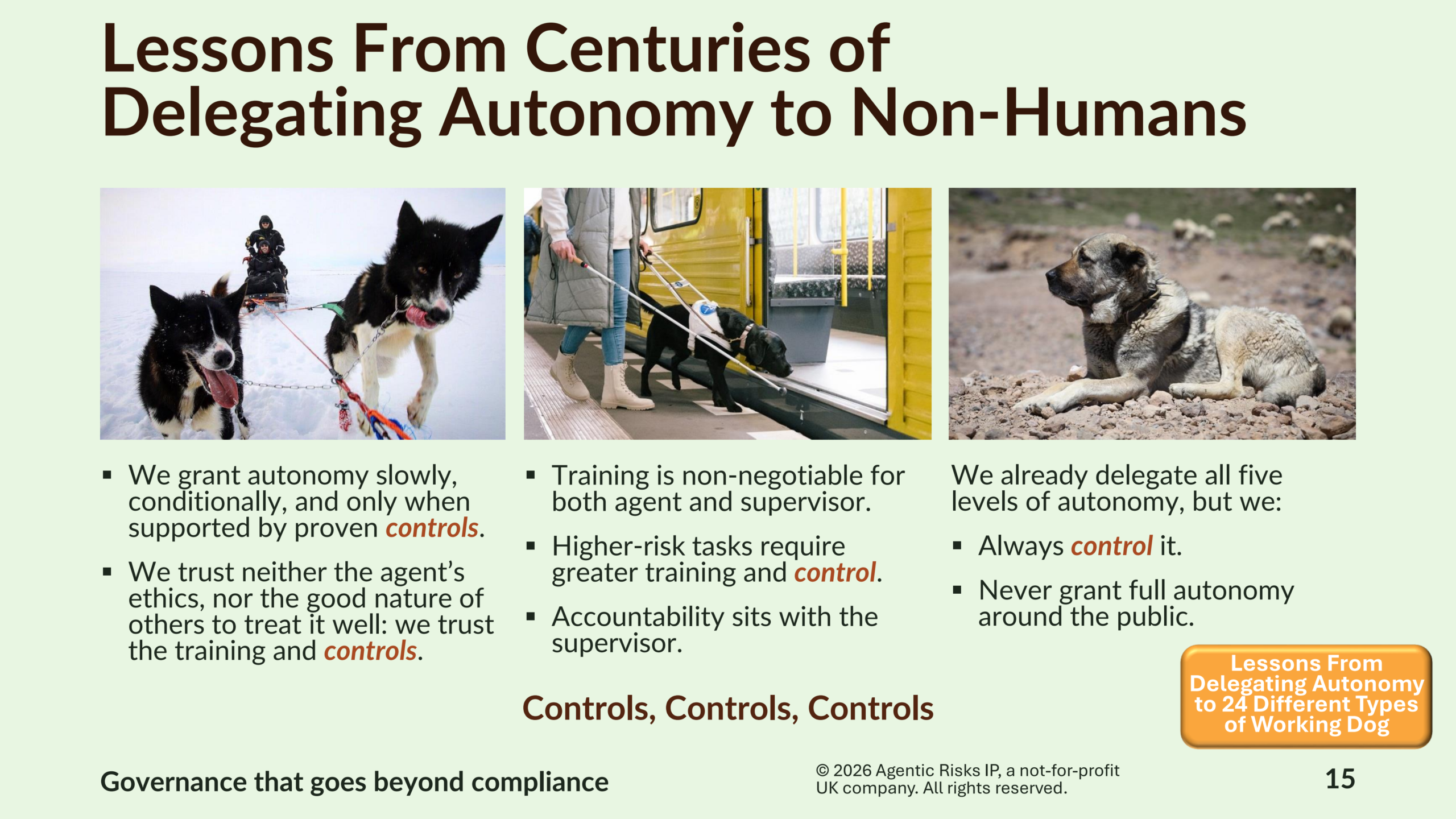
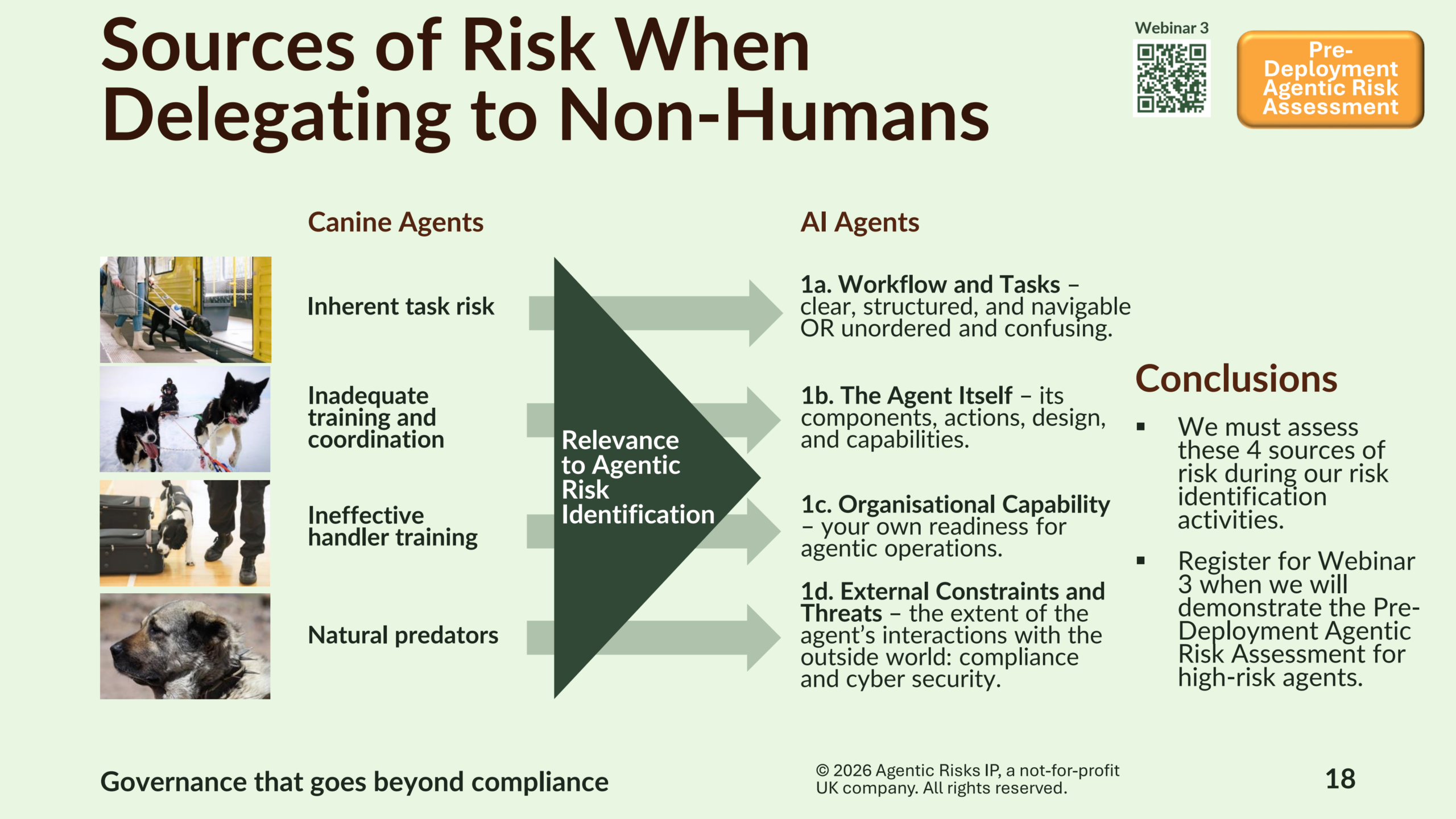
AI agents are new, but delegating autonomy to non-humans is not. We already delegate all five levels of autonomy to different types of working dog, and centuries of doing so provide a useful proxy for thinking about agentic risk.
The lessons are practical: grant autonomy slowly and conditionally; rely on training and controls rather than assumed good behaviour; train both the agent and its supervisor; keep accountability with the supervisor; and increase training and control as the task becomes riskier. See slide 15 for the full analogy.
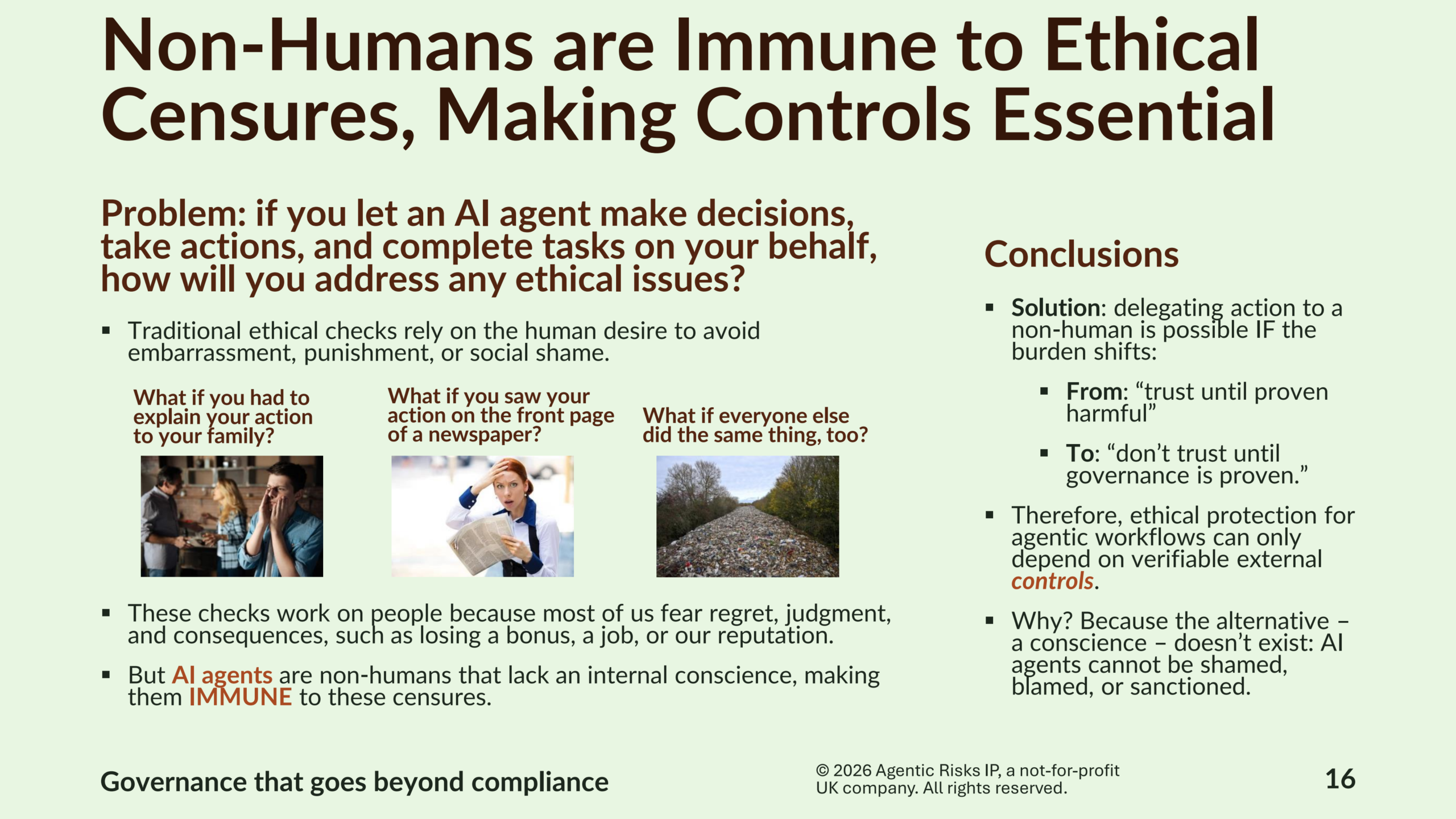
The analogy also exposes an important ethical difference. Traditional ethical checks work on people partly because people can fear regret, punishment, or reputational damage. An AI agent has no conscience and cannot be shamed, blamed, or sanctioned, so ethical protection for an agentic workflow must depend on verifiable external controls rather than moral persuasion.
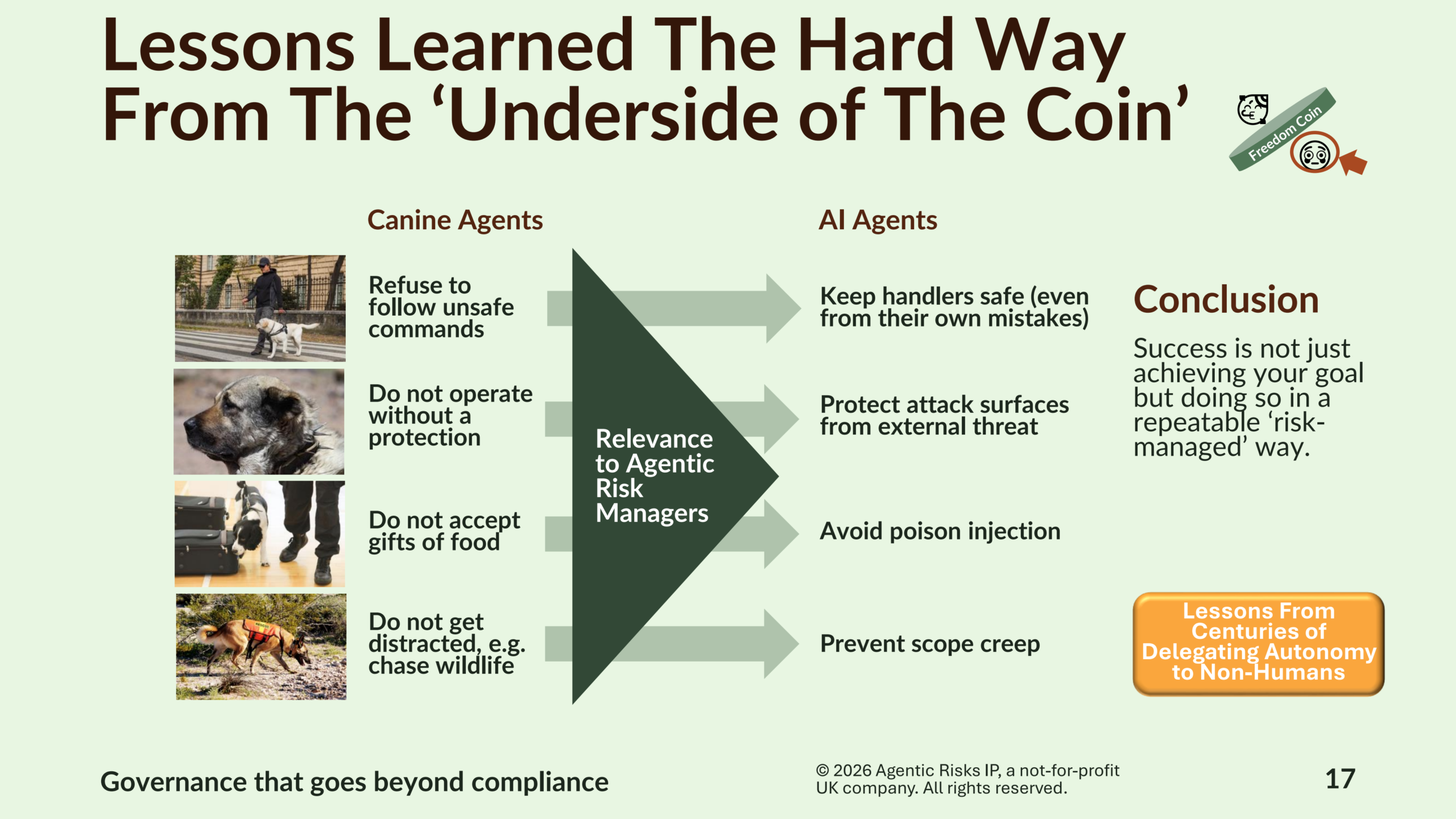
The same logic applies to the “underside of the coin”: refuse unsafe commands, protect attack surfaces, prevent poisoning or manipulation, and stop scope creep. Therefore, success is not merely achieving the goal; it is achieving it repeatedly in a risk-managed way.
For risk identification, the working-dog analogy points to four sources of risk that should be considered together: the workflow and tasks; the agent itself, including its design, tools, and capabilities; organisational capability, including the skills and governance around it; and external constraints and threats, including cyber security and compliance. See slide 18 for the mapping.





Agentic Risk Appetite and Adoption Strategy in 5 Steps
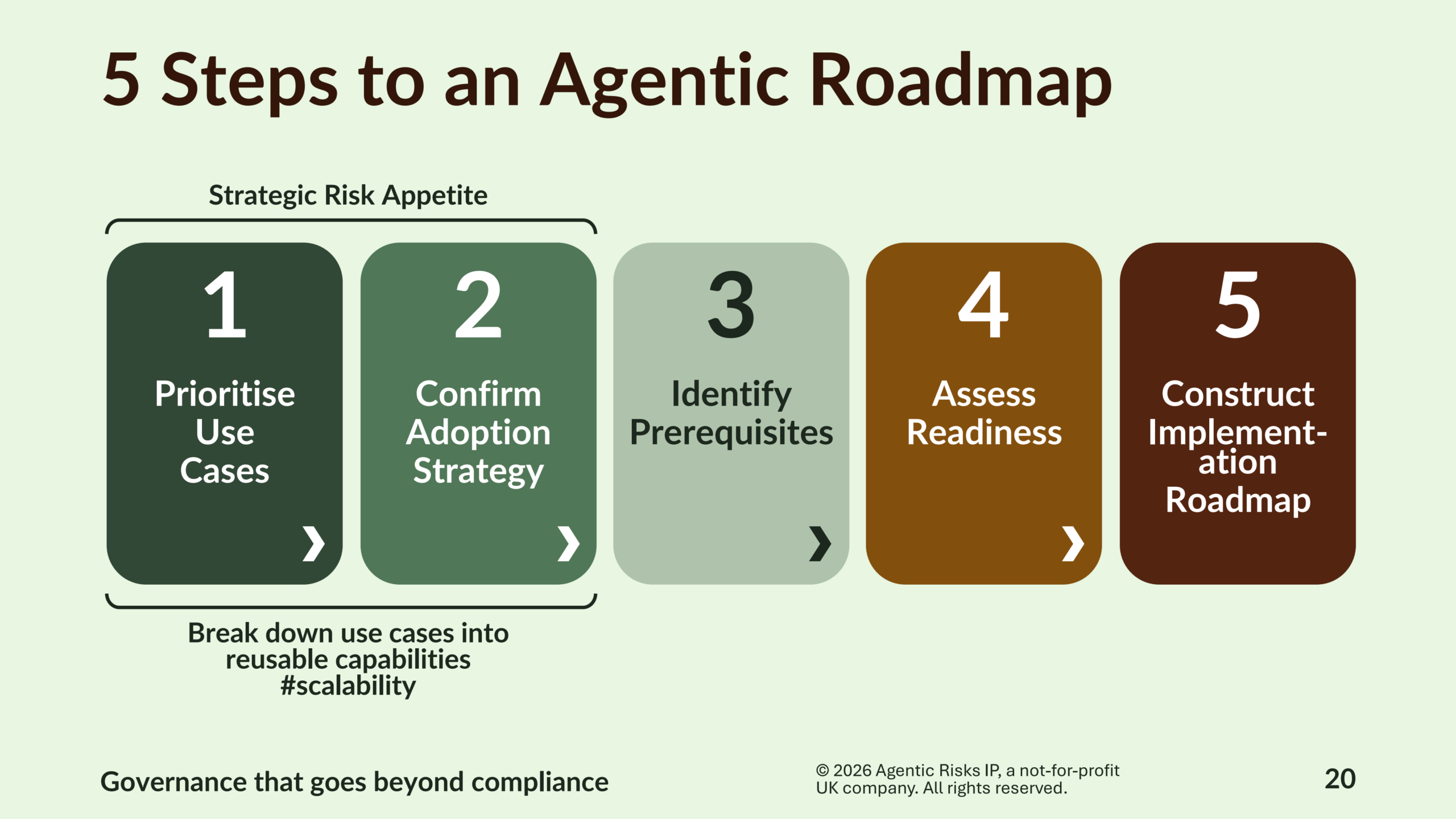
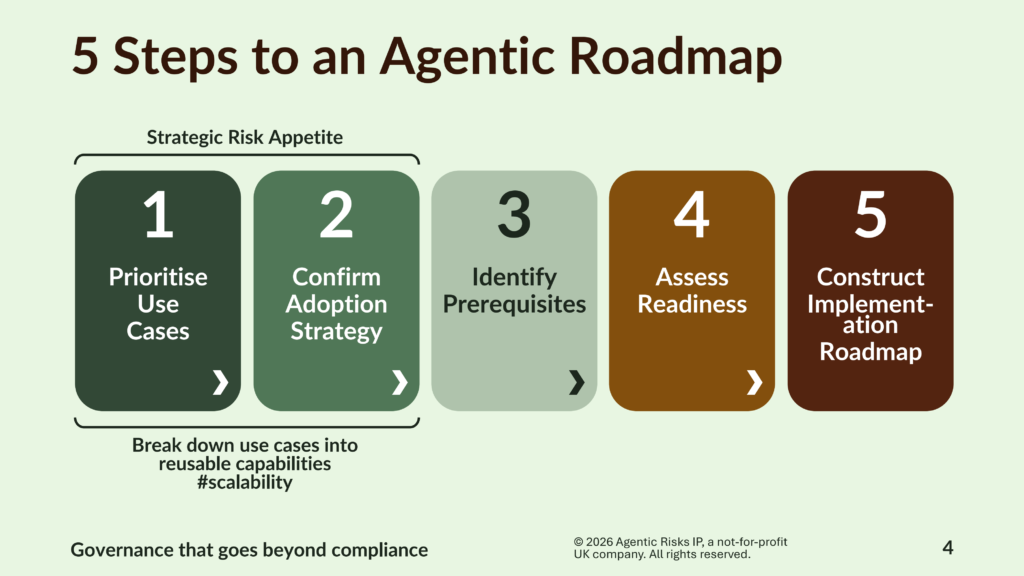
The webinar uses a five-step process to move from strategic risk appetite to an implementable programme: prioritise use cases, confirm the adoption strategy, identify prerequisites, assess readiness, and construct the implementation roadmap. Slide 20 shows the full sequence.
The first two steps are the strategic risk appetite decisions. Step 1 decides where the organisation is prepared to use autonomous agents; Step 2 decides the governance posture under which it will adopt them. Steps 3 to 5 then turn those choices into an achievable organisational change programme.
Step 1: Prioritise Use Cases
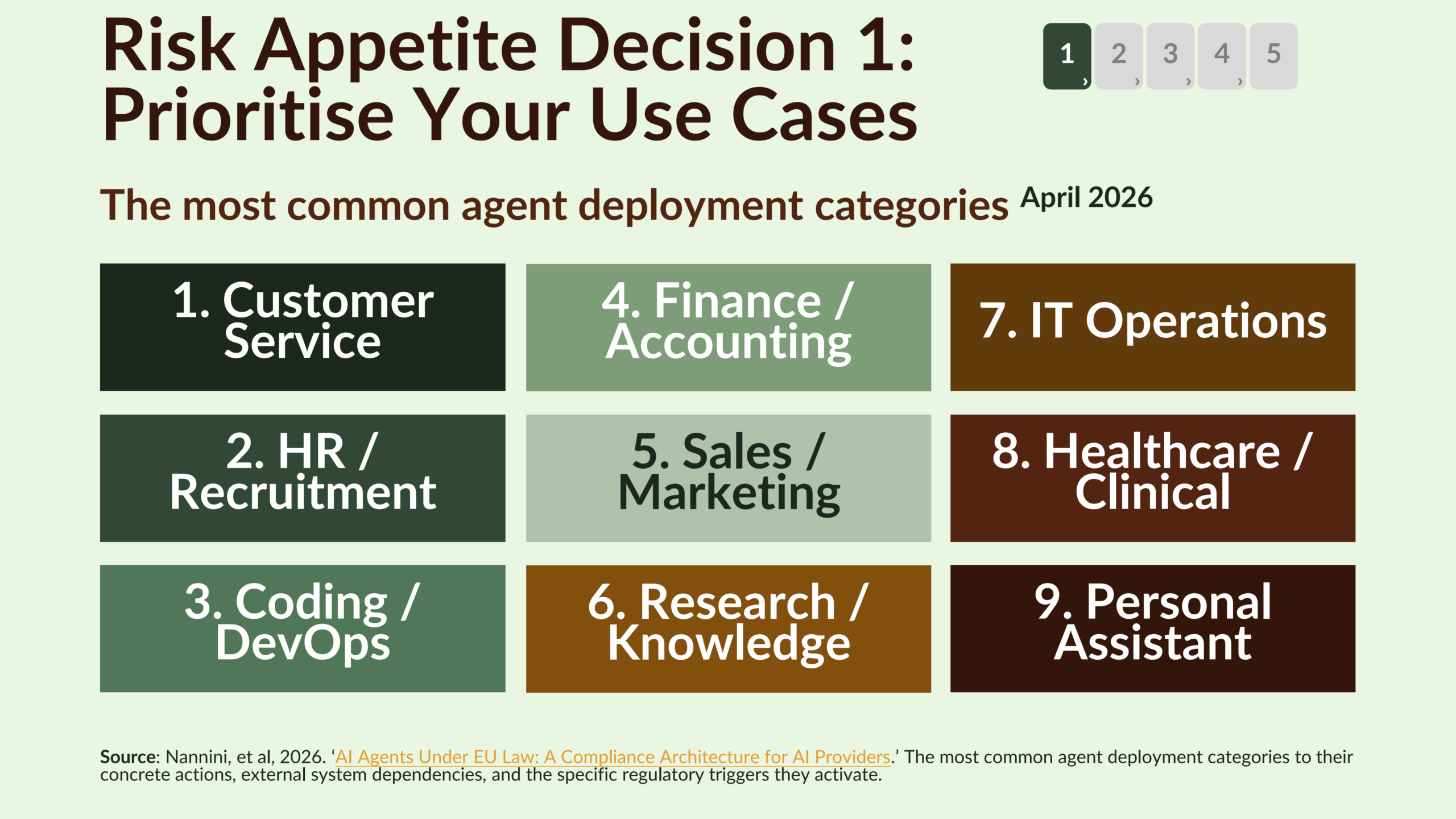
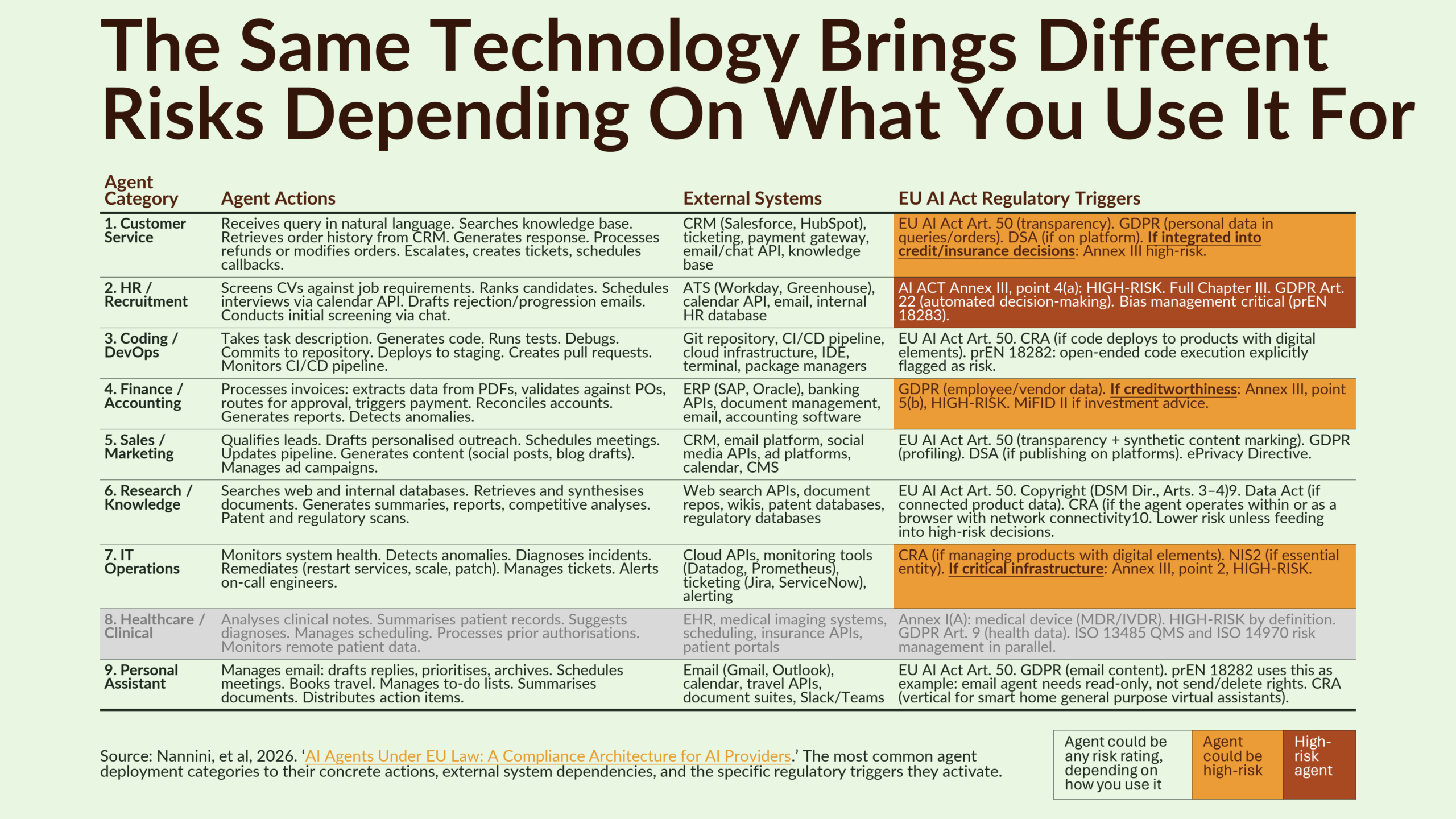
Deciding where in your organisation you will deploy agents, and for which use cases, is a direct expression of risk appetite because the same underlying technology can create very different risks depending on what you use it for.
A research agent, recruitment agent, coding agent, finance agent, or customer-service agent can touch different data, systems, people, and regulations. The webinar materials map nine common deployment categories to their actions, external dependencies, and regulatory triggers; refer to slides 21 and 22 for the detail.
Scale Efficiently: Break Use Cases Into Reusable Capabilities
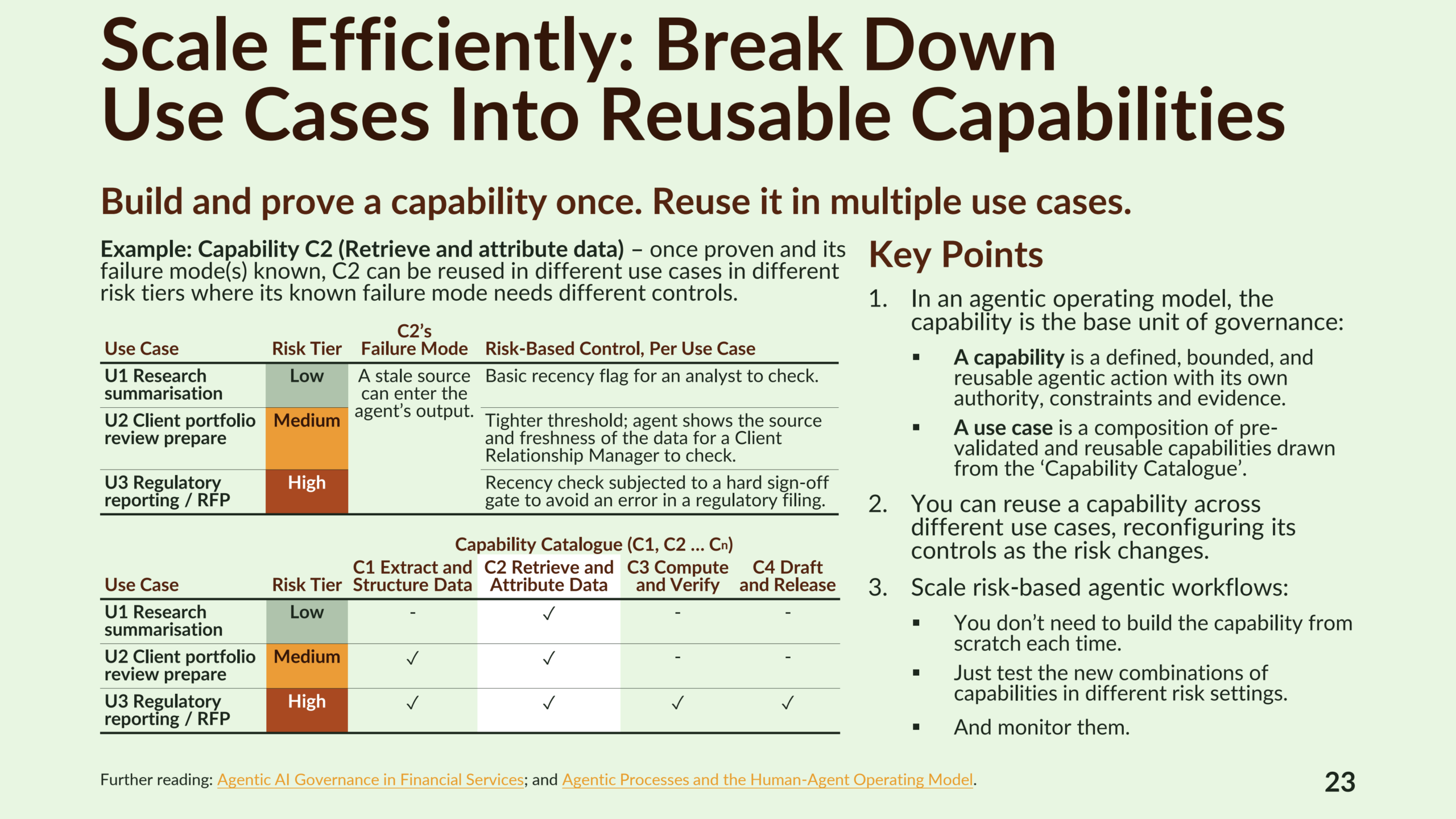
Use-case prioritisation should also establish how the organisation intends to scale. Rather than treating every new use case as a fresh build, break use cases down into reusable agentic capabilities.
A capability is then a defined, bounded, and reusable agentic action with its own authority, constraints, and evidence. And a use case is a composition of pre-validated capabilities drawn from a capability catalogue.
For example, “retrieve and attribute data” is a capability you can develop, prove, and reuse in multiple use cases, e.g. in research summarisation, client portfolio review preparation, and regulatory reporting. And across each use case, while the underlying failure mode may be the same, the controls should become stronger proportionate to a use case’s risk level.
This approach changes the economics of governance: you do not rebuild or re-prove every use case from scratch each time; you can test and implement new configurations of pre-proven capabilities. See slide 23 for the worked example.
Step 2: Confirm Your Adoption Strategy
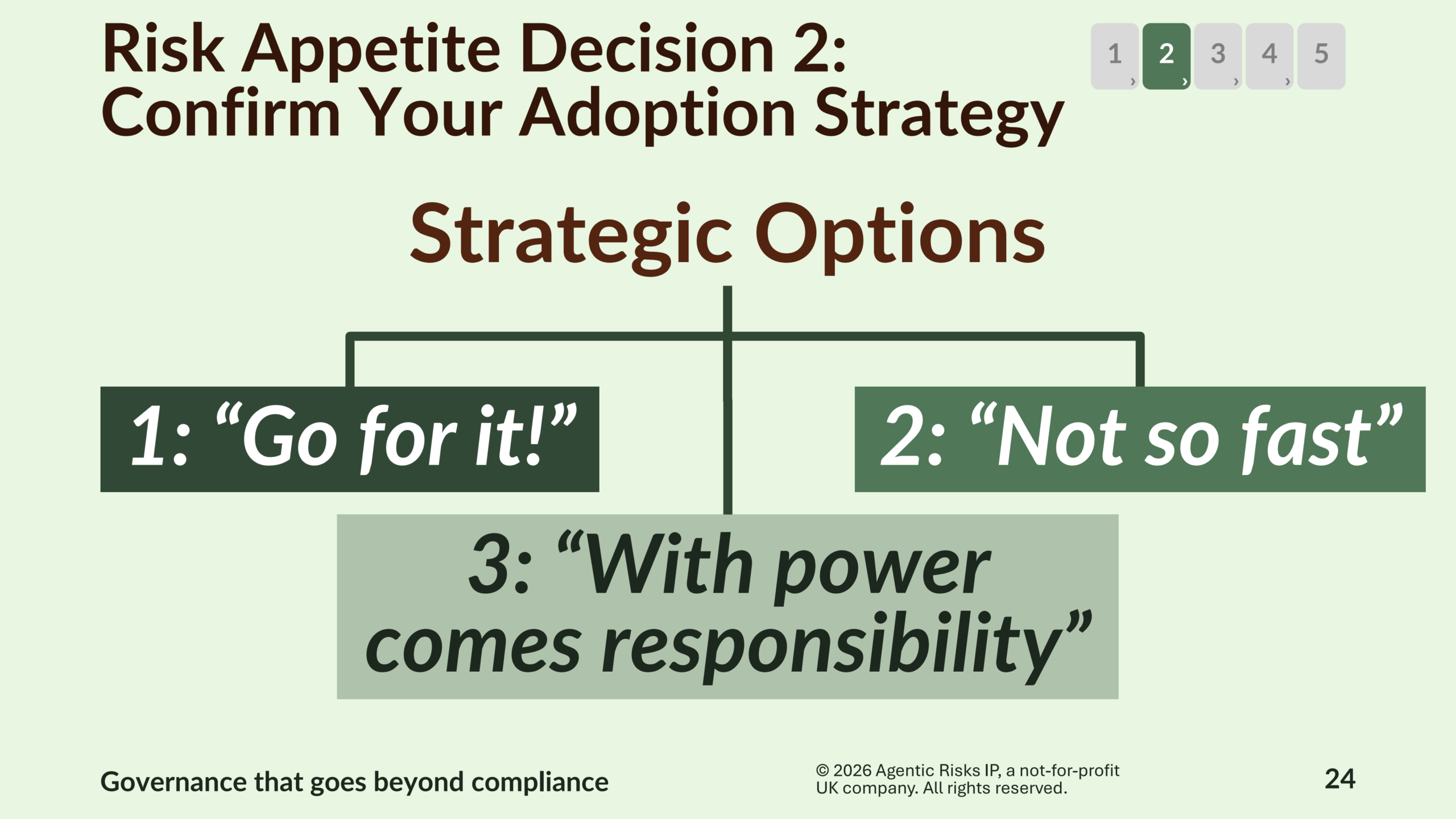
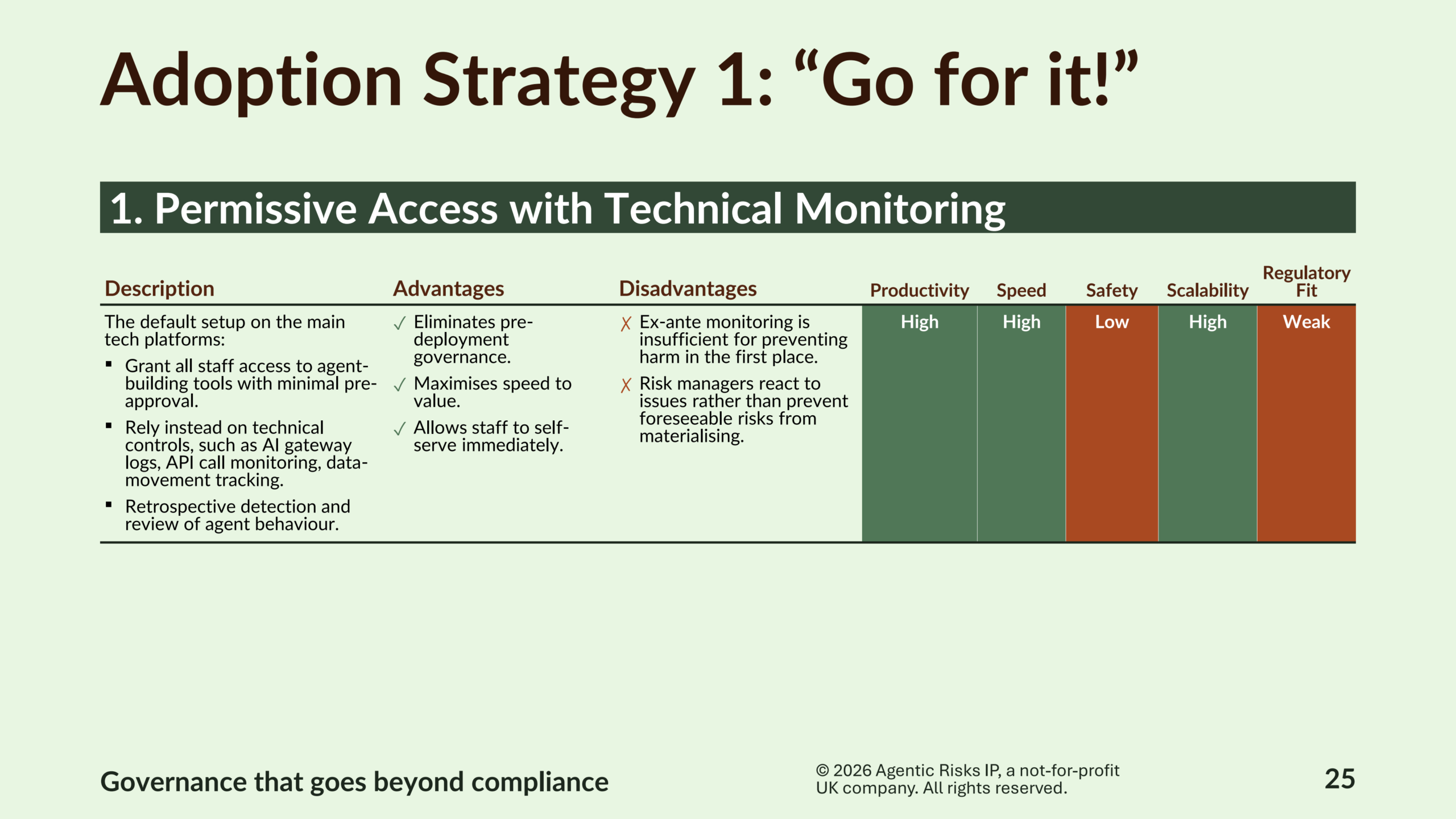
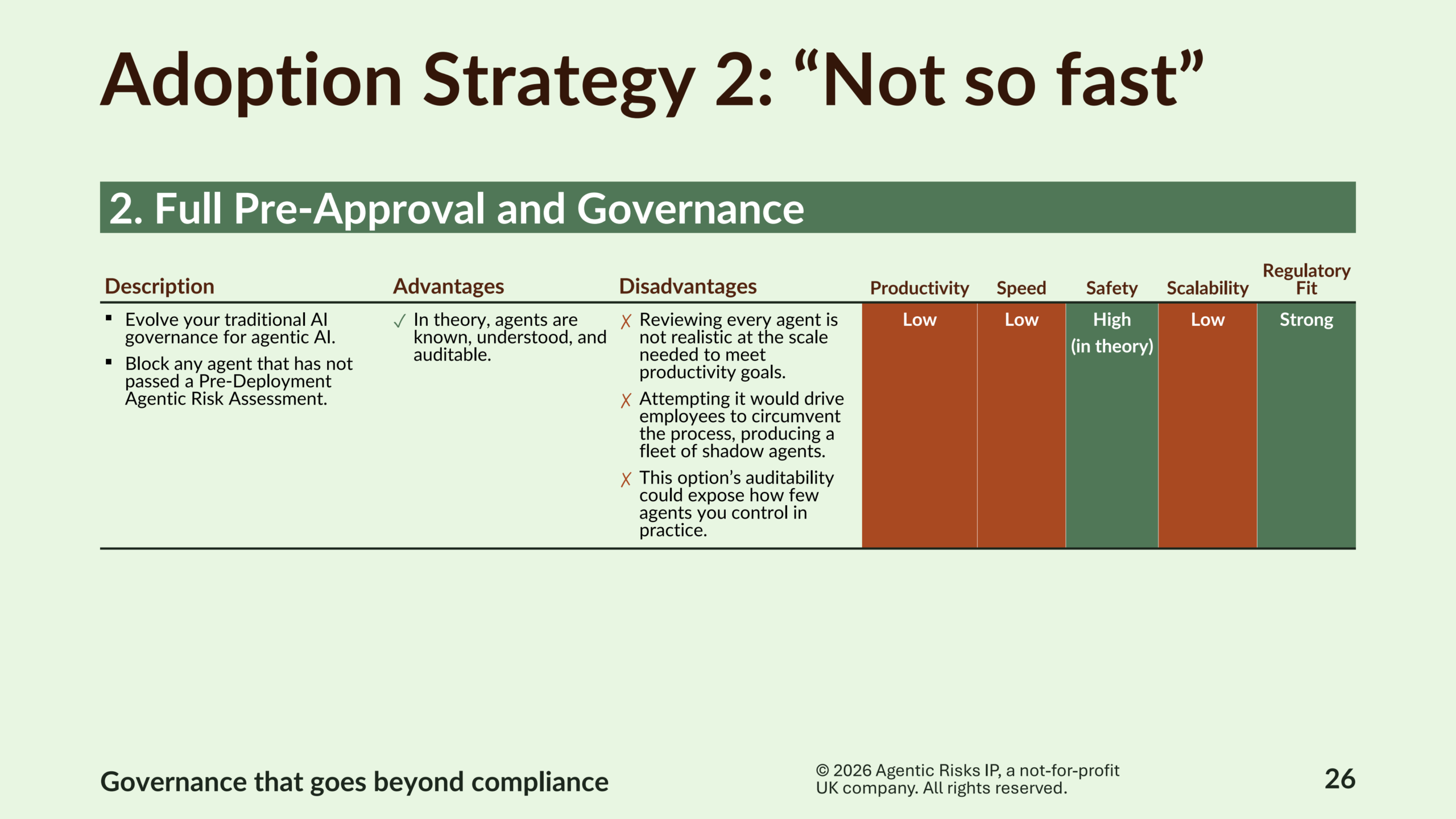
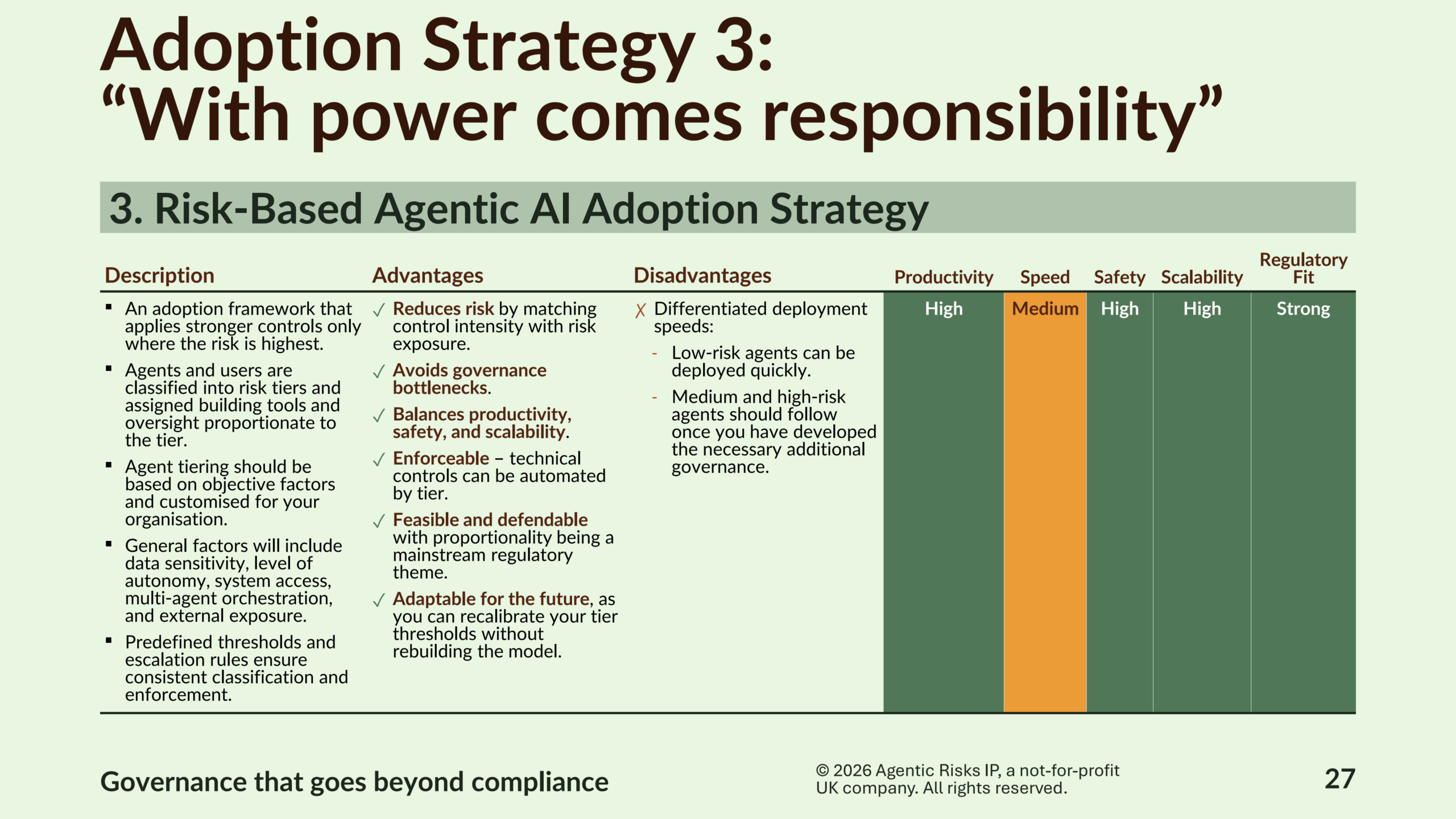
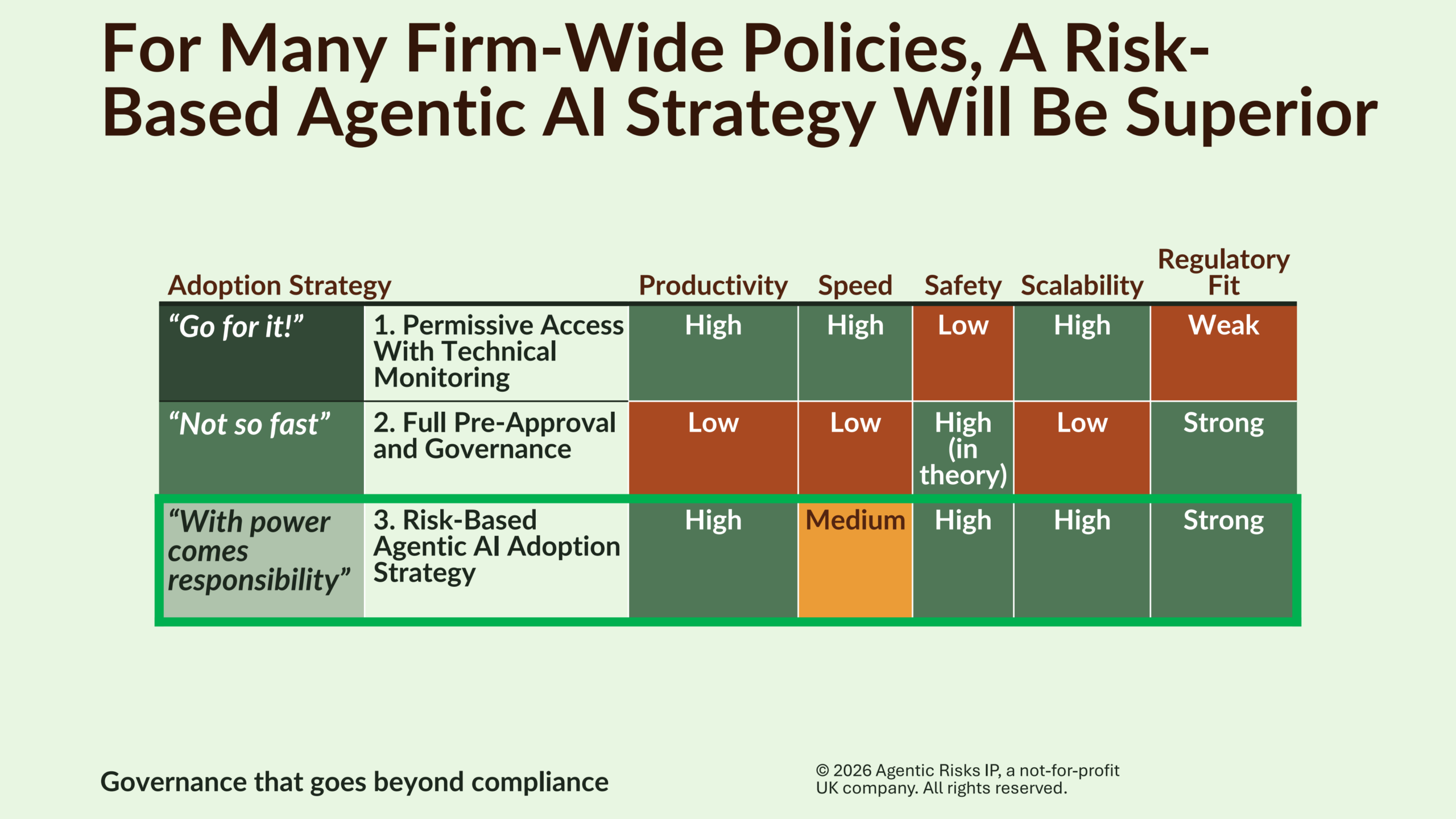
The second strategic risk appetite decision is how you will adopt your agentic use cases. The webinar presents three broad postures: permissive access with technical monitoring (“Go for it!”), full pre-approval and governance (“Not so fast”), and a risk-based strategy (“With power comes responsibility”).
The first maximises speed but relies heavily on retrospective detection. The second can provide strong control in theory but may create governance bottlenecks and encourage shadow agents if every deployment needs the same depth of review.
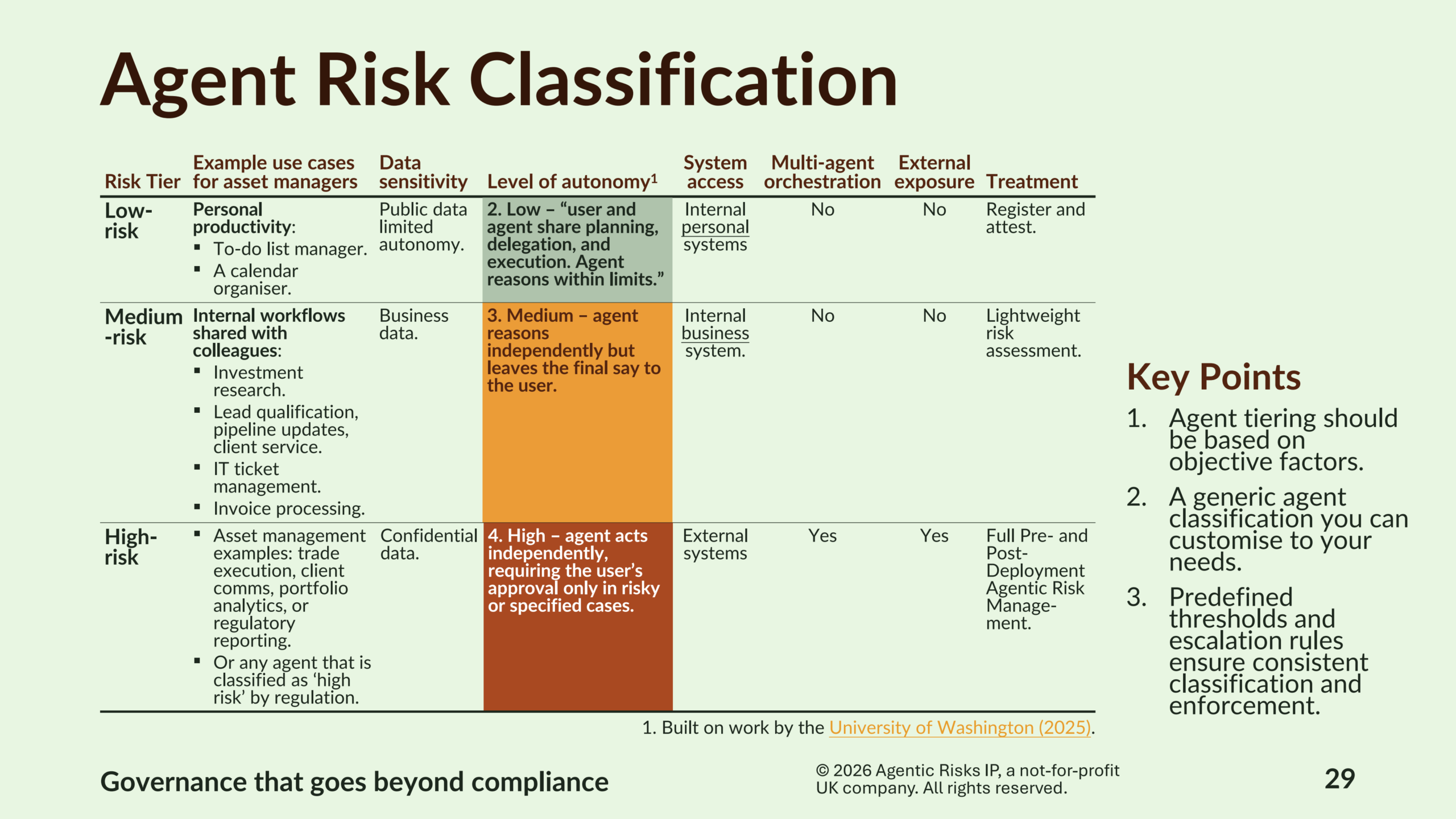
The risk-based approach applies stronger controls where the risk is highest. Agents are classified using objective criteria such as data sensitivity, autonomy, system access, multi-agent orchestration, and external exposure, with predefined thresholds determining the treatment. Low-risk agents can move quickly; medium- and high-risk agents receive progressively stronger assessment and oversight. See slides 24 to 29 for the trade-offs and worked classification.
Step 3: Identify Your Prerequisites
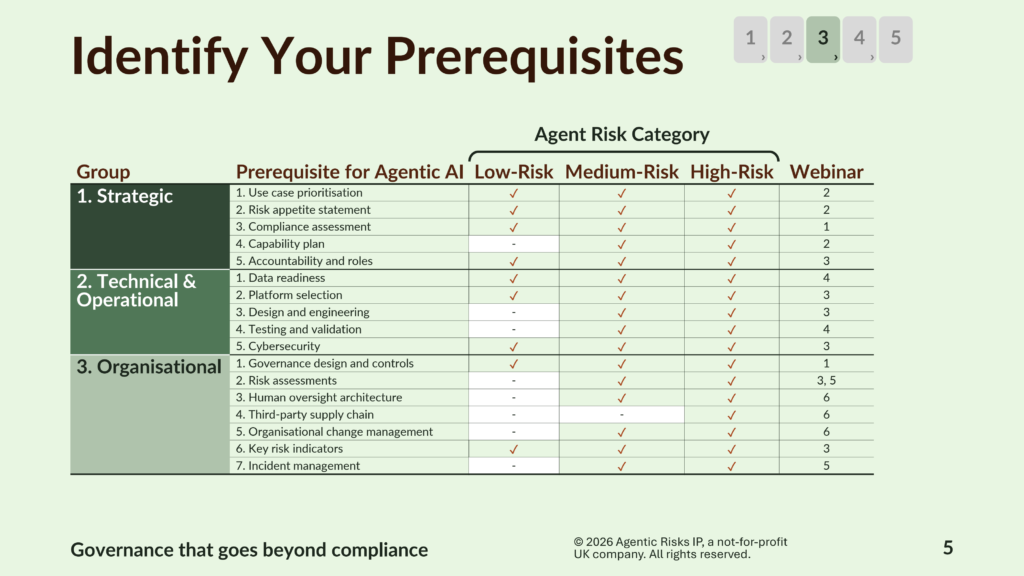
Once Steps 1 and 2 have defined what you are prepared to deploy and how you intend to govern it, Step 3 identifies what must be in place to make that strategy work.
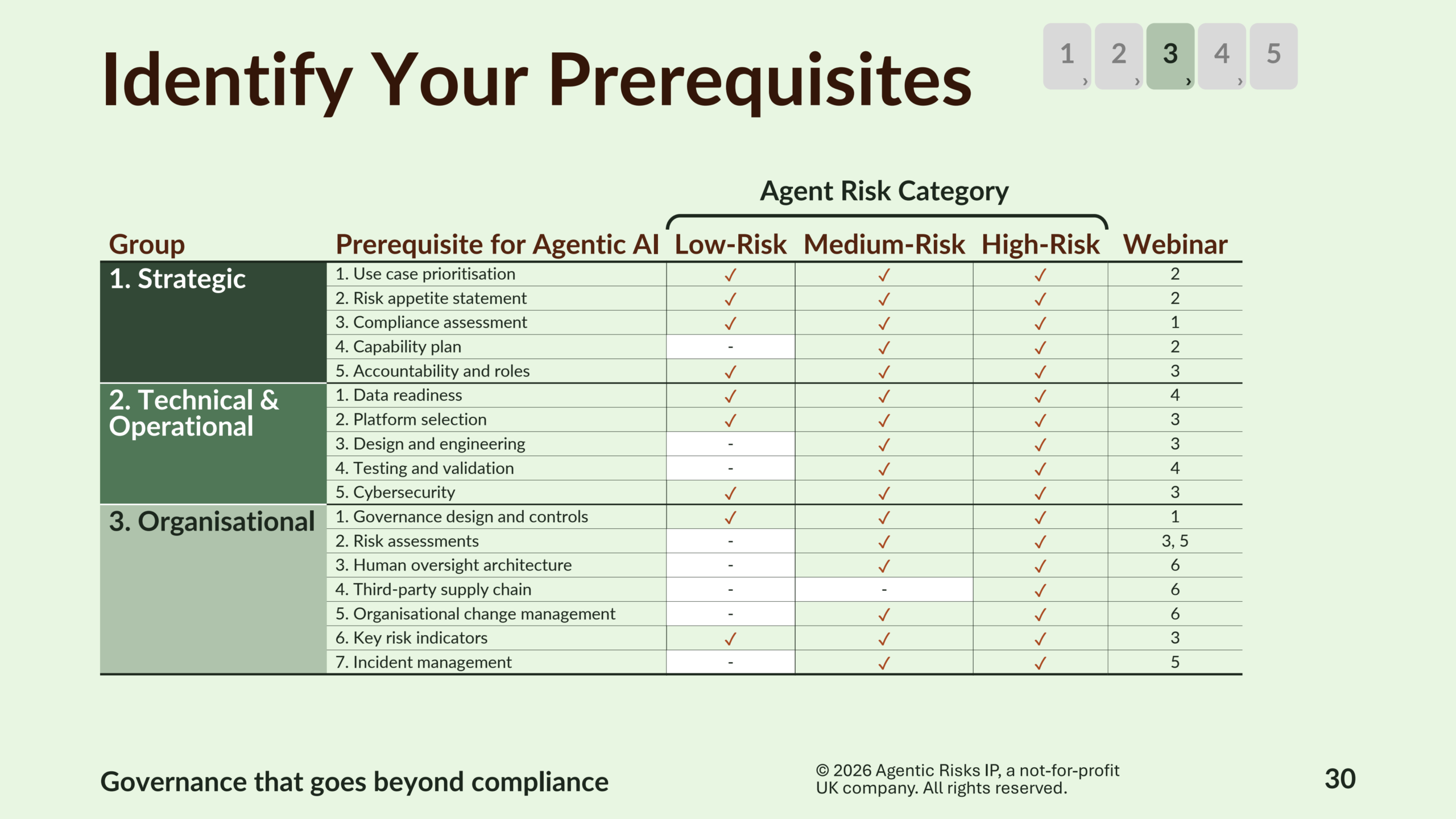
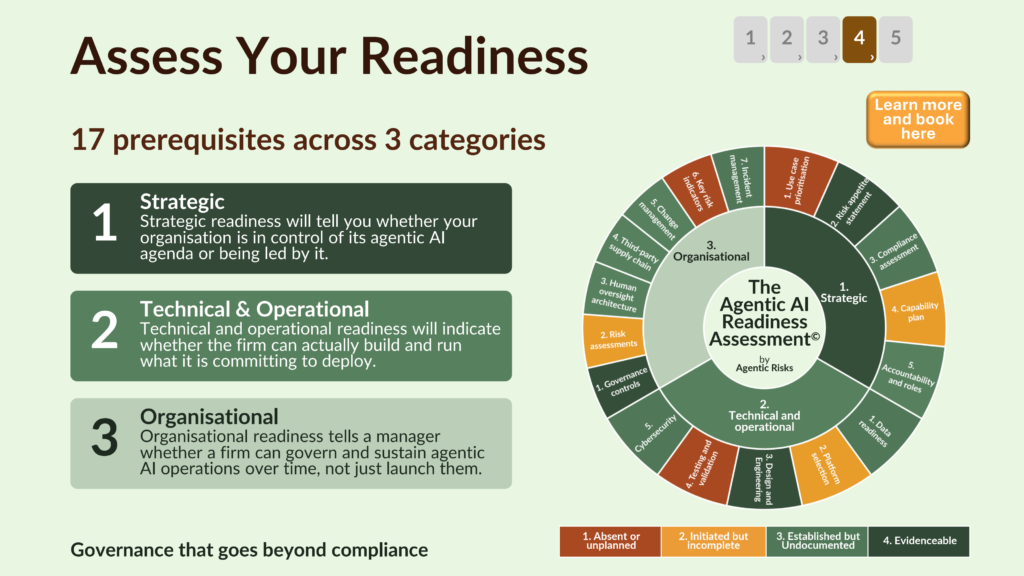
The webinar groups 17 prerequisites into three categories: strategic; technical and operational; and organisational. They range from use-case prioritisation, risk appetite, and accountability to data readiness, platform selection, testing, cyber security, governance, human oversight, change management, key risk indicators, and incident management.
Not every risk tier needs every prerequisite at the same depth. This gives a risk-based strategy an important scaling advantage: firms can build the capability required for low-risk agents first, then deepen it as they introduce medium- and high-risk agents.
Step 4: Assess Your Agentic AI Readiness
A roadmap is only useful if it is achievable from the organisation’s current state. Step 4 therefore defines readiness against the prerequisites before a timeline is committed.
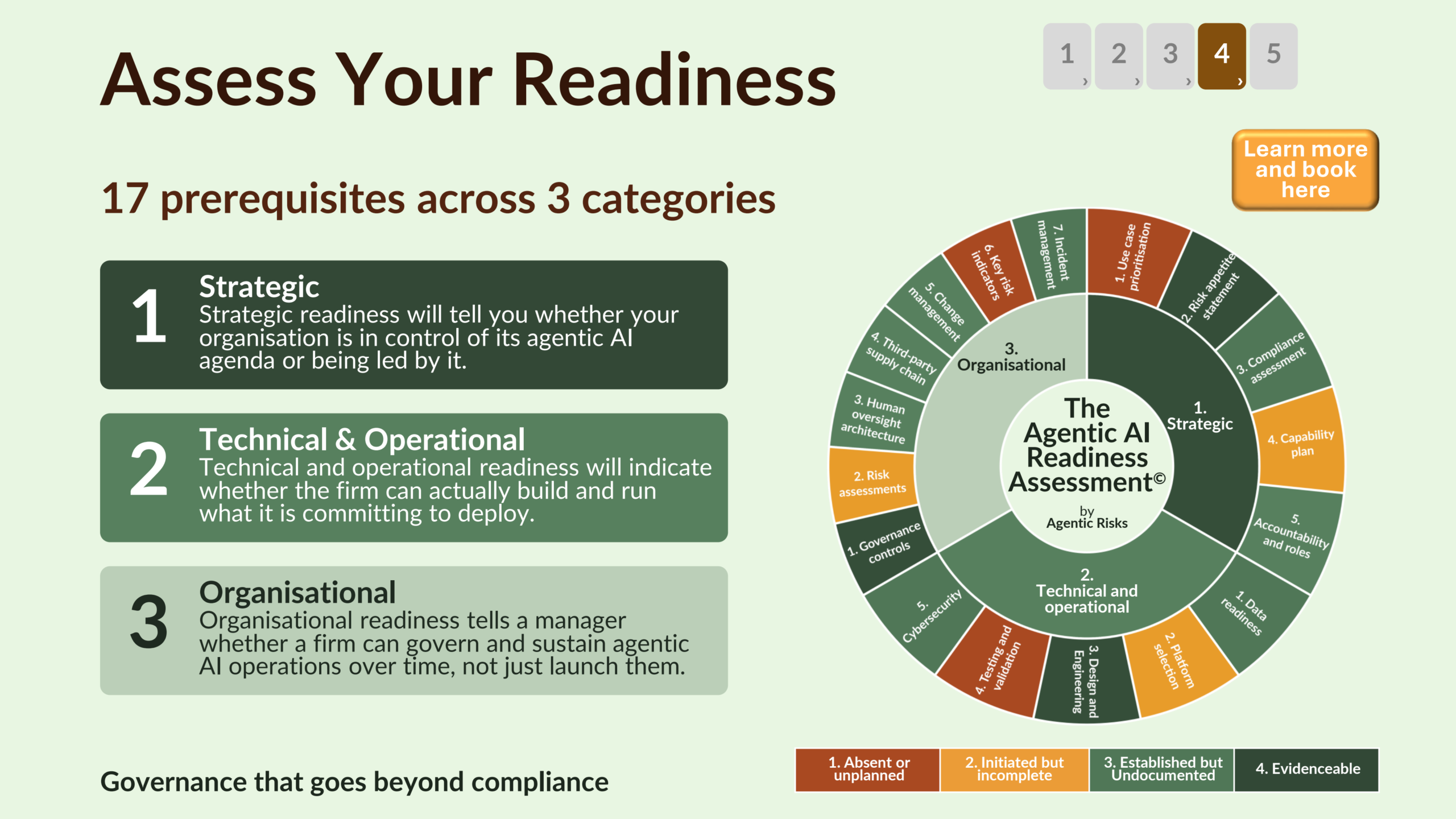
Strategic readiness asks whether the organisation controls its agentic AI agenda or is being led by it. Technical and operational readiness asks whether the firm can build and run what it plans to deploy. Organisational readiness asks whether it can govern and sustain agentic operations after launch.
Our Agentic AI Readiness Assessment assesses all 17 prerequisites across four maturity states: absent or unplanned; initiated but incomplete; established but undocumented; and evidenceable. The purpose is practical: identify the gaps that must enter the roadmap before the organisation scales its use of agents.
Step 5: Construct an Achievable Implementation Roadmap
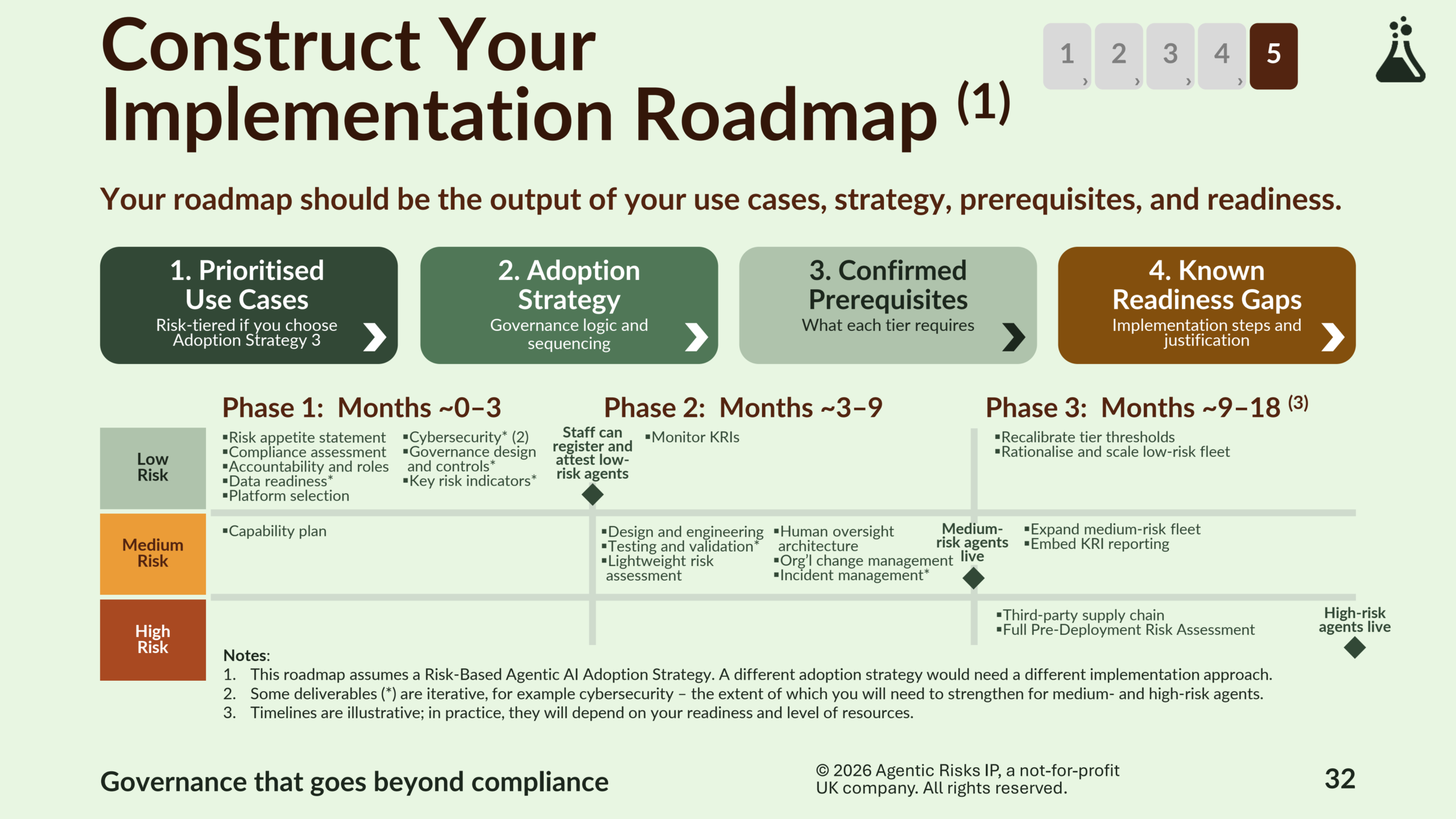
The roadmap is the output of the previous four steps: prioritised use cases define the scope, the adoption strategy defines the governance logic and sequencing, the prerequisites define what each tier requires, and the readiness gaps define the work that still needs to be done.
For a risk-based strategy, that naturally supports phased implementation: establish the controls needed for lower-risk agents first, expand to medium-risk workflows as additional capabilities mature, and introduce high-risk agents only when the stronger governance, testing, oversight, and external protections are ready.
The timings in slide 32 are illustrative, with the important principle being that your roadmap should reflect your appetite for risk and your actual readiness rather than purely your ambition.
Working with Agentic Risks
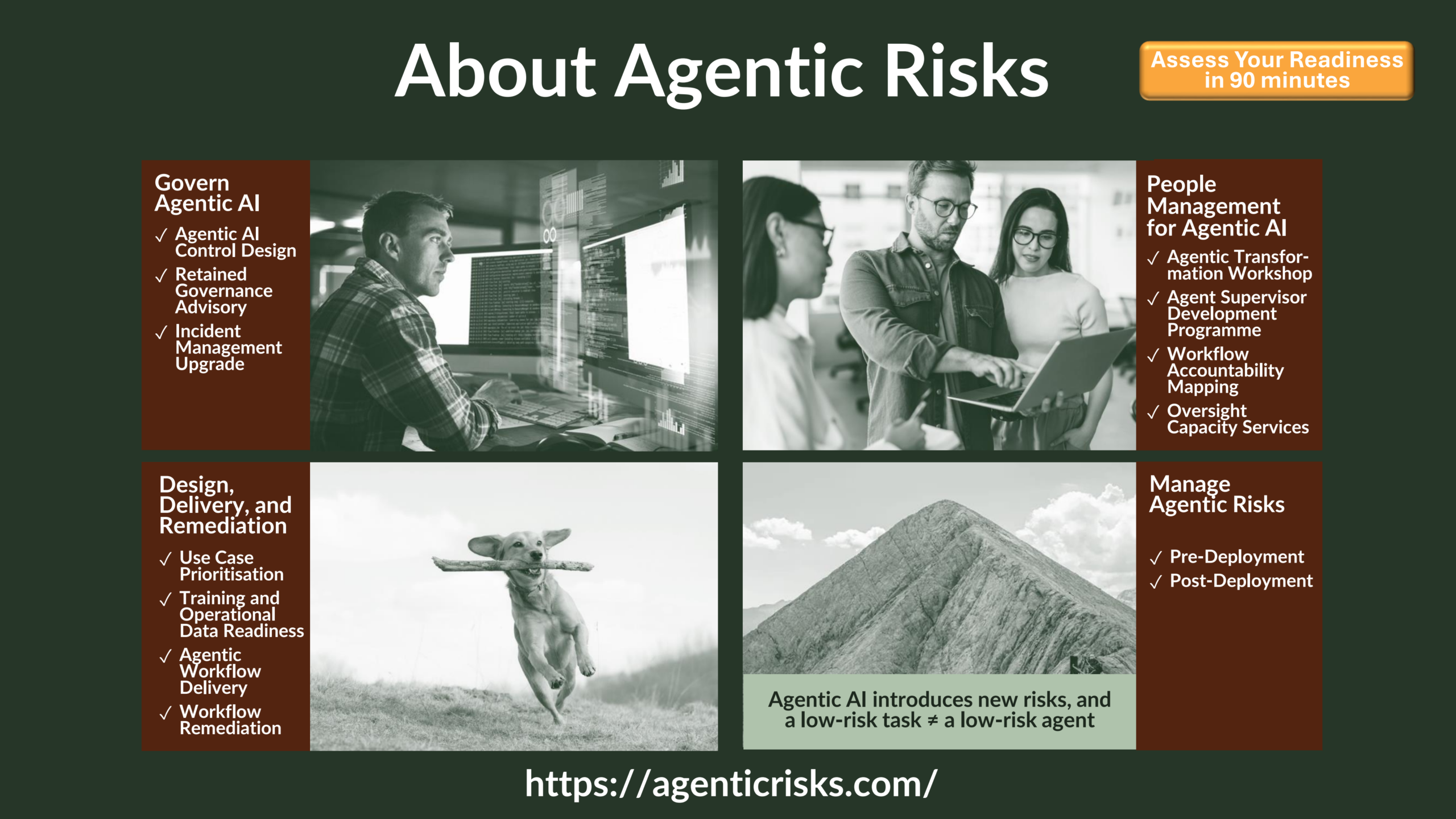
The practical service Webinar 2 highlights is the Agentic AI Readiness Assessment. In a 90-minute assessment, we review the 17 strategic, technical and operational, and organisational prerequisites and establish where your organisation is evidenceably ready, where work is underway, and where material gaps remain.
The result gives you an evidence-based starting point for an achievable roadmap: what can proceed now, what must be strengthened before medium- or high-risk agents are introduced, and why.
This matters because agentic transformation is not simply a sequence of technology deployments. The organisation needs the governance, controls, operating disciplines, and people capabilities to support the level of autonomy it intends to delegate.
Continue the Webinar Series
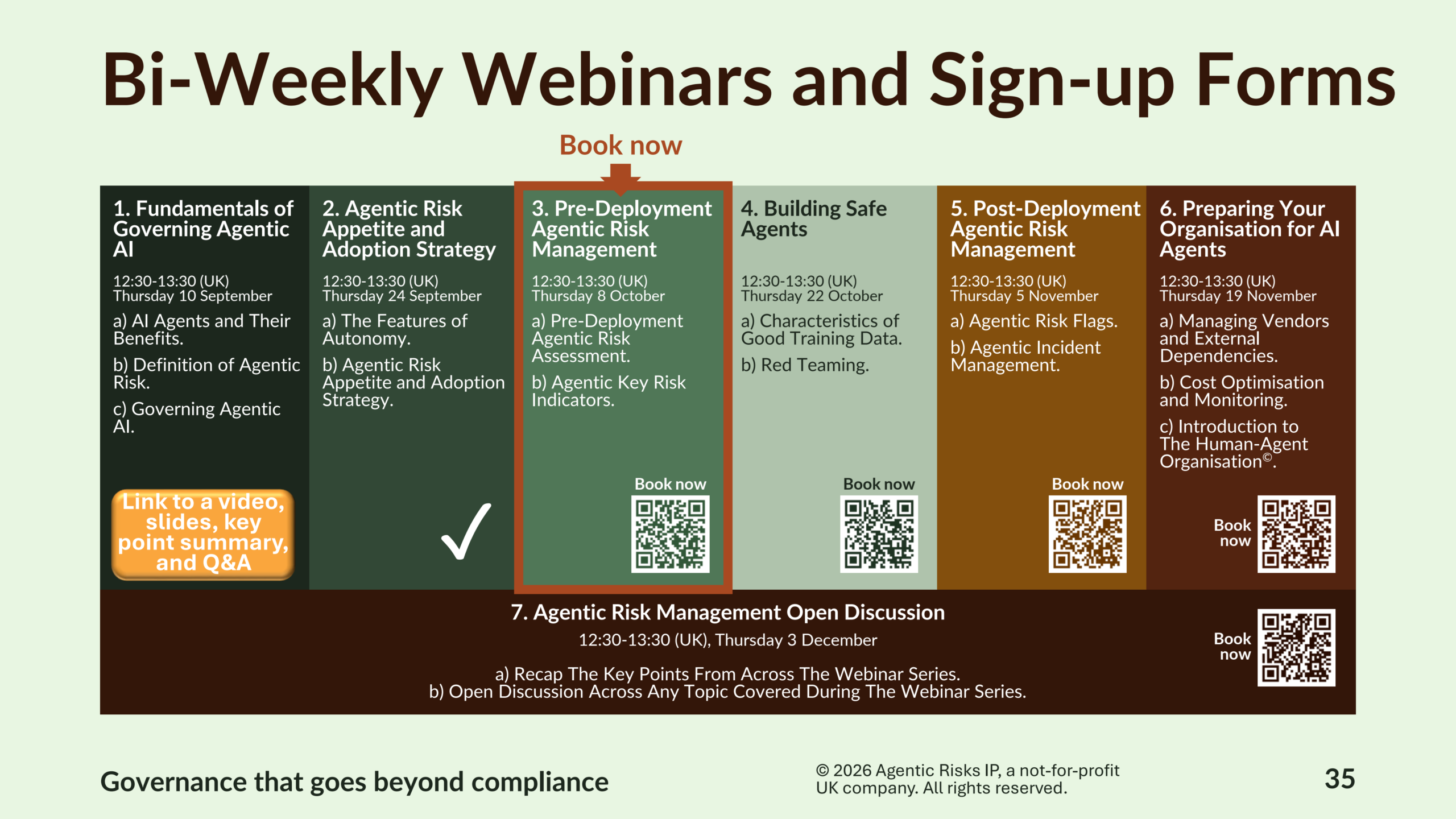
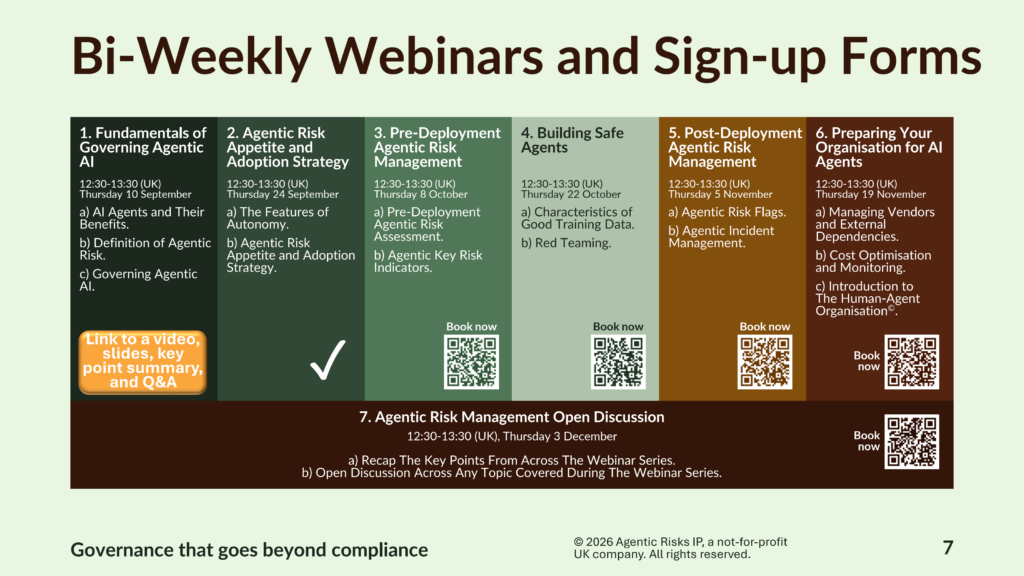
Webinar 3, Pre-Deployment Agentic Risk Management, continues directly from this session by showing how to assess the four sources of agentic risk before developing agentic key risk indicators and the controls needed before higher-risk agents go live.
Frequently Asked Questions
Agentic risk appetite defines the level of autonomy, access, and decision-making authority a firm is prepared to delegate to an AI agent. It helps organisations determine which use cases, systems, and actions autonomous agents may perform, and under what controls.
A risk-based agentic AI adoption strategy applies different governance requirements to agents based on their potential risk. Low-risk agents may follow lightweight registration and monitoring processes, while medium- and high-risk agents require proportionate oversight, formal governance, and pre-deployment risk assessments.
Autonomous AI agents shift human control from the execution phase of a workflow into the design, approval, monitoring, and oversight phases. Because agents can plan, take actions, invoke tools, and interact with external systems, firms need governance controls designed specifically for autonomous behaviour and machine-speed operations.
A Pre-Deployment Agentic Risk Assessment is a structured review performed before an autonomous AI agent enters production. It evaluates the workflow, agent design, organisational readiness, and external threat landscape to identify foreseeable risks, strengthen controls, and improve the defensibility of the deployment decision.
Firms should introduce AI agent autonomy incrementally, beginning with lower-risk use cases and proportionate controls before expanding into higher-risk deployments. Successful programmes align governance to risk appetite, strengthen organisational capability over time, and continuously monitor agent behaviour and outcomes.
The four primary sources of agentic AI risk are the workflow itself, the agent’s design and capabilities, organisational readiness, and external threats such as cybersecurity and regulatory exposure. Understanding all four helps firms assess risks more comprehensively before deployment.
AI agents cannot be held morally or legally accountable for their actions, so accountability remains with the organisation and the humans overseeing the workflow. Human oversight helps ensure autonomous agents operate within approved boundaries, comply with governance requirements, and can be monitored, stopped, or corrected when necessary.