In brief
To leverage the benefits of agentic AI you must manage the broad new class of risks that it introduces.
If left unmanaged, these risks can materialise across individual and multi-agent behaviours, system security, governance, policy integration, as well as organisational factors and human capabilities.
To enable the new discipline of agentic AI risk management, the Enterprise-Wide Agentic AI Risk Control Framework helps you identify, assess, and control these new risks, integrate them into your existing framework, and keep pace as agentic AI evolves.
To get started, set your policy on AI autonomy, map the risks to a pilot agentic workflow, and select the right controls.
AI Agents and Their Benefits
On your behalf, autonomous AI agents can perform multi-step tasks, act across systems, select tools, reason through ambiguity, decide when a task is done, and hand control back to a human if needed.
For organisations deploying AI agents, the benefits include higher productivity, scalable automation, reduced manual work, and better use of human judgement.
For example, the Fetch AI data collection agent that automates previously manually data gathering, KPI calculation, and flags the quality concerns about its outputs for approval.
AI Agents Introduce a New Class of Risks
However, while agents can outperform humans on some tasks, they behave differently and can suffer no sanction.
Because of this, to leverage the benefits of delegating autonomy to this new technology, you must manage the broad new class of risks it introduces.
If left unmanaged, these agentic risks can materialise across individual and multi-agent behaviours, system security, governance, policy integration, as well as organisational factors and human capabilities.
The Five Categories of Agentic AI Risks
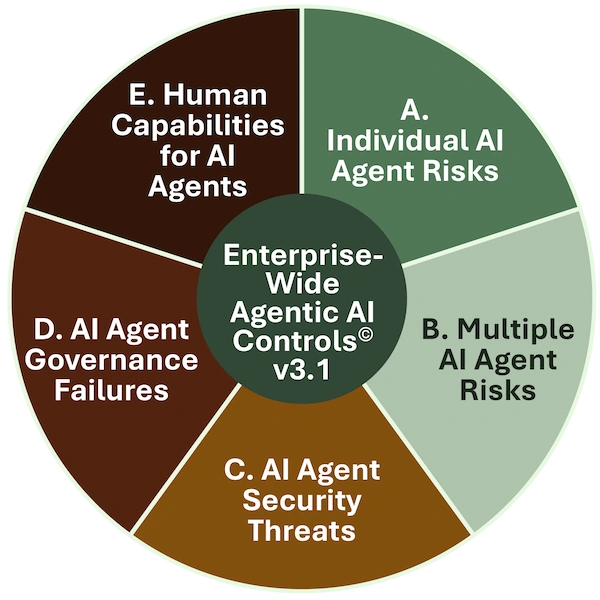
At Agentic Risks, we group agentic AI governance and risk controls into five categories:
- Individual AI Agent Risks – an AI agent may behave unpredictably, inconsistently, or unfairly, drifting from its intended purpose, compounding errors, or operating outside policy, leading to failures, bias, or inconsistency.
- Multiple AI Agent Risks – more than one agent may interact, replicate, or conflict in uncontrolled ways – creating confusion, inefficiency, security gaps, or runaway behaviours that undermine oversight and system stability.
- Agentic System Security Threats – agents and their data pipelines can be attacked, corrupted, or misused, leading to data breaches, loss of control, unsafe behaviour, or system compromise.
- AI Agent Governance Failures – agents may operate without accountability, compliance, or control, causing outages, data loss, cost overruns, policy and regulatory breaches, or reputational damage.
- Human Capabilities for AI Agents – people may resist, misuse, or over-trust AI systems, leading to stalled adoption, poor oversight, loss of skills, ethical breaches, and erosion of trust and legitimacy.
Why Traditional Risk Management Falls Short

Understandably, many organisations are unfamiliar with agentic risks, and traditional controls are insufficient. Despite this, regulators and standards bodies are clear: firms must integrate agentic AI into their existing risk management frameworks, e.g. ISO, COSO, or NIST.
To overcome this problem, the Enterprise-Wide Agentic AI Risk Control Framework helps risk managers understand how to manage the risks of autonomous AI agents effectively. It includes a complete set of known risks and best-practice agentic AI governance and risk controls.
The New Discipline of Agentic Risk Management
This emerging discipline requires organisations to:
1. Conduct comprehensive agentic AI risk identification
Using a complete, consensus-based set of risks improves the accuracy of assessments and stakeholder engagement. Without this, testing will expose gaps that should have been identified earlier.
2. Build proportionate, multi-disciplinary risk treatment plans
Risk treatment plans are most effective when based on clear, up-to-date, and auditable controls. They enable meaningful agent training and testing to prove control effectiveness and assess residual risk. Without this, testing becomes exploratory probing rather than a systematic evaluation, storing up issues for the live environment.
3. Integrate agentic AI into your existing ISO, COSO, or NIST frameworks
Risk assessments must be structured to ensure completeness but flexible enough to tailor to your context. If you do not integrate agentic AI risk management into your current frameworks, you will create parallel processes that will introduce gaps and additional overhead.
4. Stay current as agentic AI evolves
Agentic AI risks evolve fast. So, a version-controlled catalogue of risks and controls, overseen by a Governing Council, ensures the Enterprise-Wide Agentic AI Risk Control Framework’s ongoing relevance. Using outdated or narrow frameworks will create blind spots that become costly later.
Where to Start: Key Steps for Integrating Agentic AI Risk Management
The Enterprise-Wide Agentic AI Risk Control Framework is the keystone for building a multi-disciplinary response. But it is the start, not the end.
To get started, we recommend organisations consider three practical steps:
- Train staff in agentic AI and its risks and controls – develop a targeted training programme for your colleagues and stakeholders (e.g. Steering Committee, project team, impacted staff) to ensure your organisation embarks on its agentic transformation in an informed way.
- Define your AI agent autonomy policy and adoption strategy – autonomy is not a binary concept: it is a spectrum of different levels you calibrate to your needs. Therefore, you should decide your appetite for delegating autonomy early. Delaying this decision can cause your agentic transformation will either overexpose you or underwhelm.
- Map the risks and controls for a pilot agentic workflow – select a pilot use case, identify the risks, and select the controls you need to construct the risk treatment plans.
After this initial success, you will be able to scale your new agentic AI capability more broadly.
FAQs
Agentic AI behaves differently from traditional software because agents can act independently, make decisions, and use tools across systems. This creates new risks that legacy controls cannot manage. As a result, organisations need agentic AI risk management practices that account for autonomy, multi-agent behaviour, security, governance, and human capabilities.
A strong agentic AI risk management framework includes:
- A complete set of agentic AI risks.
- Best-practice governance and risk controls.
- Structured risk assessments and treatment plans.
- Integration into ISO, COSO, or NIST frameworks.
- Ongoing version control to keep pace with evolving risks.
To manage the risks of autonomous AI agents, organisations should:
- Identify potential harms and failure modes.
- Select proportionate controls to prevent or mitigate them.
- Test agents before and after deployment.
- Integrate agent oversight into existing risk management processes.
This ensures safe autonomy without slowing innovation.
The five categories are:
- Individual AI Agent Risks
- Multiple AI Agent Risks
- Agentic System Security Threats
- AI Agent Governance Failures
- Human Capabilities for AI Agents
Together, these provide a complete view of where autonomous AI agents can create risk.
The most effective approach is to map agentic AI risks and controls to your existing enterprise risk framework. Using a comprehensive and recognised set of agentic AI risk controls ensures consistency, prevents duplication, and avoids parallel or conflicting risk processes. This is also what regulators expect.
It is a comprehensive set of risks and agentic AI governance and risk controls that helps organisations adopt agentic AI safely. It enables structured risk identification, targeted treatment plans, and integration into ISO, COSO, and NIST frameworks — supported by version control to stay current as agentic AI evolves.
Begin by defining your policy and risk appetite for autonomous AI agents. Then run a pilot agentic AI risk assessment for one workflow to identify risks, select controls, and build your first treatment plan. Once proven, scale across the organisation.
Agentic AI risk management means keeping autonomous AI agents safe, predictable, and aligned to your goals. You identify where an agent could go wrong, decide how serious the impact could be, and put controls in place so it behaves responsibly. It helps you use AI agents with confidence, without losing oversight or exposing the organisation to unnecessary risk.
To implement agentic AI risk management:
- Set your policy and how much autonomy you will allow.
- Select a pilot use case.
- Assess the risks and choose required controls to build your first risk treatment plan.
- Test that the controls work and the agent behaves safely.
- Integrate this into your ISO, COSO, or NIST framework.
These five steps help you adopt autonomous AI agents safely and responsibly.