Table of Contents
Executive Summary
Agentic AI Transformation Workshops help leadership teams decide how they will govern autonomous AI agents before unstructured experimentation allows risks to materialise.
In one day, teams assess readiness, choose a governance approach, scope all the workstreams they need and identify no-regret actions that can begin without delay.
The process turns uncertainty about oversight, pace, and evidence into a deliberate, defensible agentic AI governance plan.
Our enterprise engagements show that organisations move faster when they define acceptable autonomy and ownership early and decide how their controls will work.
Contact us to turn your leadership team’s open questions into an executable agentic AI governance programme.
An Organisation That Knows Its Own Mind
In our Agentic AI Transformation Workshops, enterprise leadership teams decide, in a single day, how their organisations will govern agentic AI.
They leave with a deliberate governance plan that uses proven methods, with a shared understanding of why they made their choices, and with a record in case they ever need to demonstrate their process. A measured starting point for organisational readiness. A clearly sequenced programme with named owners. And momentum: actions they can begin immediately, whatever they decide later, within existing budgets.
Watching leadership teams reach these decisions has taught me more than governance frameworks.
This article shares five of those lessons. Each resolves an uncertainty executive teams feel before the workshop begins:
- Whether existing AI governance can stretch to cover autonomous agents.
- How to manage risk while maintaining pace.
- How to achieve human oversight of AI agents at scale.
- How to plan from evidence.
- What to do when you get back to your desks.
They are worth resolving now, because I believe agentic AI rewards the organisations that settle them early. That is the outcome this article describes: an organisation that knows its own mind – what it will build, how boldly, in what order, and how it will prove the effectiveness of its oversight to anyone entitled to ask.
I’ve noticed common obstacles between leadership teams and that outcome. Our clients recognise them instantly – and our workshops hand them a tool for each.

Our Agentic AI Transformation Workshops: Five Tools for Five Obstacles
1. When teams want to govern agents while maintaining pace, we give them three approaches and evaluate them side by side. The team chooses and records why; one even decided to do all three depending on the scenario. That record gives them a firm foundation to build on and helps leaders across the organisation design supporting solutions in their own areas. It also answers the regulator’s question – how did you choose your controls?
2. When teams ask how to achieve human oversight of AI agents at scale, we give them a model that groups use cases by risk and reuses capabilities across them. The same technology can create different risks in different uses. So, we show them how to prove an agentic capability once, reuse it across multiple uses and scale the controls to match the risk of each use. This way, they build oversight into the system.
3. When teams wonder whether their AI governance already covers agents, we give them a readiness assessment. Seventeen prerequisites for agentic AI and their leadership team scores each against a defined standard. One group debated whether, individually, they had scored themselves too optimistically and lowered their scores; others raised theirs after hearing their colleagues’ perspectives. Either way, this is the moment a plan becomes credible: when the team has confirmed its starting point and takes ownership of it.
4. When teams ask, “what do we actually do on Monday?”, we give them their own customised dependency map: it shows what each area of work needs – specific to them and their stakeholders – and what depends on it. The map turns an open question into a sequence: which decision unlocks the most, which choices should wait, and which actions can start now, whatever they decide later, with named owners and within existing budgets.
5. When teams want their ambition to survive contact with the diary, we give them a programme document within days: we order and strengthen the day’s decisions into a full agentic AI transformation plan their sponsor can carry to the next stage, be it detailed planning, stakeholder consultation, or both. So, what do they do when they get back to their desks after the workshop ends? Simple: the agentic change programme begins.
So, there we have it: five tools for overcoming five common obstacles and, together, they produce the organisation that knows its own mind.

The Era of the Human-Agent Organisation ©
Behind all five sits a deep shift: after centuries of the human-only organisation, human-agent organisations are now delegating autonomy to software that can answer, decide and act across systems, at machine speed.
The world is still adjusting. Today’s major AI regulations largely took shape before agents arrived. Research is finding that many organisations have already experienced an agent-related security incident, and that shadow agents, which organisations deploy without approval, are widespread. The Bank of England has publicly questioned how much oversight a human can realistically provide.
Our clients feel both sides. The nerves are real: agents that overstep their authority can commit the firm to decisions or obligations. So too is the excitement about the opportunity. Leadership teams often focus more on the risk of moving too slowly or doing nothing.
There Will Be Winners
At Agentic Risks, we believe this change will reward some organisations more than others.
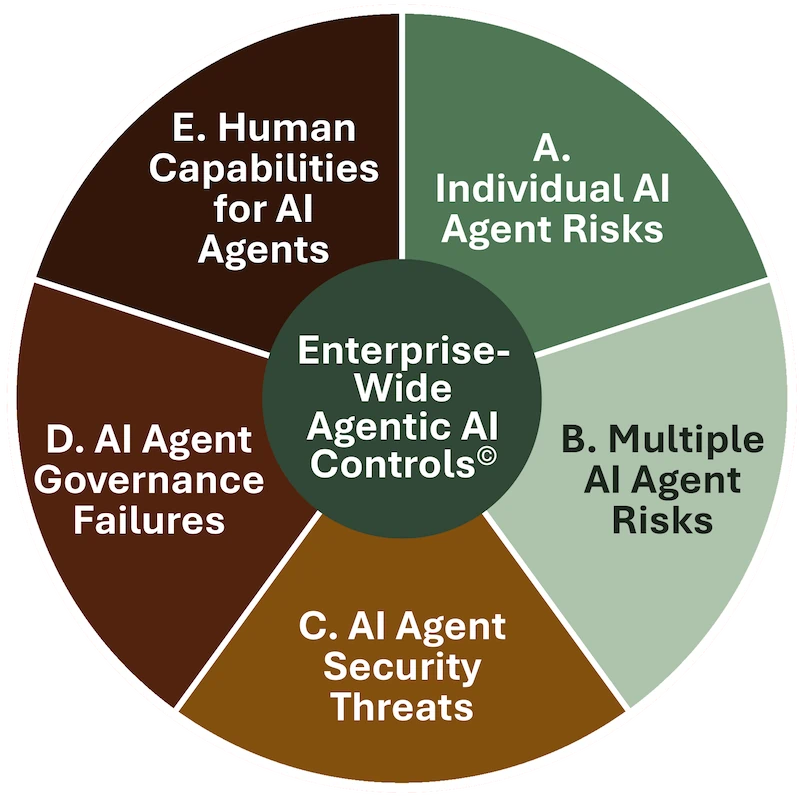
In our Agentic AI Transformation Workshops, leadership teams quickly see how different the outcomes can be. They deliberately settle five questions – coverage, sequence, posture, oversight, evidence – and convert their answers into an executable agentic AI governance plan.
Less-prepared organisations let unstructured experimentation answer the same five questions, creating flawed assumptions: teams guess or misremember acceptable autonomy levels, choose platforms before setting criteria, rely mainly on trial and error for testing, and assume oversight will work.
The winners, we believe, will be the organisations that decide early and implement fast so they can keep pace with this emerging technology. They will move quicker precisely because they have made deliberate choices. And if a regulator, auditor, or client asks how they chose their controls, they will have an answer with a date on it.
Agentic AI Transformation Workshops: What Happens Over The Day
My colleagues and I watch this happen in our workshops.
Leadership teams arrive with ambition and open questions.
By late morning, they have covered the fundamentals of agentic AI, and they hold a readiness baseline they have scored and challenged. By midday, they have chosen and recorded a governance approach.
By late afternoon, they have agreed the assumptions for an organisational change programme and are shaping it into up to 17 distinct areas of work, with immediate actions rising to the top because they can start within existing budgets whatever the team decides later.
Before the day concludes, we have watched a room of senior leaders vote unanimously to proceed – every hand raised.
Within 72 hours, we will deliver their programme document, ready for the sponsor to take to the next stage through detailed planning, consultation or both.
Our clients now know precisely what each of the five lessons means for their business. If you’d like this for your business, learn more about our Agentic AI Transformation Workshops here and contact us to discuss how we can tailor the workshop to your needs – we’d love to hear from you and give you this experience too.
Frequently Asked Questions
An agentic AI governance workshop is a structured working session in which a leadership team assesses readiness, chooses how it will govern autonomous AI agents, puts the required work in order and records why it made those choices. The outcome is a shared starting point, named owners, actions that can start immediately whatever the team decides later, and an executable change programme.
Traditional AI governance often assumes systems produce outputs for humans to review. Agentic AI can plan and act across systems at machine speed, so leadership teams must also define what agents may decide and do, how much autonomy they may have, how people will oversee them, when people must escalate issues and what evidence to keep. Existing governance can provide a foundation, and leadership teams will need to add controls for agentic AI, such as controls that adjust as risk changes.
Our readiness assessment tests 17 prerequisites for agentic AI against defined standards. The leadership team scores and challenges the baseline together, replacing individual assumptions with a shared view of strengths, gaps and priorities. That evidence becomes the starting point for a credible governance and transformation plan.
Yes. Teams can move faster when they make key decisions once and reuse them. A recorded governance approach gives leaders of each area of work clear assumptions to work from, while a dependency map shows which decisions unlock the most progress and which actions can begin immediately whatever the team decides later. Deliberate choices reduce rework, uncertainty and repeated requests for senior decisions.
Human oversight of AI agents at scale requires organisations to group use cases by risk, apply stronger controls where risk is higher and reuse capabilities they have already proven. Together, these measures create clear boundaries, monitoring, routes for raising issues and evidence.
Within 72 hours, you will receive a programme document that turns the workshop’s decisions into a plan in a clear sequence. It captures the readiness baseline, governance approach, assumptions behind the plan, named workstreams and immediate actions. The sponsor can then develop it through detailed planning, wider consultation or both.