In brief
AI agents can act autonomously to perform multi-step tasks, interact across systems, and learn from experience, making them more powerful than basic prompt-driven AI tools.
The key features of AI agents and their benefits for organisations include higher productivity, scalability, and better use of human judgement. This makes them especially suitable for workflow automation.
Organisations should de-risk their adoption of agentic AI by defining their policy for delegating autonomy, implementing effective risk controls, and piloting an agentic workflow before scaling.
What Are AI Agents?
AI isn’t a single technology. It’s a combination of tools – and AI agents are one of the most powerful. They act as your non-human workforce: digital entities that can work autonomously to perform complex, multi-step tasks.
In simple terms, here’s how AI agents work and why they differ from basic chatbots:
- AI agents act autonomously to plan tasks, break down problems, select tools, and choose the best way to achieve an objective.
- They interact across systems, such as browsing the web, writing or executing code, and communicating with software, other agents, and people – not just responding to single prompts.
- They remember, drawing on persistent memory to learn from experience and improve over time.
When multiple agents collaborate, this is known as agentic AI. In these setups, an “orchestrator” agent assigns sub-tasks to other specialist agents – like a team working together to meet a goal.
AI agents and their benefits
Organisations and businesses are now exploring the benefits of AI agents for workflow automation, productivity, and operational efficiency. Here are the most valuable advantages:
- Productivity and Cost Efficiency – AI agents analyse data quickly, reduce manual work, and improve accuracy. They can be more cost-effective than humans for repeatable and data-intensive tasks, especially where pattern recognition and prediction are required.
- Flexibility and Scalability – unlike traditional fixed software, AI agents are easier to build, adapt, and scale into new functions. As your needs evolve, agents can be extended or connected with other systems rather than rebuilt.
- Continual Learning and Improvement – with reinforcement learning and feedback loops, AI agents can learn from results and improve through experience – something that traditional automation cannot do.
A More Intelligent Form of Automation
AI agents excel at multi-step, rule-based, or repetitive workflows where fragmented systems previously forced teams to perform manual tasks. They can:
- Coordinate actions across applications.
- Reason through ambiguity.
- Decide when a task is complete.
- Hand control back to a human if needed.
This mix of independence and oversight makes them a powerful automation method for re-imagining entire processes.
Suitability and Management impact
How to Implement AI Agents Safely and Effectively
If your organization wants to leverage AI agents and their benefits, we recommend three practical next steps:
- Define your AI agent autonomy policy and adoption strategy – autonomy is not a binary concept: it is a spectrum of different levels you calibrate to your needs. Therefore, you should decide your appetite for delegating autonomy early. Delaying this decision can cause your agentic transformation to either overexpose you or underwhelm.
- Train staff in agentic AI and its risks and controls – develop a targeted training programme for your colleagues and stakeholders (e.g. Steering Committee, project team, impacted staff) to ensure your organisation embarks on its agentic transformation in an informed way.
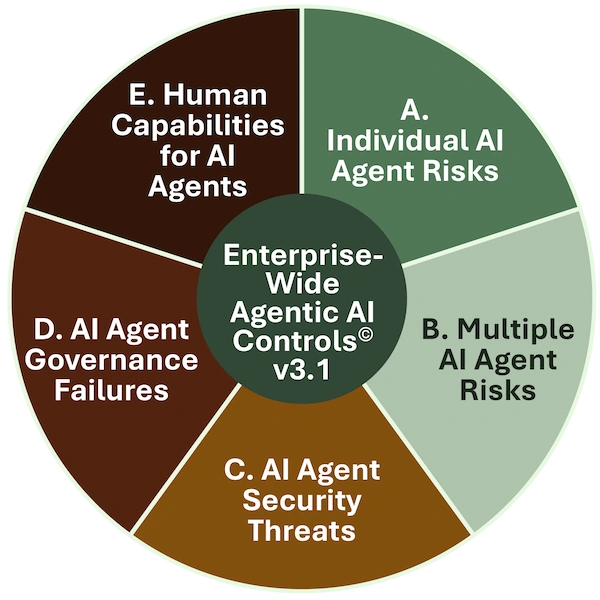
- Map the risks and controls for a pilot agentic workflow – select a pilot use case, identify the risks, and select the controls you need to construct effective risk treatment plans.
After this initial success, you will be able to scale your new agentic AI capability more broadly.
About Agentic Risks
At www.agenticrisks.com, we use our proprietary enterprise-wide agentic AI controls and real-world experience within a regulated environment to help firms adopt agentic workflows safely and with confidence.
Leverage our content and free services as much as you like or hire us as your guide.
We will help you de-risk your agentic transformation.
FAQs
Unlike basic AI tools that respond to single prompts, AI agents can plan tasks, break down work, use tools, and decide how to complete an objective. They can browse the web, write and execute code, communicate with software and people, and learn through memory and feedback.
AI agents improve productivity by processing data faster, reducing manual work caused by disconnected systems, and performing repetitive tasks with greater accuracy. They help teams focus on work that requires human judgment and higher-value decision-making.
Traditional automation follows fixed rules and scripts. Agentic AI uses multiple AI agents that collaborate, with an orchestrator assigning tasks to sub-agents. This makes automation more flexible, adaptive, and suited to complex workflows.
Yes. AI agents can learn from experience using memory and reinforcement learning techniques. This allows their performance to improve over time, unlike traditional software that requires manual re-programming to adapt.
Begin by understanding the risks and controls needed to use AI agents responsibly. Then define an autonomy and oversight policy, and test a pilot workflow to learn how agents behave in a real setting before scaling adoption.