Home > Agentic AI Risk categories > Multiple AI Agent Risks
Home > Agentic AI Risk categories > Multiple AI Agent Risks
More than one agent may interact, replicate, or conflict in uncontrolled ways – creating confusion, inefficiency, security gaps, or runaway behaviours that undermine oversight and system stability.
To protect your firm against multiple AI agent risks, you should set strict, secure rules for how agents talk, coordinate, and share tasks – use approved orchestration patterns with diversity and some randomness to reduce collusion. Log every interaction, test multi-agent scenarios, require consensus or human sign-off for high-impact actions, and monitor continuously for drift or breaches.
You should review every new agent for goal alignment, define clear ownership and authority boundaries, block conflicting commands, detect duplicates and deadlocks, and use timeouts with escalation paths to resolve loops safely.
You should enforce verifiable digital identities with least-privilege, time-limited permissions, and zero-trust checks before any interaction (with full audit logs and instant revocation on misuse), while also blocking unapproved creation or replication via a central registry, quotas, expiry timers, and alerts for immediate human review.
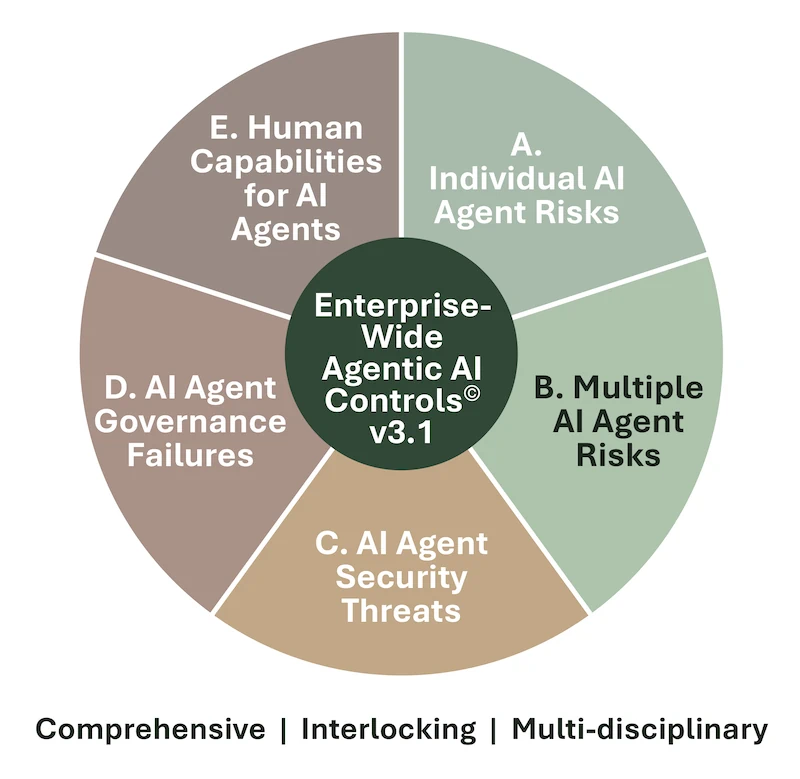
The Enterprise-Wide Agentic AI Risk Control Framework v3.1, breaks down the multiple AI agent risks category into 4 distinct risks and 27 best practice controls:
Download the framework for free to understand the risks, determine if your company is exposed to them, and select the controls that apply to your situation.


The Framework will let you perform tasks that are vital to keeping your company safe and compliant:

As agentic AI continues to evolve, the Governing Council will approve future versions, keeping your career and you at the leading edge of agentic AI risk management.
Download the current version to join our mailing list and receive future versions too.
We invite you to leave your thoughts below. Please leave your name and email address, so we can get in touch, and to minimize spam.
Multiple AI Agent Risks occur when several agents interact, replicate, or conflict in uncontrolled ways – causing confusion, inefficiency, or security gaps. An effective multiple AI agent risk management framework establishes rules for orchestration, identity, and replication, thereby maintaining a stable and compliant agentic ecosystem.
In multi-agent systems, weak identity management can let attackers impersonate agents. Use AI agent identity verification and zero-trust controls: verifiable digital IDs, least-privilege permissions, consistent revocation, real-time anomaly detection, and instant credential disabling when misuse appears.
Without alignment, agents may duplicate work, loop endlessly, or issue contradictory commands. To prevent overlapping or conflicting AI agent actions, review new agents for goal overlap, define ownership boundaries, block conflicts automatically, and use timeouts and escalation procedures to resolve deadlocks safely.
When agents coordinate poorly, they can exceed limits or create hidden dependencies. Apply multi-agent orchestration and communication controls: approved coordination patterns, randomised task allocation to prevent collusion, full interaction logging, and mandatory human approval for high-impact actions.
Self-replicating or looping agents can consume compute and destabilise operations. Uncontrolled AI agent replication prevention involves blocking unapproved agent creation, enforcing quotas and expiry timers through a central registry, and escalating anomalies for human review.
You can download the Enterprise-Wide Agentic AI Risk Control Framework v3.1 for free on www.agenticrisks.com to explore all five risk categories, including Agentic AI Risk Category B – Multiple AI Agent Risks, which comprises 4 risks and 27 best-practice controls. The framework will ensure your management of agentic risk is comprehensive, interlocking, and multi-disciplinary.
We use some cookies - read more in our policies below.
Fill in this form and get access to our
Template Agentic Risk Appetite and Adoption Strategy for free
Fill in this form and get access to the whitepaper of the
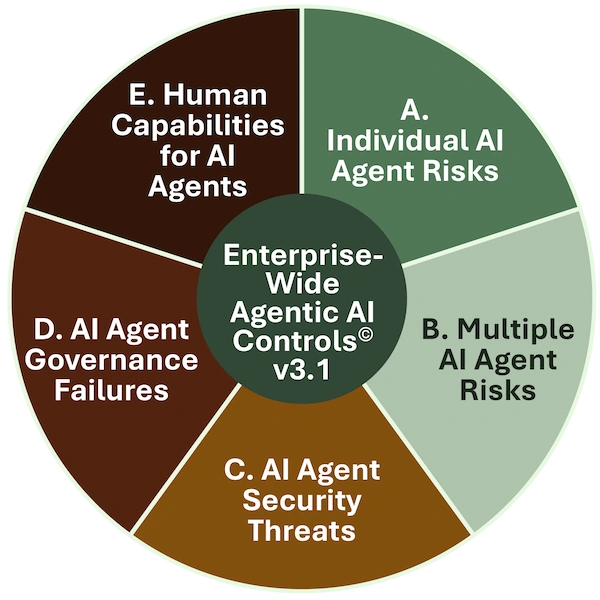
Enterprise-Wide Agentic AI Controls Framework.

Fill in this form and get access to the pdf with the
Agentic Workflow Risk Flags
pdf links still to be changed
Fill in this form and stay up to date