Home > Agentic AI Risk categories > AI Agent Governance Failures
Home > Agentic AI Risk categories > AI Agent Governance Failures
Agents may operate without accountability, compliance, or control, causing outages, data loss, cost overruns, policy and regulatory breaches, or reputational damage.
To protect your firm against AI agent governance failures, assign clear ownership and measurable KPIs to every agent. Embed agentic AI into board governance with defined risk appetite and evidence packs, and keep your enterprise risk register and public disclosures current, consistent, and aligned to evolving rules.
Lock down the tech: harden vendor and API dependencies with least-privilege, sandboxing, version locks, and segregated pipelines. Restrict and log any critical data changes in reversible environments, and enforce explainability with tamper-evident logs and live telemetry.
Control spend and failure modes by setting cost owners with real-time budgets and caps, and implementing a dedicated incident management process that includes forensic logging, fallbacks, and kill switches. Maintain continuous compliance through regulation-to-control mapping, pre-audits, and mandatory testing and registration of high-risk agents.
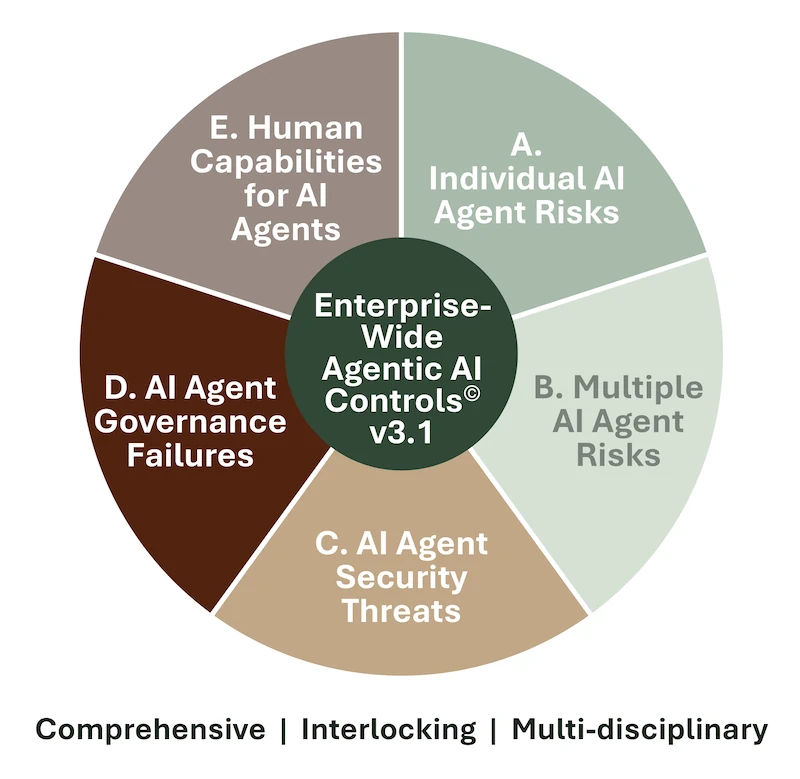
The Enterprise-Wide Agentic AI Risk Control Framework v3.1, breaks down the AI agent governance failures category into 8 distinct risks and 81 best practice controls:
Download the framework for free to understand the risks, determine if your company is exposed to them, and select the controls that apply to your situation.


The Framework will let you perform tasks that are vital to keeping your company safe and compliant:

As agentic AI continues to evolve, the Governing Council will approve future versions, keeping your career and you at the leading edge of agentic AI risk management.
Download the current version to join our mailing list and receive future versions too.
We invite you to leave your thoughts below. Please leave your name and email address, so we can get in touch, and to minimize spam.
AI Agent Governance Failures occur when autonomous agents operate without accountability, compliance, or financial control – leading to outages, regulatory breaches, or reputational harm. An effective AI agent governance failures and controls framework defines ownership, embeds AI in board governance, enforces compliance, and maintains live telemetry and auditability.
AI agents rely on third-party tools that may change or fail. Strong AI vendor and API instability risk management involves several key steps, including mapping dependencies, sandboxing integrations, version-locking APIs, validating data handling, and maintaining portable fallback designs to ensure resilience when vendors shift.
Agents can unintentionally modify or delete critical data. To prevent collateral damage from autonomous AI agents, restrict high-impact actions, require explicit permissions, use reversible environments, and maintain real-time oversight to contain harm across technical and reputational dimensions.
Unmonitored agents can generate runaway cloud bills or resource loops. Apply AI cost and resource overhead monitoring controls, such as assigning cost owners, setting compute limits, tracking telemetry, and using smart alerts to catch abnormal spending early.
Incidents without a structured response erode trust and delay recovery. A sound AI agent incident management and forensic logging framework uses immutable evidence retention, continuous monitoring, kill-switches, transparent reporting, and cross-functional reviews to strengthen resilience.
Agents must remain traceable and auditable. Create clear ownership, measurable KPIs, tamper-evident logs, and continuous telemetry. Red team testing and drift detection ensure transparency and compliance across jurisdictions.
Boards should integrate agentic AI risks into strategic decision-making. Adopt board-level agentic AI oversight and governance best practices, such as defining risk appetite for delegating autonomy, reviewing evidence packs, and linking accountability to executive KPIs to ensure responsible innovation.
Regulatory frameworks, such as the EU AI Act, NIST AI RMF, and ISO 42001, demand explainable, auditable AI controls. Maintain continuous AI regulatory risk and disclosure compliance by mapping internal safeguards to global rules, registering high-risk agents, and aligning public statements with actual practice.
You can download the Enterprise-Wide Agentic AI Risk Control Framework v3.1 for free on www.agenticrisks.com to explore all five risk categories, including Agentic AI Risk Category D – AI Agent Governance Failures, which comprises 8 risks and 81 best-practice controls. The framework will ensure your management of agentic risk is comprehensive, interlocking, and multi-disciplinary.
We use some cookies - read more in our policies below.
Fill in this form and get access to our
Template Agentic Risk Appetite and Adoption Strategy for free
Fill in this form and get access to the whitepaper of the
Enterprise-Wide Agentic AI Controls Framework.
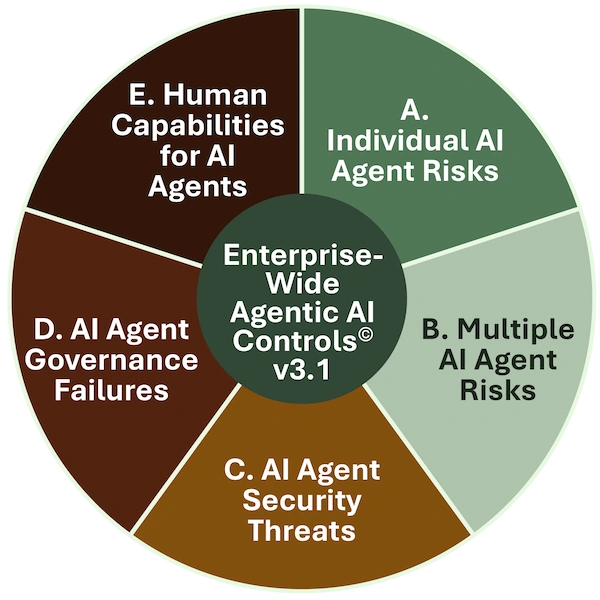

Fill in this form and get access to the pdf with the
Agentic Workflow Risk Flags
pdf links still to be changed
Fill in this form and stay up to date